Question
Distinguish between compression and rarefaction.

Answer

A longitudinal wave propagates by means of compressions and rarefactions.
When a vibrating object moves forward, it pushes and compresses the air in front of it creating a region of high pressure. This region is called a compression (C), as shown in Fig. This compression starts to move away from the vibrating object. When the vibrating object moves backwards, it creates a region of low pressure called rarefaction (R), as shown in Fig.
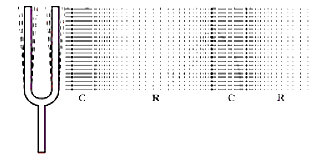

A vibrating object creating a series of compressions (C) and rarefactions (R) in the medium
Compressions are the regions of high density where the particles of the medium come very close to each other and rarefactions are the regions of low density where the particles of the medium move away from each other.
Need a full question paper?

Generate a complete, print-ready paper with questions like this in minutes — across 16+ boards, with answer keys.

Start Generating Free

Similar questions

Draw diagrams to show the refraction of light from air to glass In diagram, label the incident ray, refracted ray, the angle of incidence (i) and the angle of refraction (r).
A couple of 15 N force acts on a rigid body, such that arm of couple is 85 cm. Calculate moment of couple in the SI system.
(a) What do you understand by the term lens?
(b) What are the various kinds of lenses? Draw a neat diagram of each kind.
Briefly, describe an experiment to show that a prism itself produces no colour.
Distinguish between a real and a virtual image.
A pair of scissors is used to cut a piece of a cloth by keeping it at a distance 8.0 cm from its rivet and applying an effort of 10 kgf by fingers at a distance 2.0 cm from the rivet. (a) Find : (i) the mechanical advantage of scissors and (ii) the load offered by the cloth (b) How does the pair of scissors act: as a force multiplier or as speed multiplier?
(i) (a) Name the kind of reactions taking place :
(i) In the star
(ii) In muclear reactor
(iii) In our body.
(b) When an alpha particle gains two clectrons it becomes neutral and becomes an atom of an element which is rare gas. What is the name of this rare gas?
(ii) State three precautions in the handling of radioactive substances.
(iii) (a) Define radionctivity.
(b) What happens inside the mucleus that causes the emission of a beta particle?
(c) Express the above change in the form of an equation.
Three 250 W heaters are connected in parallel to a 100 V supply, Calculate the energy supply in kWh to the three heaters in 5 hour.
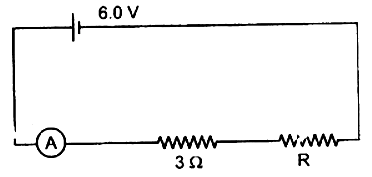
The figure shows a circuit. When the circuit is switched on, the ammeter reads $0.5 A.$

(i) Calculate the value of the unknown resistor $R.$
(ii) Calculate the charge passing through the $3 Ω$ resistor in $120 s.$
(iii) Calculate the power dissipated in the $3 Ω$ resistor.
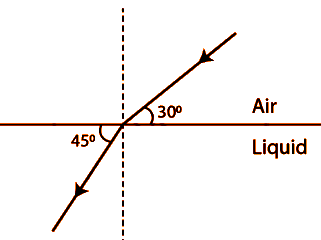
The diagram alongside shows the refraction of a ray of light from air to a liquid.

  1. Write the values of (i) angle of incidence, (ii) angle of refraction.
  2. Use Snell’s law to find the refractive index of liquid with respect to air.