Questions

[3 Mark Question Answer]

🎯

Test yourself on this topic

25 questions · timed · auto-graded

Question 13 Marks
Fig. shows three ways in which the string of an instrument can vibrate.
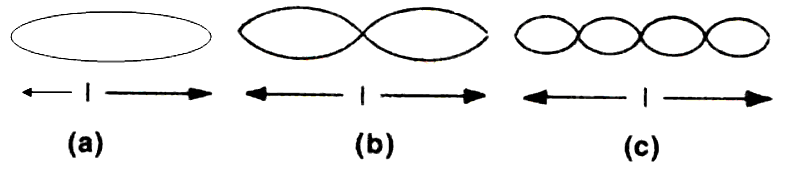
(i) Which of the diagram shows the principle note?
(ii) Which has the frequency four times that of the first?
(iii) What is the ratio of the frequency of the vibration in (a) and (b)?
Answer
(i) Diagram (a) shows the principal note as the string in this diagram is vibrating in one loop.
(ii) Diagram (c) has the frequency four times that of first.
(iii) The ratio of frequency of the vibration in (a) and (b) is 1:2.
View full question & answer
Question 23 Marks
Explain the phenomenon of resonance giving examples.
Answer
When the frequency of the forced vibration is equal to the natural frequency of a body nearby or an integer multiple of it then the body vibrates with a large amplitude. This phenomenon is called resonance.
E.g.1 all stringed instruments are provided with sound box (or sound chamber). This box is so constructed that the column of of air inside it, has a natural frequency which is the same as that of the strings stretched on it, so that when the strings are made to vibrate, the air column inside the box is set to forced vibrations. Since the sound box has a large area, it sets a large volume of air into vibration of the same frequency as that of the string. So, due to resonance, a loud sound is produced.
E.g.2 Radio and TV receivers have electronic circuits which produce electrical vibrations, the frequency of which can be changed by changing the values of the electrical components of that circuit. When we want to tune a radio or TV receiver, we merely adjust the values of the electronic components to produce vibrations of frequency equal to that of the incoming radio waves which we want to receive. When the two frequencies match, due to resonance, the energy or signal of that particular frequency is received from the incoming waves. The signal is then amplified in the receiver set.
View full question & answer
Question 33 Marks
Write two differences between transverse and longitudinal waves.
Answer
Transverse waves Long itud ina I waves
1. In these waves, the vibrations of the particles are perpendicular to the direction of wave and form crest and trough in the medium. 1. In these waves, the vibrations of the particles are along the direction of propagation of wave and form compress ons and rarefactions in the medium
2. These waves can be formed only in the medium which possesses rigidity. Hence, they can travel only in soIids and on the surface of liquids. 2. These waves can travel in solids, liquids as well as gases.
View full question & answer
Question 43 Marks
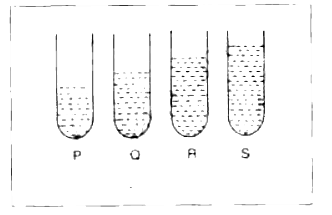
In fig. , P, Q, R and S represent test tubes each of height 20 cm which are filled with water upto heights of 10 cm, 14 cm, 16 cm and 18 cm respectively. If a vibrating tuning fork is placed over the mouth of test tube Q, a loud sound is heard.
(i) Describe the observations with the tubes P, R and S.
(ii) Give the reason for your observation in each case.
(iii) State the principle illustrated by the above experiment.
Answer
(i) No loud sound is heard with P and R but a loud sound is heard with S.
(ii) Resonance occurs with the air column in tubes Q and S whereas no resonance occurs in the air columns of tubes P and R. The frequency of vibrations of air column in the tube S is thrice the frequency of vibrations of air column in the tube Q, while the frequency of vibrations of air column in tubes P and R is neither equal to nor an integer multiple of frequency of vibrations of air column in tube Q.
(iii) When the frequency of vibrations of air column is either equal to or an integer multiple of the frequency of the vibrating tuning fork, resonance occurs.
View full question & answer
Question 53 Marks
Name three factors on which the frequency of vibration of a stretched string depends.
Answer
Frequency of vibrations of a stretched string depends upon:
1. Frequency of the fundamental note of a stretched string is inversely proportional to the length of the vibrating string.
2. Frequency is directly proportional to the square root of the tension of the string.
3. Frequency is inversely proportional to the square root of linear density. That is, mass per unit length of the material of the string. Thinner is the wire, higher is the frequency.
View full question & answer
Question 63 Marks
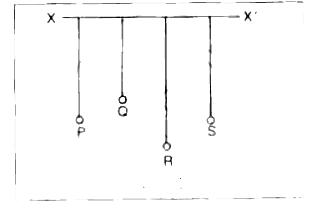
In fig. P, Q, R and S are four pendulums suspended from the same elastic string XX'. Lengths of pendulum P and S are equal, while the length of Q is smaller and R is longer. The pendulum P is set into vibration. What is your observation? Give reason for your observation.
Answer
Observation: It is observed that the pendulum S also starts vibrating and it ultimately acquires the same amplitude as that of P and the vibrations of S are in phase with those of P (i.e. they reach their extreme positions on either side simultaneously). The pendulums Q and R also vibrate but they vibrate with smaller amplitudes.
Reason: The vibrations produced in pendulum P are communicated to the other pendulums Q,R and S through the elastic string XX'. The pendulums Q and R are in the state of forced vibrations, while the pendulum S is in the state of resonance. This is because the natural period of pendulum S is equal to that of P (being of same length), and therefore resonance takes place. The pendulum S therefore vibrates with the amplitude of P and remains in phase with the pendulum A.
View full question & answer
Question 73 Marks
Distinguish between mechanical and electromagnetic waves.
Answer
Electromagnetic wavesMechanical waves
1. They can travel in vacuum.1. They cannot travel in vacuum. They need a materia I medium for their propagation.
2. These are formed by the periodic vibrations of mutually perpendicular electric and magnetic field in a plane normal to the direction of wave propagation.2. These are formed by the vibrations of the medium particles about their mean positions. These vibrations can be along the direction of propagation of wave or perpendicular to it..
3. These are traverse in nature.3. These waves can be transverse as well as IonqitudnaI.

View full question & answer
Question 83 Marks
Distinguish between compression and rarefaction.
Answer
A longitudinal wave propagates by means of compressions and rarefactions.
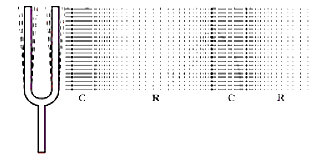
When a vibrating object moves forward, it pushes and compresses the air in front of it creating a region of high pressure. This region is called a compression (C), as shown in Fig. This compression starts to move away from the vibrating object. When the vibrating object moves backwards, it creates a region of low pressure called rarefaction (R), as shown in Fig.


A vibrating object creating a series of compressions (C) and rarefactions (R) in the medium
Compressions are the regions of high density where the particles of the medium come very close to each other and rarefactions are the regions of low density where the particles of the medium move away from each other.
View full question & answer
Question 93 Marks
A person standing between two vertical cliffs produces a sound. Two successive echoes are heard at 4 s and 6 s. Calculate the distance between the cliffs.
Answer
Let $A_1$ and $A_2$ be the distances of the two cliffs from the man. then
$ 2 A_1=320 \times 4=1280 $
and, $2 \mathrm{~A}_2=320 \times 6=1920$ Adding (i) and (ii) $ 2\left(A_1+A_2\right)=3200 $
or, $A_1+A_2=1600 \mathrm{~m}$ $\therefore$ distance between the two cliffs $=1600 \mathrm{~m}$
View full question & answer
Question 103 Marks
A man fires a gun and hears its echo after 5 s. The man then moves 310 m towards the hill and fires his gun again. This time he hears the echo after 3 s. Calculate the speed of sound.
Answer
Here, $t 1=5 \mathrm{~s}$. Let $\mathrm{d}$ be the distance of the hill from the man and $v$ be the velocity of sound.
Then $\mathrm{t}=\frac{2 \mathrm{~d}}{\mathrm{v}}$ $ 5=\frac{2 \mathrm{~d}}{\mathrm{v}} \text { or } \mathrm{d}=\frac{5 \mathrm{v}}{2}........(i) $
When the man moves, through a distance $310 \mathrm{~m}$ towards the wall, then $\mathrm{d}^{\prime}=\mathrm{d}-310$ and $\mathrm{t}^{\prime}=3 \mathrm{~s}$.
$ \therefore 3=\frac{2 \mathrm{~d}-310}{\mathrm{v}} $
or, $d-310=\frac{v}{2}$;.........(ii)
Subtracting (ii) from (i)
$ \begin{aligned} & \mathrm{d}-\mathrm{d}+310=\frac{5 \mathrm{v}}{2}-\frac{3 \mathrm{v}}{2}=\frac{2 \mathrm{v}}{2}=\mathrm{v} \\ & \therefore \mathrm{v}=310 \mathrm{~m} / \mathrm{s} \end{aligned} $
View full question & answer
Question 113 Marks
How will you find the velocity of sound waves?
Answer
A simple method for finding the velocity of sound is echo or open air method. For example: A person stands at a known distance $(\mathrm{d} \mathrm{m}$ ) from a cliff and fires a pistol and simultaneously starts the stop watch. He stops the stop-watch as soon as he hears the echo. The distance traveled by sound during this time ( $t$ seconds) is twice the distance $(2 \mathrm{~d} m)$. The velocity $(v)$ of sound is then calculated as under: Velocity of sound $=\frac{\text { distance travelled }}{\text { time taken }}=\frac{2 \mathrm{~d}}{\mathrm{t}}$ By repeating the experiment two or three times, the average velocity of sound can be calculated.
View full question & answer
Question 123 Marks
What is the difference between echo and reverberation?
Answer
The sound heard after reflection from a rigid obstacle is called an echo. To hear the cho of a sound distinctly, the reflecting surface in air should be at a minimum distance of 17 m from the listener.
If the distance is less than 17 m, the reflected sound will reach the ears before the original sound dies out. In such a case, the original sound mixes up with the reflected sound. Due to repeated reflections at the reflecting surface, the sound gets prolonged. This effect is known as reverberation.
View full question & answer
Question 133 Marks
Define wavelength. Give its SI units.
Answer
The wavelength is the distance between two successive crests or two successive troughs on a transverse wave.
It is also equal to the distance between any two points where the particles are passing through their respective mean positions in the same direction.
It is also the distance between two successive compressions or two successive rarefactions on a longitudinal wave.
The SI unit of wavelength is metre (m).
View full question & answer
Question 143 Marks
State three factors on which loudness of sound heard by a listener depends.
Answer
The loudness of a sound heard by a listener depends upon:
1. Loudness is directly proportional to the square of the amplitude.
2. Loudness varies inversely as the square of distance.
3. Loudness is directly proportional to the surface area of a vibrating body.
View full question & answer
Question 153 Marks
Comment on the statement ‘loudness of sound is a subjective quantity, while intensity is an objective quantity.
Answer
The intensity at any point of the medium is the amount of sound energy passing per second normally through unit area at that point.
The loudness of a sound depends on the energy conveyed by the sound wave near the eardrum of the listener. Loudness, being a sensation, also depends on the sensitivity of the ears of the listener. Thus the loudness of sound of a given intensity may differ from listener to listener. Further, two sounds of the same intensity but of different frequencies may differ in loudness even to the same listener because of the sensitivity of ears is different for different frequencies. So, loudness is a subjective quantity while intensity being a measurable quantity is an objective quantity for the sound wave.
View full question & answer
Question 163 Marks
Explain the following and illustrate your answer by drawing appropriate diagram:
Quality of a musical note.
Answer
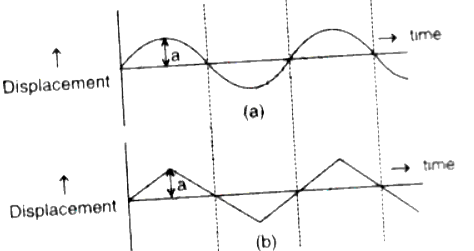
Quality of a musical note: quality of a sound is that characteristic which distinguishes the two sounds of the same loudness and same pitch, but emitted by two different instruments. It depends on the waveform.

Two sounds of same amplitudes (i.e same loudness) and same frequency but of different wave forms.
View full question & answer
Question 173 Marks
Explain the following and illustrate your answer by drawing appropriate diagram:
Pitch
Answer
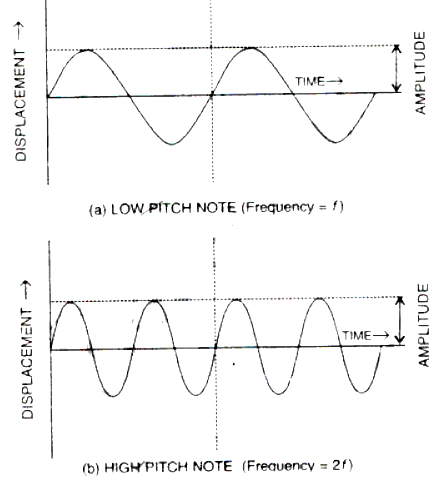
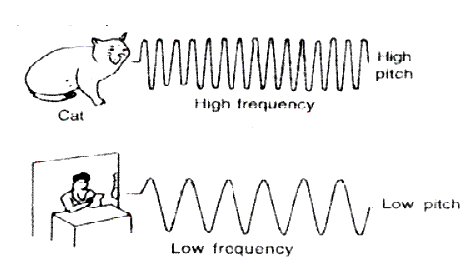
Pitch: The 'pitch' of a note is determined solely by its frequency. The pitch in fact, is a subjective sensation in the ear depending only upon the frequency of the musical note. The relation between pitch and frequency is linear to a very close approximation.

Waves of different pitch
View full question & answer
Question 183 Marks
Explain the following and illustrate your answer by drawing appropriate diagram:
Loudness
Answer
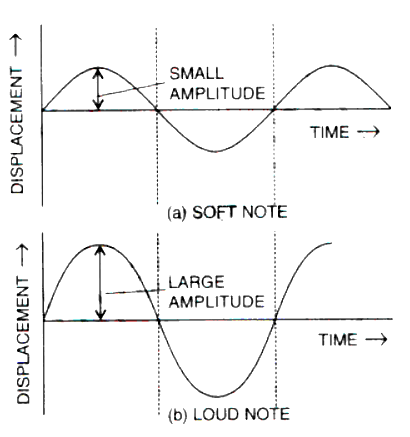
Loudness: Loudness is the property by virtue of which a loud sound can be distinguished from a faint one, both having the same pitch and quality. The loudness of a sound depends on the amplitude (or intensity) of the wave.
Soft and loud notes
View full question & answer
Question 193 Marks
Explain the following and illustrate your answer by drawing appropriate diagram:
Frequency
Answer
Frequency: Frequency of a vibrating body is defined as the number of vibrations completed by the body in one second.
View full question & answer
Question 203 Marks
 A rifle shot is fired in a valley between two parallel walls. The echo from one wall is heard in 3 s and the echo from the other wall is heard 3 s later. If the velocity of sound at 00 c is $330 ms^{-1}$ and the temperature in the valley is 100 c , calculate the width of the valley. For every 10 c rise in temperature, the velocity of sound increase by $0.61 ms^{-1}$.
Answer
Give that, speed of sound at $0^{\circ}=330 \mathrm{~m} / \mathrm{s}$
For every $1^{\circ}$ rise in temperature, the velocity of sound increases by $0.61 \mathrm{~m} / \mathrm{s}$ $\therefore$ the velocity of sound at $10^{\circ}=330+(0.61 \times 10)=330+6.1=336.1 \mathrm{~m} / \mathrm{s}$
Let $A_1$ and $A_2$ be the distances of the two walls from the point of refile shots. Then
$ \begin{aligned} & 2 \times A_1=336.1 \times 3=1008.3 ...........(i) \\ & 2 \times A_2=336.1 \times 6=2016.6 ...........(ii) \end{aligned} $
Adding (i) and (ii) we get
$ 2\left(A_1+A_2\right)=3024.9 $
or, $\left(A_1+A_2\right)=1512.45 \mathrm{~m}$
Thus the width of the velley is $1512.45 \mathrm{~m}$
View full question & answer
Question 213 Marks
What is meant by echo? What are the conditions necessary for its formation?
Answer
The sound heard after reflection from a rigid obstacle (such as cliff, a hillside, a wall of a building, edge of a forest etc.), is called an echo.
Conditions necessary for echo formation are:
1. The minimum distance between the source of sound and its reflector should be 17 m.
2. Reflected sound should reach the person atleast 0.1 second after the original sound is heard.
View full question & answer
Question 223 Marks
Name musical instrument, one in each case, which produces its notes by using the following. In each case state the method used to produce notes of different pitches and loudness.
(a) A vibrating string.
(b) A vibrating column air.
(c) Vibration of any other body.
Answer
(a)
Guitar produces notes using vibrating string.
To produce notes with different pitches, strings of different thicknesses are plucked. When a string of greater thickness is plucked, a note with higher pitch is produced and vice-versa.
To produce the notes of different loudness, all stringed instruments are provided with hollow sound box which contains air. In these instruments vibrations are produced in the sound box when the strings on it are made to vibrate by plucking, are forced vibrations. Larger the surface area of the air in the sound box, louder will be the sound produced.
(b)
Flute produces notes using a vibrating column of air.
In a flute, the notes of different frequencies or pitch are produced by changing the effective length of the air column when different holes in it are closed.
In a flute, the notes of different loudness can be produced by using flutes of different diameters. A flute with larger diameter shall have more air enclosed in it and hence the sound produced by it shall be louder.
(c)
Piano produces notes using a vibration of any other body.
When we strike the keys of piano, strings of different thickness are set in vibration at their natural frequencies; hence sound of higher pitch can be produced by striking the string of greater thickness.
A piano's wires are attached to a sounding board with help of which sound of different loudness can be produced. The vibrating wire makes the board vibrate, which makes the sound louder.
View full question & answer
Question 233 Marks
What is meant by resonance? Give two examples of resonance from daily life.
Answer
When the frequency of the forced vibration is equal to the natural frequency of a body nearby or an integer multiple of it then the body vibrates with a large amplitude. This phenomenon is called resonance.
E.g.1 all stringed instruments are provided with sound box (or sound chamber). This box is so constructed that the column of of air inside it, has a natural frequency which is the same as that of the strings stretched on it, so that when the strings are made to vibrate, the air column inside the box is set to forced vibrations. Since the sound box has a large area, it sets a large volume of air into vibration of the same frequency as that of the string. So, due to resonance, a loud sound is produced.
E.g.2 Radio and TV receivers have electronic circuits which produce electrical vibrations, the frequency of which can be changed by changing the values of the electrical components of that circuit. When we want to tune a radio or TV receiver, we merely adjust the values of the electronic components to produce vibrations of frequency equal to that of the incoming radio waves which we want to receive. When the two frequencies match, due to resonance, the energy or signal of that particular frequency is received from the incoming waves. The signal is then amplified in the receiver set.
View full question & answer
Question 243 Marks
Write down the factors on which the frequency of vibrating depends. Explain them.
Answer
Frequency of vibrations of a stretched string depends upon:
1. Frequency of the fundamental note of a stretched string is inversely proportional to the length of the vibrating string.
2. Frequency is directly proportional to the square root of the tension of the string.
3. Frequency is inversely proportional to the square root of linear density. That is, mass per unit length of the material of the string. Thinner is the wire, higher is the frequency.
View full question & answer
Question 253 Marks
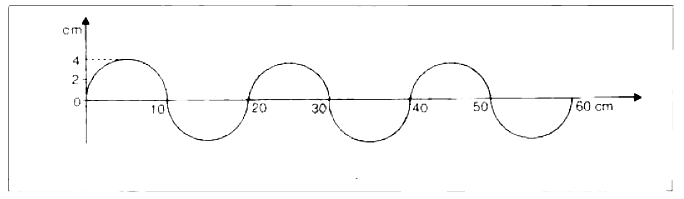
In fig. shows a snap shot of a wave from of frequency 50 Hz in a string. The numbers in the diagram represents distance in centimeters. Fpr the wave motion, find
(a) Wavelength,
(b) Amplitude,
(c) Velocity.
Answer
(a) Wavelength = Distance between two successive crests or two successive troughs=10 cm
(b) Amplitude = Maximum displacement of the particles from the mean position = 4 cm
(c)
Velocity= frequency × wave length
Given, frequency = 50 Hz,
wavelength= 10 cm= 0.1 m
.·. Velocity= 50 x 0.1=5 m/s
View full question & answer
[3 Mark Question Answer] - Physics STD 10 Questions - Vidyadip