Question
distinguish between:
Conservative and non-conservative forces

Answer

Conservative and non-conservative forces,
No Conservative Non-conservative forces
i. If work done by or against a force is independent’ of the actual path, the force is said to be a conservative force. If work done by or against a force is dependent of the actual path, the force is said to be a non- conservative force.
ii. During work done by a conservative force, the mechanical energy is conserved. During work done by a non­ conservative force, the mechanical energy may not be conserved.
iii. Work done is completely recoverable. Work done is not recoverable.
Example:
gravitational force, magnetic force etc.
Example:
Frictional force, air drag etc.

Need a full question paper?

Generate a complete, print-ready paper with questions like this in minutes — across 16+ boards, with answer keys.
Start Generating Free

Similar questions

What are different types of thermistor and what are their applications?
Three resistors $10\ Ω, 20\ Ω$ and $30\ Ω$ are connected in series combination.
i. Find equivalent resistance of series combination.
ii. When this series combination is connected to $12\ V$ supply, by neglecting the value of internal resistance, obtain potential difference across each resistor.
Explain the origin of displacement current?
Varying electric and magnetic fields regenerate each other. Explain.
A force $\overrightarrow{ F }=4 \hat{ i }+6 \hat{ j }+3 \hat{ k }$ acting on a particle produces a displacement of $\overrightarrow{ S }=$ $\overrightarrow{ s }=2 \hat{ i }+3 \hat{ j }+ 5 \hat{ k }$ where $F$ is expressed in newton and $s$ in metre. Find the work done by the force.
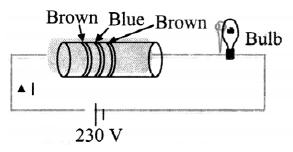
An electric circuit with a carton resistor and an electric bulb ( 60 watt, $300 \Omega$ ) are connected in series with a 230 V source.

Image
i. Calculate the current flowing through the circuit.
ii. If the electric bulb of 60 watt is replaced by an electric bulb ( 80 watt, $300 \Omega$ ), will it glow? Justify your answer.
Derive the formula for the range and maximum height achieved by a projectile thrown from the origin with initial velocity $\vec{u}$ at an angel $\theta$ to the horizontal.
Calculate mass of the Earth from given data, Acceleration due to gravity $g = 9.81 \ m/s^2,$ Radius of the Earth $R_E = 6.37 \times 10^6 m, G = 6.67 \times 10^{-11} N m^2/kg^2$
A body is thrown with a velocity of 49 m/s at an angle of 30° with the horizontal. Find
i) the maximum height attained by it
ii) the time of flight and
iii) the horizontal range.
In a random temperature scale X, water boils at 200 °X and freezes at 20 °X. Find the boiling point of a liquid in this scale if it boils at 62 °C.