Question
Derive the formula for the range and maximum height achieved by a projectile thrown from the origin with initial velocity $\vec{u}$ at an angel $\theta$ to the horizontal.
Answer

Expression for range:
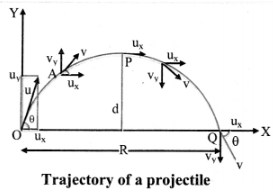
1. Consider a body projected with velocity $\vec{u}$, at an angle $\theta$ of projection from point $O$ in the co-ordinate system of the $X Y$ - plane, as shown in figure.
2. The initial velocity $\vec{u}$ can be resolved into two rectangular components:
Image
  1. $u_x = u \cos \theta $ (Horizontal component)
    $u_y = u \sin \theta $ (Vertical component)
  2. The horizontal component remains constant throughout the motion due to the absence of any force acting in that direction, while the vertical component changes according to
    $v_y = u_y + a_yt$
    with $a_y = -g$ and $u_y = u \sin \theta $
  3. Thus, the components of velocity of the projectile at time t are given by,
    $v_x = u_x = u \cos \theta $
$v_y = u_x – gt = u \sin \theta – gt$
  1. Similarly, the components of displacements of the projectile in the horizontal and vertical directions at time t are given by,
    s = (u cosθ) t
    $s_y=(u \sin \theta) t -\frac{1}{2} gt ^2$
    6. At the highest point, the time of ascent of the projectile is given as, $t _{ A }=\frac{u \sin \theta}{g} \ldots \ldots \ldots \ldots . .(2)$
    7. The total time in air i.e., time of flight is given as, $T=2 t_A=\frac{2 u \sin \theta}{g}$
    8. The total horizontal distance travelled by the particle in this time $T$ is given as,
    $R = u _{ x } \cdot T$
    $R = u \cos \theta \cdot\left(2 t _{ A }\right)$
    $R = u \cos \theta \cdot \frac{2 u \sin \theta}{ g } \ldots \ldots \ldots \ldots \ldots .[\text { From (3)] }$
    $R =\frac{u^2(2 \sin \theta \cdot \cos \theta)}{g}$
    $R =\frac{ u ^2 \sin 2 \theta}{ g } \ldots \ldots \ldots \ldots .[\because \sin 2 \theta=2 \sin \cdot \cos \theta]$
    This is required expression for horizontal range of the projectile.
    Expression for maximum height of a projectile:
    The maximum height H reached by the projectile is the distance travelled along the vertical (y) direction in time $t_A.$
    Substituting $s_y = H$ and $t = t_a$  in equation (1),
    we have,

    $H =( u \sin \theta) t _{ A }-\frac{1}{2} gt _{ A }{ }^2$
    $\therefore \quad H = u \sin \theta\left(\frac{ u \sin \theta}{ g }\right)-\frac{1}{2} g\left(\frac{ u \sin \theta}{ g }\right)^2$
    $\therefore \quad H =\frac{ u ^2 \sin ^2 \theta}{2 g }=\frac{ u _y^2}{2 g }$
    ....[From (2)]
    This equation represents maximum height of projectile.

Need a full question paper?

Generate a complete, print-ready paper with questions like this in minutes — across 16+ boards, with answer keys.

Start Generating Free