Question
Distinguish between free vibrations and forced vibrations.

Answer

Get the step-by-step solution for this question inside the Vidyadip app.

Get the answer in the app

Need a full question paper?

Generate a complete, print-ready paper with questions like this in minutes — across 16+ boards, with answer keys.
Start Generating Free

Similar questions

Write a note on thermodynamic equilibrium.
Why should a photodiode be operated in reverse biased mode?
If the adiabatic ratio for a gas is $5 / 3$, find the molar specific heat of the gas at
(i) constant volume
(ii) constant pressure.
$( R =8.314 J / mol . K )$
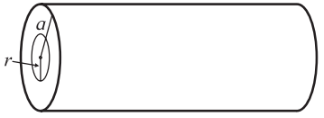
Figure shows a section of a very long cylindrical wire of diameter a, carrying a current I. The current density which is in the direction of the central axis of the wire varies linearly with radial distance r from the axis according to the relation $J = J _{ o } r / a$. Obtain the magnetic field B inside the wire at a distance r from its centre.
$Jr$


Image
At what distance from the mean position is the kinetic energy of a particle performing S.H.M. of amplitude 8 cm, three times its potential energy?
Why is the base of a transistor made thin and is lightly doped?
The frequency of revolution of the charged particles in a cyclotron does not depend upon their speed. Why?
A moving-coil galvanometer has coil of area $10 cm ^2$ and 100 turns. It is suspended by a fibre of torque constant $10^{-8} N \cdot m /$ degree in a radial magnetic field of induction $0.05 Wb / m ^2$. Find the angle through which the coil will be deflected when a current of $16 \mu A$ passes through it.
In a potentiometer circuit. $E=2 V , r =2 \Omega_{ r } R _{\text {wire }}=10 \Omega_{ s } R _{\text {ext }}=1988 \Omega$ and $L =4 m$ (in the usual notation). What is the potential gradient along the wire?
Derive Laplace's law for spherical membrane of bubble due to surface tension.