Question 13 Marks
From the definition of linear SHM, derive an expression for the angular frequency of a body performing linear SHM.
Answer
When a body of mass $m$ performs linear SHM, the restoring force on it is always directed towards the mean position and its magnitude is directly proportional to the magnitude of the displacement of the body from the mean position. Thus, if $\vec{F}$ is the force acting on the body when its displacement from the mean position is $\vec{x}$,
$
\vec{F}= m =- k \vec{x}
$
where the constant $k$, the force per unit displacement, is the force constant.
Let $\frac{k}{m}=\omega^2$, a constant. $m$
$\therefore$ Acceleration, $a =-\frac{k}{m} x =-\omega^2 x$
$\therefore$ The angular frequency
$
\omega=\sqrt{\frac{k}{m}}=\sqrt{\left|\frac{a}{x}\right|}
$
$
=\sqrt{\text { acceleration per unit displacement }}
$
View full question & answer→Question 23 Marks
Distinguish between free vibrations and forced vibrations.
Question 33 Marks
A disc, of radius $12 cm$ and mass $250 g$, is suspended horizontally by a long wire at its centre. Its period $T _1$ of angular SHM is measured to be $8.43 s$. An irregularly shaped object $X$ is then hung from the same wire and its period $T_2$ is found to be $4.76 s$. What is the rotational inertia of object $X$ about its suspension axis ?
Answer
Data : $R =0.12 m , M =0.25 kg , T ,=8.43 s , T _2=4.76 s$
The $Ml$ of the disc about the rotation axis (perpendicular through its centre) is $=\frac{1}{2} MR ^2$
$
=\frac{1}{2}(0.25)(0.12)^2=\frac{144}{8} \times 10^{-4}=1.8 \times 10^{-3} kg \cdot m ^2
$
The period of torsional oscillation, $T=2 \pi \sqrt{\frac{I}{c}}$
$\therefore$ For the disc and object $X$, respectively,
$
T_1=2 \pi \sqrt{\frac{I_1}{ c }} \text { and } T_2=2 \pi \sqrt{\frac{I_2}{ c }}
$
the torsion constant $c$ being common for both.
$\therefore T_1^2=4 \pi^2 \frac{I_1}{c}$ and $T_2^2=4 \pi^2 \frac{I_2}{c}$
$\therefore \frac{I_1}{I_2}=\frac{T_1^2}{T_2^2} \quad$ MaharashtraBoardSolutions.Guru
$
\begin{aligned}
\therefore I_2=I_1\left(\frac{T_2}{T_1}\right)^2 & =\left(1.8 \times 10^{-3}\right)\left(\frac{4.76}{8.43}\right)^2 \\
& =5.738 \times 10^{-4} kg \cdot m ^2
\end{aligned}
$
View full question & answer→Question 43 Marks
A clock regulated by a seconds pendulum keeps correct time. During summer the length of the pendulum increases to $1.01 m$. How much will the clock gain or lose in one day ? $g =9.8$ $\left.m / s ^2\right]$
Answer
Data: $L =1.01 m , g =9.8 m / s ^2$
$
\begin{aligned}
T & =2 \pi \sqrt{\frac{L}{g}}=2 \times 3.142 \times \sqrt{\frac{1.01}{9.8}} \\
& =6.284 \sqrt{\frac{1.01}{9.8}}=2.017 s
\end{aligned}
$
The period of a seconds pendulum is 2 seconds. Hence, the given pendulum clock will lose $0.017 s$ in $2.017 s$ during summer.
$\therefore$ Time lost in 24 hours
$
=\frac{24 \times 3600 \times 0.017}{2.017} s =728.1 s
$
The given pendulum clock will lose 728.1 seconds per day during summer.
View full question & answer→Question 53 Marks
Calculate the length of a seconds pendulum at a place where $g=9.81 m / s ^2$.
Answer
Data : $T =2 s , g =9.81 m / s ^2$
Period of a simple pendulum, $T=2 \pi \sqrt{\frac{L}{g}}$
For a seconds pendulum, $2=2 \pi \sqrt{\frac{L}{g}}$
$\therefore$ The length of the seconds pendulum,
$L =\frac{g}{\pi^2}=\frac{9.81}{(3.142)^2}=0.9937$
View full question & answer→Question 63 Marks
A simple pendulum of length $1 m$ has a bob of mass $10 g$ and oscillates freely with an amplitude of $2 cm$. Find its potential energy at the extreme position. [ $g =9.8 m / s ^2$ ]
Answer
Data : $L =1 m , m =10 g =10 \times 10^{-3} kg =10^{-2} kg , g =9.8 m / s ^2, A =2 cm =0.02 m$
Period of a simple pendulum, $T=2 \pi \sqrt{\frac{L}{g}}$
Period of a simple pendulum, $T=2 \pi \sqrt{\frac{L}{g}}$
$\therefore \omega=\frac{2 \pi}{T}=\sqrt{\frac{8}{L}}$
At the extreme position,
$
\begin{aligned}
PE & =\frac{1}{2} m \omega^2 A^2=\frac{1}{2} m \times \frac{8}{L} \times A^2 \\
& =\frac{1}{2} \times 10^{-2} \times \frac{9.8}{1} \times(0.02)^2=1.96 \times 10^{-5} J
\end{aligned}
$
View full question & answer→Question 73 Marks
Distinguish between a simple pendulum and a conical pendulum.
Question 83 Marks
A simple pendulum is set into oscillations in a uniformly travelling car along a horizontal road. What happens to its period if the car takes a sudden turn towards the left ?
Answer
The equilibrium position of the string makes an angle $\theta=\tan ^{-1}\left( a _{ c } / g \right)$ with the vertical due to the centrifugal force to the right.
The centripetal acceleration, $a_c$, is horizontal and towards the left. The acceleration due to gravity is vertically downward.
$
\therefore g _{\text {eff }}=\sqrt{g^2+a_{ c }^2}
$
so that the period of oscillation $T=2 \pi \sqrt{L / g_{\text {eff }}}$
$\therefore$ As the car takes a sudden left turn, the period of oscillation decreases.
View full question & answer→Question 93 Marks
From the definition of linear SHM, derive an expression for the angular frequency of a body performing linear SHM.
Answer
When a body of mass $m$ performs linear SHM, the restoring force on it is always directed towards the mean position and its magnitude is directly proportional to the magnitude of the displacement of the body from the mean position. Thus, if $\vec{F}$ is the force acting on the body when its displacement from the mean position is $\vec{x}$,
$\vec{F}= m \vec{a}=- kx \vec{x}$
where the constant $k$, the force per unit displacement, is called the force constant.
Let $\frac{k}{m}=\omega^2$, a constant.
$\therefore$ Acceleration, $a=-\frac{k}{m}=-\omega^2 x$
$\therefore$ The angular frequency,
$\omega=\sqrt{\frac{k}{m}}=\sqrt{\left|\frac{a}{x}\right|}$
$=\sqrt{\text { acceleration per unit displacement }}$
View full question & answer→Question 103 Marks
Define period or periodic time, frequency, amplitude and path length of simple harmonic motion (SHM).
Answer
1. Period or periodic time of SHM : The time taken by a particle performing simple harmonic motion to complete one oscillation is called the period or periodic time of SHM.
2. Frequency of SHM : The number of oscillations performed per unit time by a particle executing SHM is called the frequency of SHM.
3. Amplitude of SHM : The magnitude of the maximum displacement of a particle performing SHM from its mean position is called the amplitude of SHM.
4. Path length of SHM : The length of the path over which a particle performs SHM is twice the amplitude of the motion and is called the path length or range of the SHM. [Note: The frequency of SHM is equal to the reciprocal of the period of SHM.]
View full question & answer→Question 113 Marks
When the displacement in SHM is one-third of the amplitude, what fraction of the total energy is potential and what fraction is kinetic?
Answer
$
\begin{aligned}
\text { Data : } x & = A / 3 \\
TE & =\frac{1}{2} k A^2, PE =\frac{1}{2} k x^2 \\
\frac{ PE }{ TE } & =\frac{\frac{1}{2} k x^2}{\frac{1}{2} k A^2}=\left(\frac{x}{A}\right)^2=\left(\frac{A / 3}{A}\right)^2=\frac{1}{9}
\end{aligned}
$
Since $KE = TE - PE$
$
\therefore \frac{ KE }{ TE }=\frac{ TE - PE }{ TE }=1-\frac{ PE }{ TE }=1-\frac{1}{9}=\frac{8}{9}
$
Therefore, $\frac{1}{9}$ th of the total energy is potential and $\frac{8}{9}$ th of the total energy is kinetic.
View full question & answer→Question 123 Marks
A particle of mass $10 g$ is performing SHM. Its kinetic energies are $4.7 J$ and $4.6 J$ when the displacements are $4 cm$ and $6 cm$, respectively. Compute the period of oscillation.
Answer
Data : $m=0.01 kg , KE _1=4.7 J , x _1=4 \times 10^{-2} m , KE _2=4.6 J , x _2=6 \times 10^{-2} m$ Since the total energy of a particle in SHM is constant,
$
\begin{aligned}
KE _1+ PE _1 & = KE _2+ PE _2 \\
\therefore KE _1- KE _2 & = PE _2- PE _1=\frac{1}{2} m \omega^2\left(x_2^2-x_1^2\right) \\
& =\frac{1}{2} m \frac{4 \pi^2}{T^2}\left(x_2^2-x_1^2\right) \quad\left(\because \omega=\frac{2 \pi}{T}\right) \\
\therefore T^2 & =2 m \pi^2 \frac{\left(x_2^2-x_1^2\right)}{ KE _1- KE _2} \\
& =2(0.01) \pi^2 \frac{\left[\left(6^2-4^2\right) \times 10^{-4}\right]}{4.7-4.6} \\
& =0.2 \pi^2 \times 20 \times 10^{-4}=4 \pi^2 \times 10^{-4}
\end{aligned}
$
$\therefore$ The period of oscillation,
$
T=\sqrt{4 \pi^2 \times 10^{-4}}=2 \pi \times 10^{-2}=6.284 \times 10^{-2} s
$
View full question & answer→Question 133 Marks
Represent graphically the variations of KE, PE and TE of a particle performing linear SHM with respect to its displacement.
Question 143 Marks
A particle performs linear SHM of amplitude $10 cm$. At what displacement of the particle from its mean position will the potential energy (PE) of the particle be $1 \%$ of the maximum $PE$ ?
Answer$ PE =\frac{1}{2} k x^2 \text { and }( PE )_{\max }=\frac{1}{2} k A^2$
$\therefore \frac{ PE }{( PE )_{\max }}=\left(\frac{x}{A}\right)^2 \quad \therefore \frac{1}{100}=\left(\frac{x}{10 cm }\right)^2$
$\therefore x^2=1 cm ^2$
$\therefore x= \pm 1 cm \text { is the required displacement. } $
View full question & answer→Question 153 Marks
The maximum potential energy (PE) of a particle in SHM is $2 \times 10^{-4} J$. What will be the PE of the particle when its displacement from the mean position is half the amplitude of SHM ?
Answer$ ( PE )_{\max }=\frac{1}{2} kA ^2, PE =\frac{1}{2} kx ^2$
$\therefore PE =( PE )_{\max }\left(\frac{x}{A}\right)^2=2 \times 10^{-4} J \times\left(\frac{1}{2}\right)^2$
$=5 \times 10^{-5} J \text { is the required answer. } $
View full question & answer→Question 163 Marks
State the expressions for the kinetic energy and potential energy of a particle performing SHM. Find their values at
(i) an extreme position
(ii) the mean position.
Using the expressions for the kinetic energy and potential energy of a particle in simple harmonic motion at any position, show that
(i) at the mean position, total energy = kinetic energy
(ii) at an extreme position, total energy $=$ potential energy.
Answer
For a particle of mass $m$ executing SHM with force constant $k$, amplitude $A$ and angular frequency $\omega=\sqrt{k / m}$, its kinetic and potential energies are respectively,
$KE =\frac{1}{2} k\left( A ^2- x ^2\right)$ and
$P E=\frac{1}{2} k x^2$
and total energy, $E =\frac{1}{2} kA { }^2$
(i) At the mean position, $x=0$,
$
KE =\frac{1}{2} kA { }^2= E \text { and } PE =0
$
(ii) At an extreme position, $x= \pm A, K E=0$ and $P E=\frac{1}{2} k A^2=E$
That is, the energy transfers back and forth between kinetic energy and potential energy, while the total mechanical energy of the oscillating particle remains constant. The total energy is entirely kinetic energy at the mean position and entirely potential energy at the extremes.
View full question & answer→Question 173 Marks
State the expression for the total energy of SHM in terms of acceleration.
AnswerThe total energy of a particle of mass $m$ performing SHM with angular frequency $\omega, E=\frac{1}{2}$ $m \omega^2 A^2$The maximum acceleration of the particle, $a_{\max }=\omega^2 A^2$ $E =\frac{1}{2} mAa _{\max }$ is the required expression.
View full question & answer→Question 183 Marks
The amplitude and periodic time of $SHM$ are $5$ cm and $6$ s, respectively. What is the phase at a distance of $2.5$ cm from the mean position?
AnswerData: $A=5\ cm , T=6\ s , x =2.5\ cm$
Since the particle starts from the mean position, its epoch, $\alpha=0$.
$\therefore$ The equation of motion is $x = A$ sin $\omega t$
$\therefore$ The required phase of the particle,
$ \omega=\sin ^{-1} \frac{x}{A}$
$=\sin ^{-1} \frac{2.5}{5}=\sin ^{-1} \frac{1}{2}=\frac{\pi}{6} rad $
View full question & answer→Question 193 Marks
A particle in linear SHM is in its 5th oscillation. If its displacement at that instant is $-\frac{1}{2} A$ and is moving toward the mean position, determine its phase at that instant.
AnswerData : $x=-\frac{1}{2}$ A. $5$ th oscillation
A $\sin \theta_1=-\frac{1}{2} A \therefore \theta_1=\sin ^{-1}\left(-\frac{1}{2}\right)=\pi-\frac{\pi}{6} rad$
As the particle is in its 5 th oscillation, its phase is
$\theta=2 \times 2 \pi+\theta_1=4 \pi+\left(\pi-\frac{\pi}{6}\right)=5 \pi-\frac{\pi}{6}=\frac{29 \pi}{6} rad$
Question $6.$
The amplitude and periodic time of SHM are $5 cm$ and $6 s$, respectively. What is the phase at a distance of $2.5 cm$ from the mean position?
Solution :
Data : $A =5 cm , T =6 s , x =2.5 cm$
Since the particle starts from the mean position, its epoch, $\alpha=0$.
$\therefore$ The equation of motion is $x = A \sin \omega t$
$\therefore$ The required phase of the particle,
$ \omega=\sin ^{-1} \frac{x}{A}$
$=\sin ^{-1} \frac{2.5}{5}=\sin ^{-1} \frac{1}{2}=\frac{\pi}{6} rad $
View full question & answer→Question 203 Marks
Describe the state of oscillation of a particle if the phase angle of SHM is rad.
Answer
Data : $\theta=\frac{25 \pi}{4} rad$
$
\theta=\frac{25 \pi}{4}=6 \pi+\{\pi}{4}=3(2 \pi) rad +\frac{\pi}{4} rad
$
The first term indicatfraces that the particle has completed 3 oscillations. The second term indicates that the displacement of the particle in the 4 th oscillation is $A \sin \frac{\pi}{4}=+\frac{1}{\sqrt{2}} A$. where $A$ is the amplitude of the SHM, and moving towards the positive extreme.
View full question & answer→Question 213 Marks
The displacement of a particle performing linear SHM is given by $x=6 \sin \left(3 \pi t+\frac{5 \pi}{6}\right)$ metre.
Find
the amplitude, frequency and the phase constant of the motion.
Answer
Data : $x=6 \sin \left(3 \pi t+\frac{5 \pi}{6}\right)$ metre
Comparing this equation with $x = A \sin (\omega t +\alpha)$, we get:
1. Amplitude, $A=6 m$
2. $\omega=3 \pi rad / s$
$\therefore$ Frequency, $f =\frac{\omega}{2 \pi}=\frac{3 \pi}{2 \pi}=1.5 Hz 5 \%$
3. Phase constant, $\alpha=\frac{5 \pi}{6}$ rad
View full question & answer→Question 223 Marks
The differential equation for a particle performing linear SHM is $\frac{d^2 x}{d t^2}=-4 x$. If the amplitude is $0.5 m$ and the initial phase is $\pi / 6$ radian, obtain the expression for the displacement and find the velocity of the particle at $x=0.3 m$.
Answer
Data : $A =0.5 m , \alpha=\pi / 6 rad$
(1) $\frac{d^2 x}{d t^2}=-4 x$
Comparing this equation with the general equation $\frac{d^2 x}{d t^2}=-\omega^2 x$, we get, $\omega^2=4$ or $\omega=2 rad / s$
Now, $x=A \sin (\omega t+\alpha)$
Substituting the values of A, $\omega$ and $\alpha$, the expression for the displacement for the given SHM is
$
x=0.5 \sin (2 t+\pi / 6) m
$
(2) The velocity of the particle at $x=0.3 m$ is $v = \pm \omega \sqrt{A^2-x^2}$ $= \pm 2 \sqrt{(0.5)^2-(0.3)^2}= \pm 0.8 m / s$
View full question & answer→Question 233 Marks
A body of mass $M$ attached to a spring oscillates with a period of 2 seconds. If the mass is increased by $2 kg$, the period increases by 1 second. Find the initial mass, assuming that Hooke's law is obeyed.
AnswerData $: m_1=M, T_1=2 s , m_2=M+2 k g, T_2=2 s+1 s=3 s$
Period, $T=2 \pi \sqrt{\frac{m}{k}}$ (in the usual notation)
$ \therefore T_1=2 \pi \sqrt{\frac{M}{k}} \text { and } T_2=2 \pi \sqrt{\frac{M+2}{k}}$
$\therefore \frac{T_2}{T_1}=\sqrt{\frac{M+2}{M}} \therefore \frac{3}{2}=\sqrt{\frac{M+2}{M}} $
$9 \quad M+2$
$\therefore \frac{9}{4}=\frac{M+2}{M} \quad \therefore 9 M=4 M+8$
$\therefore$ Initial mass, $M=\frac{8}{5}= 1 . 6 kg$
View full question & answer→Question 243 Marks
A particle performs SHM of amplitude $10 cm$. Its maximum velocity during oscillations is $100 cm / s$. What is its displacement, when the velocity is $60 cm / s$ ?
Answer$ \text { Data }: A=10 cm , v_{\max }=100 cm / s , v=60 cm / s$
$V _{\max }=\omega A =100 cm / s$
$\therefore \omega=\frac{v_{\max }}{A}=\frac{100}{10}=10 rad / s $
Let $x$ be the displacement when the velocity is
$ v=60 cm / s . \text { Then, }$
$ v=\omega \sqrt{A^2-x^2}$
$\therefore 60 =10 \sqrt{100-x^2} \quad \therefore 6=\sqrt{100-x^2}$
$\therefore 36 =100-x^2 \quad \therefore x^2=64$
$\therefore x = \pm 8\ cm$
View full question & answer→Question 253 Marks
The equation of motion of a particle executing SHM is $x = a \sin \left(\frac{\pi}{6} t\right)+ b \cos \left(\frac{\pi}{6} t\right)$, where a $=3 cm$ and $b =4 cm$. Express this equation in the form $x = A \sin \left(\frac{\pi}{6} t+\phi\right)$. Hence, find $A$ and $\varphi$.
AnswerLet $a = A \cos \varphi$ and $b = A \sin \varphi$, so that
$ A^2=a^2+b^2 \text { and } \phi=\tan ^{-1} \frac{b}{a}$
$\therefore x=A \cos \phi \sin \frac{\pi}{6} t+A \sin \phi \cos \frac{\pi}{6} t$
$\therefore x=A \sin \left(\frac{\pi}{6} t+\phi\right) \quad$
$\text { as required. } $
Data : $a=3 cm , b=4 cm$
$\therefore A=\sqrt{a^2+b^2}=\sqrt{9+16} =5 cm $
$\sin \phi=\frac{b}{A}=\frac{4}{5} \text { and } \cos \phi =\frac{a}{A}=\frac{3}{5} \text { (both positive) }$
$\therefore \phi$ lies in the first quadrant.
$\therefore \phi=\tan ^{-1} \frac{b}{a}=\tan ^{-1} \frac{4}{3}=\tan ^{-1} 1.333=53^{\circ} 8^{\prime}$
View full question & answer→Question 263 Marks
A $3 kg$ block, attached to a spring, performs linear SHM with the displacement given by $x =2$ $\cos (50 t ) m$. Find the spring constant of the spring.
AnswerData : $m=3 kg , x =2 \cos (50 t ) m$
Comparing the given equation with $x = A \cos \omega t$,
$ \omega=50 rad / s$
$\omega^2= k / m $
$\therefore$ The spring constant,
$ k =m \omega^2=(3)(50)^2$
$=3 \times 2500=7500 N / m $
View full question & answer→Question 273 Marks
See Question 20 above. What is the maximum acceleration of the shadow ?
Question 283 Marks
Calculate the time taken by a body performing SHM of period 2 seconds to cover half the amplitude starting from an extreme position.
Answer
Data : $T =2 s , x _0=+ A$ (initially at positive extremity), $x =\frac{A}{2}$
$
\omega=\frac{2 \pi}{T}=\frac{2 \pi}{2}=\pi rad / s
$
Assuming the particle starts from positive extremity,
$
\begin{aligned}
& x=A \cos \omega t \quad \text { MaharashtraBoardSolutions.Guru } \\
\therefore & \frac{A}{2}=A \cos \omega t \quad \therefore \cos \omega t=\frac{1}{2} \\
\therefore \omega t & =\cos ^{-1} \frac{1}{2}=\frac{\pi}{3} \\
\therefore & \pi t=\frac{\pi}{3} \quad \therefore t=\frac{1}{3} s
\end{aligned}
$
$\therefore$ Starting from the positive extremity, the particle takes $\frac{1}{3} s$ to cover a distance equal to half the amplitude.
View full question & answer→Question 293 Marks
A particle performing linear SHM has a period of 6.28 seconds and path length of $20 cm$. What is the velocity when its displacement is $6 cm$ from the mean position?
Answer
$
\begin{array}{c}
\text { Data : } T =6.28 s , 2 A =20 cm \therefore A =10 cm , x =6 cm \\
v=\omega \sqrt{A^2-x^2}=\frac{2 \pi}{T} \sqrt{A^2-x^2} \\
\end{array}
$
The velocity of the particle at $x=6 cm$,
$
\begin{aligned}
\therefore v & =\frac{2 \times 3.14}{6.28} \sqrt{(10)^2-(6)^2} \\
& =\sqrt{100-36}=\sqrt{64}= \pm 8 cm / s
\end{aligned}
$
View full question & answer→Question 303 Marks
A particle performing linear SHM has maximum velocity of $25 cm / s$ and maximum acceleration of $100 cm / s ^2$. Find the amplitude and period of oscillation, [ $\pi=3.142$ ]
Answer$ \text { Data : } v_{\max }=25 cm / s , a_{\max }=100 cm / s ^2$
$v_{\max }=\omega A \text { and } a_{\max }=\omega^2 A$
$\therefore \frac{a_{\max }}{v_{\max }}=\frac{\omega^2 A}{\omega A}=\omega \quad \therefore \omega=\frac{100}{25}=4 rad / s$
$\therefore \text { Amplitude, } A=\frac{v_{\max }}{\omega}=\frac{25}{4}=6.25 cm / s$
$\text { Period, } T=\frac{2 \pi}{\omega}=\frac{2 \pi}{4}=\frac{\pi}{2}=\frac{3.142}{2}=1.571 s$
View full question & answer→Question 313 Marks
The maximum velocity of a particle performing linear SHM is $0.16 m / s$. If its maximum acceleration is $0.64 m / s ^2$, calculate its period.
Answer$ \text { Data : } v_{\max }=0.16 m / s , a_{\max }=0.64 m / s ^2$
$v _{\max }=\omega A \text { and } a _{\max }=\omega^2 A$
$\therefore \frac{a_{\max }}{v_{\max }}=\frac{\omega^2 A}{\omega A}=\omega$
$\therefore \omega=\frac{0.64}{0.16}=4 rad / s$
$\therefore T=\frac{2 \pi}{\omega}=\frac{2 \pi}{4}=\frac{\pi}{2}=\frac{3.142}{2}=1.571 s $
View full question & answer→Question 323 Marks
A body performs SHM on a path $0.12\ m$ long. Its velocity at the centre of the path is $0.12\ m / s$. Find the period of SHM. Also find the magnitude of the velocity of the body at $\sqrt{3} \times 10^{-}$ ${ }^2 m$ from the centre of the path.
AnswerThe path length of the SHM is the range $2 A$, and the velocity at the centre of the path, i.e., at the equilibrium position, is the maximum velocity $v_{\max }$ *
$\text { Data : } 2 A =0.12 m , v _{\max }=0.12 m / s \text {, }$
$ x= \pm \sqrt{3} \times 10^{-2} m$
$\therefore A=\frac{0.12}{2}=0.06 m$
$v_{\max }=\omega A \text { (in magnitude) }$
$\therefore \omega=\frac{v_{\max }}{A}=\frac{0.12}{0.06}=2 rad / s $
$\therefore$ The period, $T=\frac{2 \pi}{\omega}=\frac{2 \pi}{2}=\pi=3.142 s$
The magnitude of the velocity is
$v =\omega \sqrt{A^2-x^2} $
$=2 \sqrt{\left(6 \times 10^{-2}\right)^2-\left( \pm \sqrt{3} \times 10^{-2}\right)^2} $
$=2 \sqrt{(36-3) \times 10^{-4}}=2 \sqrt{33} \times 10^{-2}$
$ =2\left(5.745 \times 10^{-2}\right)=0.1149 m / s$
View full question & answer→Question 333 Marks
A particle executes SHM with amplitude $5 cm$ and period $2 s$. Find the speed of the particle at a point where its acceleration is half the maximum acceleration.
Answer
Data: $A =5 cm =5 \times 10^{-2} m , T =2 s$,
$
a=\frac{a_{\max }}{2}=\frac{A \omega^2}{2}
$
Acceleration, $a=\omega^2 x$ (numerically)
$
\therefore x=\frac{a}{\omega^2}=\frac{A \omega^2}{2 \omega^2}=\frac{A}{2}
$
$
\text { Speed, } \begin{aligned}
v & =\omega \sqrt{A^2-x^2}=\omega \sqrt{A^2-\frac{A^2}{4}} \\
& =\frac{\omega A \sqrt{3}}{2}=\frac{2 \pi}{2 T} A \sqrt{3} \quad\left(\because \omega=\frac{2 \pi}{T}\right) \\
& =\frac{3.142 \times 5 \times 10^{-2} \times 1.732}{2} \\
& =13.6 \times 10^{-2} m / s =13.6 cm / s
\end{aligned}
$
View full question & answer→Question 343 Marks
A body of mass $1 kg$ is made to oscillate on a spring of force constant $16 N / m$. Calculate
(i) the angular frequency
(ii) the frequency of oscillation.
Answer
Data : $m=1 kg , k =16 N / m$
Angular frequency, $\omega=\sqrt{\frac{k}{m}}=\sqrt{\frac{16}{1}}=4 rad / s$
Frequency, $f=\frac{\omega}{2 \pi}=\frac{4}{2 \times 3.142}=0.6365 Hz$
View full question & answer→Question 353 Marks
A body of mass $m$ tied to a spring performs SHM with period 2 seconds. If the mass is increased by $3 m$, what will be the period of SHM ?
Answer
$
T=2 \pi \sqrt{\frac{m}{k}} \quad \therefore \frac{T_2}{T_1}=\sqrt{\frac{m_2}{m_1}}=\sqrt{\frac{m+3 m}{m}}=\sqrt{4}=2
$
$\therefore T _2=2 T _1=2 \times 2=4$ seconds gives the required period of SHM.
View full question & answer→Question 363 Marks
How does the frequency of an SHM vary with
1. the force constant $k$
2. the mass of the particle performing SHM ?
Answer
The frequency of a particle of mass $m$ performing SHM is $f =\frac{1}{T}=\frac{1}{2 \pi} \sqrt{\frac{k}{m}}$.
1. $\therefore f \propto \sqrt{k}$
Thus, the frequency of an SHM is directly proportional to the square root of the force constant of the motion.
2. $\therefore f \propto \frac{1}{\sqrt{m}}$
Thus, the frequency of an SHM is inversely proportional to the square root of the mass of the particle performing SHM.
View full question & answer→Question 373 Marks
For a particle performing linear SHM, show that its average speed over one oscillation is $\frac{2 \omega A}{\pi}$, where $A$ is the amplitude of SHM.
OR
Show that the average speed of a particle performing SHM in one oscillation is $\frac{2}{\pi} \times$ maximum speed.
Answer
During one oscillation, a particle performing SHM covers a total distance equal to $4 A$, where A is the amplitude of SHM. The time taken to cover this distance is the period (T) of SHM.
$
\text { Average speed }=\frac{\text { distance covered } \text { in one oscillation }}{\text { time taken for one oscillation }}
$
$
\therefore v_{ av }=\frac{4 A }{T} \quad
$
But $T=\frac{2 \pi}{\omega}$
where $\omega$ is a constant related to the system.
$
\therefore v_{a v}=4 A \times \frac{\omega}{2 \pi}=\frac{2 \omega A}{\pi}
$
But $\omega A=$ maximum speed
$
\therefore \text { Average speed }=\frac{2}{\pi} \times \text { maximum speed }
$
View full question & answer→Question 383 Marks
At what position is the velocity of a particle in SHM maximum ? What is its magnitude? At what position is the velocity minimum? What is its magnitude?
Answer
The velocity of a particle in SHM is $v =\omega \sqrt{A^2-x^2} \ldots(1)$
where $\omega$ is a constant related to the system and A is the amplitude of SHM.
From EQ. (1) it is clear that the velocity is maximum when $A^2-x^2$ is maximum, that is when displacement $x =0$, i.e., the particle is at the mean position.
$
\therefore v _{\max }=\omega A
$
Also from Eq. (1), the velocity is minimum when $A^2-x^2$ is minimum, equal to zero. This occurs when $x$ is maximum, $x= \pm A$, i.e., the particle is at the extreme positions.
$
\therefore v _{\min }=0
$
View full question & answer→Question 393 Marks
At what position is the acceleration of a particle in SHM maximum? What is its magnitude?
At what position is the acceleration minimum ? What is its magnitude?
Answer
The magnitude of the acceleration of a particle performing SHM is $a=\omega^2 x \ldots$ (1)
where $\omega$ is a constant related to the system.
From Eq. (1), the acceleration has a maximum value $a_{\max }$ when displacement $x$ is maximum, $| x |= A$, i.e., the particle is at the extreme positions.
$\therefore a_{\max }=\omega^2 A$
Also from EQ. (1), the acceleration has a minimum value when $x$ is minimum, $x=0$, i.e., the particle is at the mean position.
$
\therefore a_{\min }=0
$
View full question & answer→Question 403 Marks
Define:
(1) periodic motion
(2) oscillatory motion. Give two examples.
Answer
(1) Periodic motion : A motion that repeats itself at definite intervals of time is said to be a periodic motion.
Examples: The motion of the hands of a clock, the motion of the Earth around the Sun.
(2) Oscillatory motion : A periodic motion in which a body moves back and forth over the same path, straight or curved, between alternate extremes is said to be an oscillatory motion. Examples: The motion of a taut string when plucked, the vibrations of the atoms in a molecule, the oscillations of a simple pendulum.
[Note: The oscillatory motion of a particle is also called a harmonic motion when its position, velocity and acceleration can be expressed in terms of a periodic, sinusoidal functions-sine or cosine, of time.
View full question & answer→Question 413 Marks
At what distance from the mean position is the kinetic energy of a particle performing S.H.M. of amplitude 8 cm, three times its potential energy?
AnswerData $: A =8 cm , KE =3 PE$ $KE =\frac{1}{2}\left(A^2- x ^2\right)$ and $PE =\frac{1}{2} k x^2$ Given, $KE =3 PE$. $\therefore \frac{1}{2} k \left( A ^2- x ^2\right)=3\left(\frac{1}{2} k x^2\right)$ $\therefore A ^2- x ^2=3 x ^2 \therefore 4 x ^2= A ^2$
$\therefore$ the required displacement is $x = \pm \frac{A}{2}= \pm \frac{8}{2}= \pm 4 cm$
View full question & answer→Question 423 Marks
Prove that under certain conditions a magnet vibrating in uniform magnetic field performs angular S.H.M.
AnswerConsider a bar magnet of magnetic moment $\mu$, suspended horizontally by a light twistless fibre in a region where the horizontal component of the Earth's magnetic field is $B _h$. The bar magnet is free to rotate in a horizontal plane. It comes to rest in approximately the North-South direction, along $B_h$. If it is rotated in the horizontal plane by a small
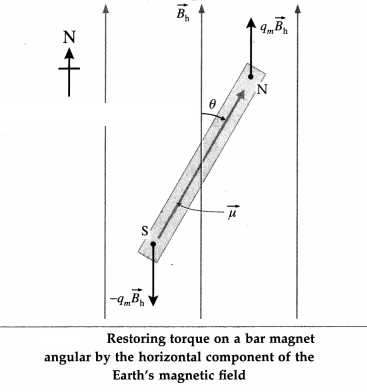
displacement $\theta $ from its rest position $(\theta = 0)$, the suspension fibre is twisted. When the magnet is released, it oscillates about the rest position in angular or torsional oscillation.
The bar magnet experiences a torque $\tau$ due to the field $B _{ h }$. Which tends to restore it to its original orientation parallel to $B_h$. For small $\theta_{\text {, th }}$ this restoring torque is
$\tau=-\mu B_h \sin \theta=-\mu B_h \mu \ldots \text { (1) }$
where the minus sign indicates that the torque is opposite in direction to the angular displacement θ. Equation (1) shows that the torque (and hence the angular acceleration) is directly proportional in magnitude of the angular displacement but opposite in direction. Hence, for small angular displacement, the oscillations of the bar magnet in a uniform magnetic field is simple harmonic. View full question & answer→Question 433 Marks
Using differential equation of linear S.H.M, obtain the expression for
(a) velocity in S.H.M.,
(b) acceleration in S.H.M.
AnswerThe general expression for the displacement of a particle in SHM at time t is x = A sin (ωt + α) … (1)
where A is the amplitude, ω is a constant in a particular case and α is the initial phase.
The velocity of the particle is
$
\begin{aligned}
v & =\frac{d x}{d t}=\frac{d}{d t}[A \sin (\omega t+\alpha)] \\
& =\omega A \cos (\omega t+\alpha) \\
& =\omega A \sqrt{1-\sin ^2(\omega t+\alpha)}
\end{aligned}
$
From Eq. (1), $\sin (\omega t+\alpha)=x / A$
$\therefore v=\omega A \sqrt{1-\frac{x^2}{A^2}}$$
\therefore v=\omega \sqrt{A^2-x^2}
$
Equation (2) gives the velocity as a function of $x$. The acceleration of the particle is $a =\frac{d v}{d t}=\frac{d}{d t}[ A \omega \cos (\omega t +\alpha) J$ at at $\therefore a=-\omega^2 A \sin (\omega t+\alpha)$
But from Eq. (1), $A \sin (\omega t+\alpha)=x$
$
\therefore a=-\omega^2 x \ldots \text { (3) }
$
Equation (3) gives the acceleration as a function of x. The minus sign shows that the direction of the acceleration is opposite to that of the displacement.
View full question & answer→Question 443 Marks
Define linear simple harmonic motion.
AnswerDefinition: Linear simple harmonic motion (SHM) is defined as the linear periodic motion of a body, in which the force (or acceleration) is always directed towards the mean position and its magnitude is proportional to the displacement from the mean position.
OR
A particle is said to execute linear SHM if the particle undergoes oscillations about a point of stable equilibrium, subject to a linear restoring force always directed towards that point and whose magnitude is proportional to the magnitude of the displacement of the particle from that point.
Examples : The vibrations of the tines (prongs) of a tuning fork, the oscillations of the needle of a sewing machine.
View full question & answer→