Question
Distinguish between : Glucocorticoids and mineralcorticoids

Answer

Glucocorticoids Mineralocorticoids
1. Glucocorticoids control carbohydrate metabolism.1. Mineralocorticoids regulate mineral concentration.
2. These are secreted by the cells of zona fasciculata.2. These are secreted by the cells of zona glomerulosa.
3. These also regulate protein and fat metabolism.3. These regulate salt-water balance.
4. Cortisol is the main glucocorticoid.4. Aldosterone is the main mineralocorticoid.

Need a full question paper?

Generate a complete, print-ready paper with questions like this in minutes — across 16+ boards, with answer keys.

Start Generating Free

Similar questions

Read the following and answer any four questions from (i) to (v) given below:
Ginkgo tree has been saved from extinction by selective breeding followed by channeling into trade of nature lovers. This is an ex-situ conservation, where endangered species are protected from all adverse factors. Offspring produced in captive breeding are released in natural habitat for acclimatisation.
  1. What is the significance of offsite collections?
  1. Restock depleted populations.
  2. Protection of endangered species.
  3. Reintroduce species in wild.
  4. All of these.
  1. Which of the following is not an ex-situ conservation?
  1. Wetlands
  2. Orchards
  3. Aquaria
  4. Botanical gardens.
  1. Select the incorrect statements for ex-situ conservation.
  1. It is conservation of species outside their natural habitats.
  2. Endangered species are kept under human supervision and provided all the essentials.
  3. The species population recovers in natural environment.
  4. Both (b) and (c).
  1. Conditions maintained in seed banks for orthodox seeds are:
  1. Low moisture content.
  2. Anaerobic conditions.
  3. Low temperature.
  4. All of these.
  1. Assertion: Animal species which have become extinct in wild continue to be maintained in zoological parks.
Reason: Captive breeding is the conservation of those cases where these is no realistic chance of in-situ survival.
  1. Both assertion and reason are true and reason is the correct explanation of assertion.
  2. Both assertion and reason are true but reason is not the correct explanation of assertion.
  3. Assertion is true but reason is false.
  4. Both assertion and reason are false.
Read the following and answer any four questions from (i) to (v) given below:
A 23 year old Sahil has been diagnosed with an infection of reproductive tract caused by bacteria. He complains about burning sensation during urination, pus-containing discharge and pain around genitalia. This infection has incubation period of 2-5 days but can be cured.
  1. From which disease is Sahil suffering?
  1. Chlamydiasis.
  2. Herpes.
  3. Gonorrhoea.
  4. Syphilis.
  1. Which among the following reproductive tract infections is transmitted by bacteria?
  1. Trichomoniasis.
  2. Chancroid.
  3. Genital warts.
  4. Both (a) and (b).
  1. Which mode of treatment would be useful for Sahil?
  1. Cryosurgery.
  2. Use of Podophyllum preparation.
  3. Use of antibiotic ampicillin.
  4. It cannot be treated.
  1. What technique was used to diagnose Sahil's disease?
  1. Gram staining of discharge and culture.
  2. ELISA Test.
  3. Antibody detection.
  4. Antigen test.
  1. Find the odd one out.
  1. Treponema pallidum.
  2. Neisseria gonorrhoeae.
  3. Haernophilus ducreyi.
  4. Trichomonas vaginalis.
Distinguish between : T. S. of artery and T.S. of vein.
Cuticular transpiration and Stomatal transpiration.
Read the following and answer any four questions from (i) to (v) given below:
Rajesh, Ravi, and Rohit are roommates. 'They are doing their graduation. Few months back Ravi fell ill. it took him around 3 weeks to recover. Both his friends were absolutely healthy at that time. After sometime, Rajesh also fell ill from some other disease. This time Ravi and Rohit both contracted the same illness. Based on the above information, answer the following questions.
  1. Which of the following holds true for Ravi's illness?
  1. Ravi was suffering from a communicable disease that is transmitted through vector.
  2. Ravi was suffering from a communicable disease that is transmitted through faecal oral route.
  3. Ravi was suffering from a non-communicable disease like anaemia.
  4. Ravi was suffering from a non-communicable disease like Down's syndrome.
  1. Select the correct statement.
  1. Ravi contracted a disease caused by air borne microbes.
  2. Ravi could have suffered a nutritional disorder.
  3. Ravi suffered a non-contagious disease.
  4. Both (b) and (c)
  1. Which could be correctly said for Rajesh's illness?
  1. Rajesh's illness was due to a microbial infection.
  2. Rajesh's illness could be contagious or non-contagious.
  3. Rajesh's illness could be cured by antibiotics.
  4. All of these
  1. Which of the following may depicts Ravi's and Rajesh's illness?
S.no
Ravi
Rajesh
(a)
Which of the following may depicts Ravi's and Rajesh's illness?
Myocardial infection
(b)
Whooping cough
Tetanus
(c)
Gastritis
Rhinitis
(d)
Hypertensio
Thyroid
  1. Assertion: Diabetes mellitus is a non-communicable disease which can be completely cured.
Reason: Diabetes mellitus is caused by deficiency of aldosterone hormone.
  1. Both assertion and reason are true, and reason is the correct explanation of assertion.
  2. Both assertion and reason are true, but reason is not the correct explanation of assertion.
  3. Assertion is true, but reason is false.
  4. Both assertion and reason are false.
Column IColumn II 
(a) Metchnikoff(i) ABO Blood group system
(b) Fleming(ii) Concept of immunity
(c) Edward Jenner(iii) Phagocytic cells
(d) Karl Lands teiner(iv) Lysozyme
Read the following and answer any four questions from (i) to (v) given below:
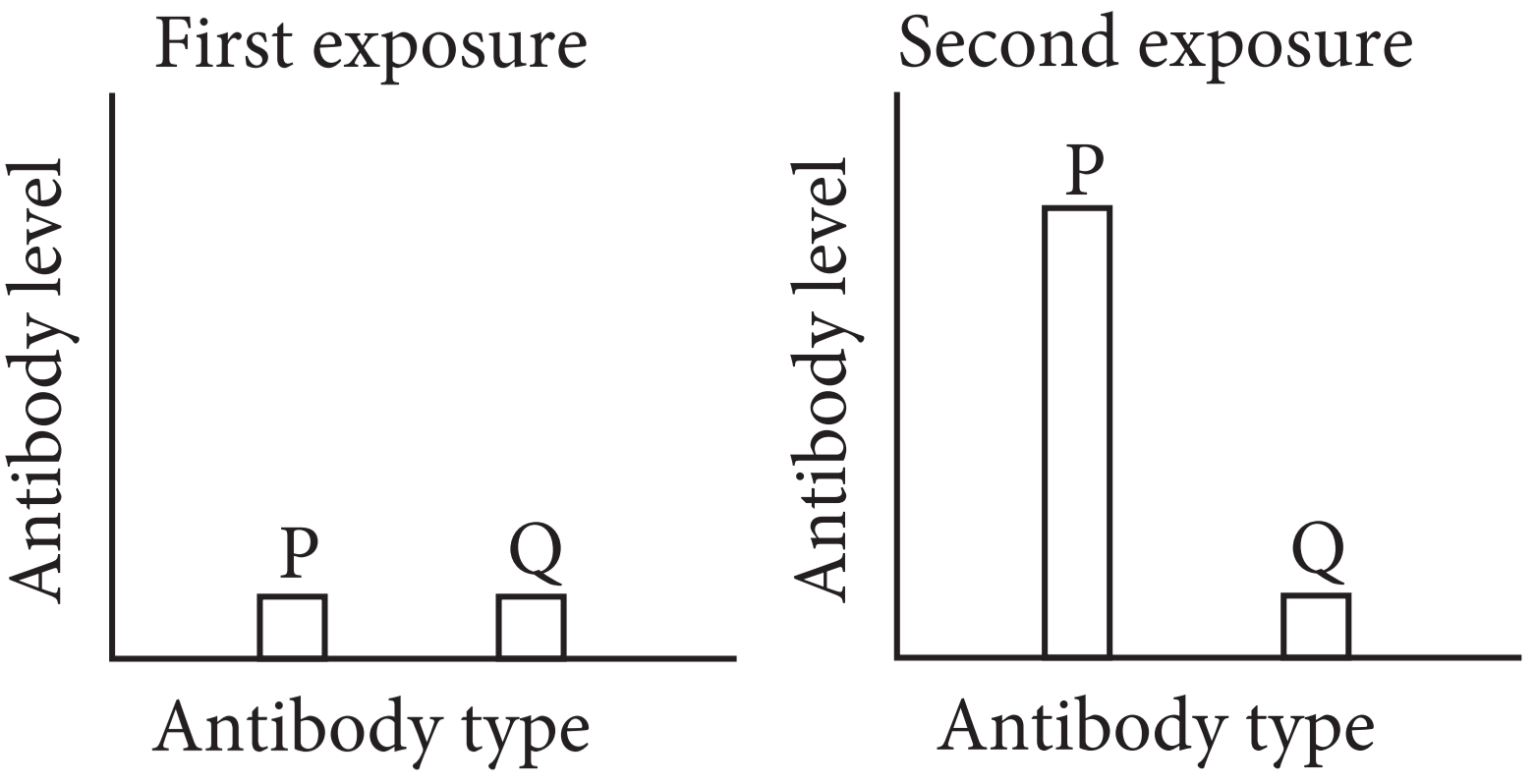
In a study to test a new vaccine against a viral disease, mouse model testing is done. In this process, mice are vaccinated and their blood samples were tested. Mice developed mild disease symptom. After few days those mice were again infected with the virus. This time they do not show any disease symptoms. Their blood samples were tested. Two graphs show antibody concentration for the first and second infection in mice blood.

Based on the above information, answer the following questions.
  1. P and Qin the given graphs indicate.
  1. IgM and IgG respectively.
  2. IgG and IgM respectively
  3. IgG and IgM respectively
  4. IgM and IgA respectively.
  1. Which form of pathogen is used in vaccination?
  1. Activated and strong pathogenic antigen.
  2. Inactivated and weakened pathogenic antigen.
  3. Hyperactive and strong pathogen.
  4. Preformed antibodies.
  1. Which of the following is incorrect for P?
  1. It is the most abundant class of lg.
  2. It is found in blood, lymph, and intestine.
  3. It is unable to cross the placental barrier.
  4. It is a monomer.
  1. How does vaccination work?
  1. The immune system produces antibodies which stay in the blood.
  2. Memory lymphocytes remain in the body to fight off any future infection with the same pathogen.
  3. The dead pathogen stays in the body and constantly stimulates the immune system.
  4. All of these.
  1. Assertion: Mice do not show any disease symptoms during second exposure to the pathogenic virus.
Reason: The antibody production is accelerated and more intense during secondary immune response.
  1. Both assertion and reason are true, and reason is the correct explanation of assertion.
  2. Both assertion and reason are true, but reason is not the correct explanation of assertion.
  3. Assertion is true, but reason is false.
  4. Both assertion and reason are false.
Read the following and answer any four questions from (i) to (v) given below:
Population is defined as the total number of individuals of a species present in a particular area at a given time. 'The scientific study of human population is called demography. The rapid increase in population over a relatively short period is called population explosion. Four basic processes are involved in increase or decrease in the population size. Population shows two types of growth; exponential and logistic.
  1. Which of the following factors are responsible for population explosion?
  1. Decrease in number of people of reproducible age.
  2. Decline in infant mortality rate.
  3. Increase in maternal mortality rate.
  4. Rapid decline in death rate.
  1. A and B
  2. B and C
  3. B and D
  4. A and D
  1. What is the shape of curve showing logistic growth?
  1. Sigmoid.
  2. J-shape.
  3. Linear.
  4. Hyperbola.
  1. What is immigration?
  1. Number of individuals of the population who left the habitat.
  2. Number of individuals that have come into the habitat.
  3. Number of individuals of a species per unit area at given time.
  4. Number of births per 1000 individuals.
  1. Equation of Verhulst-Pearl logistic growth is:
  1. $\frac{\text{dN}}{\text{dt}}=\text{rN}$
  2. $\frac{\text{dN}}{\text{dt}}=\frac{\text{K-N}}{\text{k}}$
  3. $\frac{\text{dN}}{\text{dt}}=\text{rN}\Big(\frac{\text{K-N}}{\text{k}}\Big)$
  4. $\frac{\text{dN}}{\text{dt}}=\text{rN}\Big(1-\frac{\text{K-N}}{\text{k}}\Big)\text{r}$
  1. Which of the following contributes to decrease in population?
  1. Fertility.
  2. Natality.
  3. Social mobility.
  4. Emigration.
Read the following and answer any four questions from (i) to (v) given below:
The process of copying genetic information from template strand of DNA into RNA is called transcription. It is mediated by RNA polymerase. Transcription takes place in the nucleus of eukaryotic cells. In transcription, only a segment of DNA and only one of the strands is copied into RNA.
  1. What are regions of transcription unit in a DNA molecule?
  1. Promoter
  2. Structural gene
  3. Terminator
  4. All of these
  1. Monocistronic structural genes are found in which organisms?
  1. Prokaryotes
  2. Bacteria
  3. Viruses
  4. Eukaryotes
  1. Which enzyme helps in tailing or polyadenylation?
  1. Poly-A polymerase
  2. Exonuclease
  3. RNA polymerase I
  4. RNA polymerase II
  1. Assertion: A single RNA polymerase in prokaryotes synthesis all types of RNAs.
Reason: Prokaryotic RNA polymerase has sigma $(\sigma)$ factor.
  1. Both assertion and reason are true, and reason is the correct explanation of assertion.
  2. Both assertion and reason are true, but reason is not the correct explanation of assertion.
  3. Assertion is true, but reason is false.
  4. Both assertion and reason are false.
  1. Read the given list of materials.
  1. RNA polymerase enzyme
  2. DNA template.
  3. DNA template.
  4. Okazaki segments.
  5. Four types of ribonucleotides triphosphates.
  6. Divalent metal ions $Mg^{2+}$​​​​​​​ as a cofactor.
Which of the above given materials are required for transcription?
  1. (1) (2) (3) and(4)
  2. (1) (2) (3) (5) and(6)
  3. (1) (2) (5) and(6)
  4. All of these
Read the following and answer any four questions from (i) to (v) given below:
Aditya went to his hometown located in countryside along with his parents during his summer vacations. His grand parents' house is surrounded by farmland from all sides. Lots of crops were growing nearby and Aditya was very excited to visit the crop fields. He seeked permission from his mother to play in farmland along with his friends and then went to play in the fields. On returning back he had running nose, watering eyes and continuous sneezing which was very frequent. TI1e symptoms worsened with time. Based on the above information, answer the following questions.
  1. What could be the possible reason for Aditya's condition?
  1. Allergy
  2. Infection
  3. Malnutrition
  4. Genetic disorder
  1. How can allergy be diagnosed in a person?
  1. Presence of large amount of IgE antibodies in the blood.
  2. Presence of large number of bacteria in the blood.
  3. Presence of bilirubin and bilirubin pigments in the stool.
  4. Presence of sickle shaped RBCs in the blood
  1. The symptoms which Aditya developed on account of being allergic are consequence of?
  1. Inflammation of membrane lining the nose and conjunctiva
  2. Swelling up of tissue surrounding bronchioles of lungs
  3. Dilation of all arteries so that large amount of fluid passes from blood to tissues.
  4. All of these.
  1. Name the type of allergy that Aditya developed.
  1. Asthma
  2. Anaphylaxis
  3. Hay fever
  4. Urticaria
  1. Assertion : Hay fever is the form of allergy due to pollens of grasses and other plants.
Reason : Hay fever symptoms are due to release of histamines and often respond well to treatment with antihistamines.
  1. Both assertion and reason are true, and reason is the correct explanation of assertion.
  2. Both assertion and reason are true, but reason is not the correct explanation of assertion.
  3. Assertion is true, but reason is false.
  4. Both assertion and reason are false.