Question
Distinguish between isotopes and isobars. Give one example for each of the species.

Answer

S. No. Isotopes Isobars
1. The nuclides having the same atomic number (Z). The nuclides having the same atomic mass (A) but.
2. But different atomic masses (A) are called isotopes. Examples: $^1_1\text{H},\ ^2_1\text{H},\ ^3_1\text{H}$ Different atomic numbers (Z) are called isobars. Examples: $^3_1\text{H},\ ^3_2\text{He}$

Need a full question paper?

Generate a complete, print-ready paper with questions like this in minutes — across 16+ boards, with answer keys.
Start Generating Free

Similar questions

A long charged cylinder of linear charge density $+\lambda_1$ is surrounded by a hollow coaxial conducting cylinder of linear charge density $-\lambda_2$. Use Gauss’s law to obtain expressions for the electric field at a point (i) in the space between the cylinders, and (ii) outside the larger cylinder.
  1. Describe the working of photodiode by drawing the circuit diagram.
  2. Draw the characteristics of a photodiode for different illumination intensities.
  3. Why is photodiode operated in reverse bias even though the reverse bias current is much weaker than the current in forward bias?
Write Maxwell’s generalisation of Ampere’s Circuital Law. Show that in the process of charging a capacitor, the current produced within the plates of the capacitor is
$\text{i} = \varepsilon_{\circ}\frac{^{\text{d}\Phi}\text{E}}{\text{dt}}$where$\Phi_{E}$ is the electric flux produced during charging of the capacitor plates.
A wave pulse is travelling on a string with a speed v towards the positive X-axis. The shape of the string at t = 0 is given by $\text{g(x)}=\text{A}\sin\big(\frac{\text{x}}{\text{a}}\big),$ where A and a are constants.
  1. What are the dimensions ot A and a?
  2. Write the equation of the wave for a general time t, if the wave speed is v.
How will establish displacement current of 6 A between the plates of a capacitor of capacitance $6 \mu F$ ?
State the law of radioactive decay.
Plot a graph showing the number (N) of undecayed nuclei as a function of time (t) for a given radioactive sample having half life $T_½.$
Depict in the plot the number of undecayed nuclei at (i) $t = 3 T_½$ and (ii) $t = 5 T_½.$
Find the time required for a 50Hz alternating current to change its value from zero to the rms value.
State briefly the underlying principle of a transistor oscillator. Draw a circuit diagram showing how the feedback is accomplished by inductive coupling. Explain the oscillator action.
A positive point charge (+ q) is kept in the vicinity of an uncharged conducting plate. Sketch electric field lines originating from the point on to the surface of the plate.
Derive the expression for the electric field at the surface of a charged conductor.
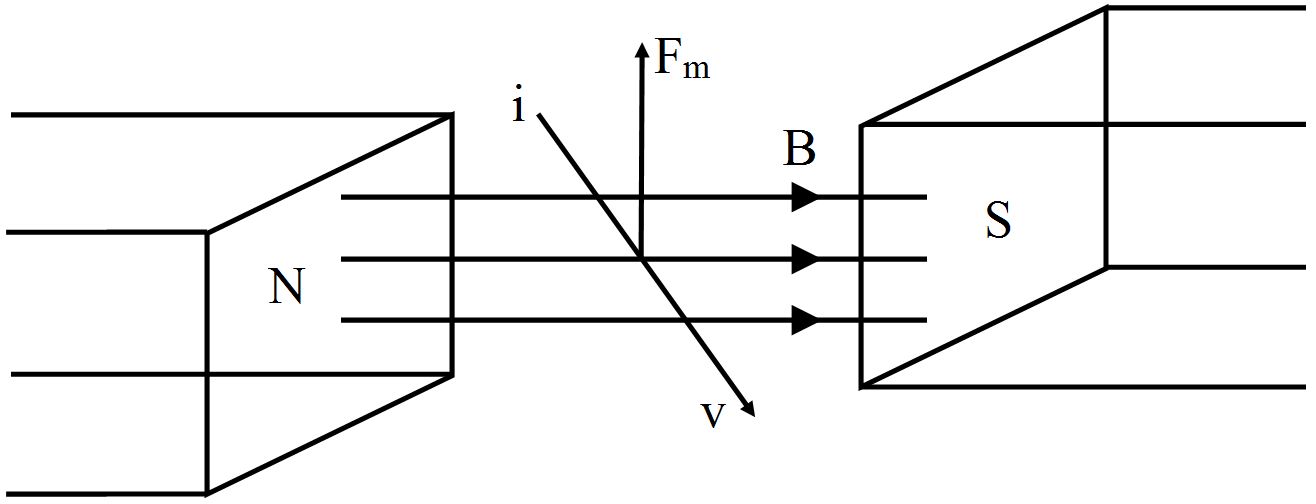
A charged particle enters into a uniform magnetic field and experiences an upward force as indicated in the figure. What is the charge sign on the particle?