Question
Distinguish between: Menarche and Menopause.

Answer

MenarcheMenopause
1. Menarche is the beginning of menstrual cycle.1. Menopause is the stoppage of menstrual cycle.
2. Menarche is at the age of 10 to 14.2. Menopause is at the age of 45 to 50.
3. Menarche begins with secretion of FSH and LH.3. Menopause is caused due to decline of FSH and LH secretion.
4. Menarche is the beginning of the reproductive period.4. Menopause is the end of the reproductive period.

Need a full question paper?

Generate a complete, print-ready paper with questions like this in minutes — across 16+ boards, with answer keys.
Start Generating Free

Similar questions

Image
How is a transgenic tobacco plant protected against Meloidogyne incognita? Explain the procedure.
Read the following and answer any four questions from $7(i)$ to $7(v)$ given below:
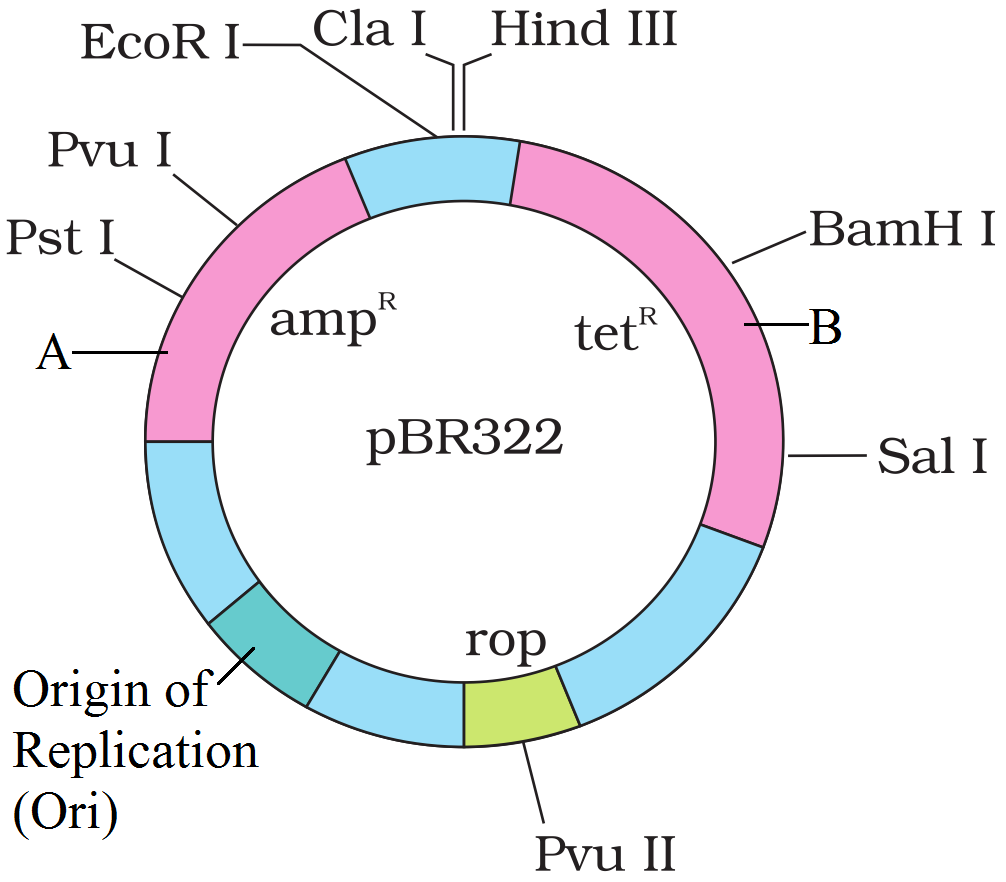
The vectors are DNA molecules that can carry a foreign DNA segment and replicate inside the host cell. Vectors may be plasmids, bacteriophages (viruses that attack bacteria), cosmids, yeast artificial chromosomes (YACs), Bacterial artificial chromosomes (BACs) and viruses. The most widely used, versatile, easily manipulated vector $pBR\ 322$ is an ideal plasmid vector. Features that are required to facilitate cloning into a vector includes origin of replication (Ori) which is a specific sequence of DNA bases responsible for initiating replication, selectable marker genes and cloning sites
  1. Pin $pBR\ 322$ denotes that it is a:
  1. plasmid
  2. prokaryote
  3. protist
  4. plant cell.
  1. Ori is a specific DNA sequence that help in.
  1. Attachment of primers.
  2. Initiation of replication.
  3. Extension of DNA base.
  4. Initiation of denaturation.
  1. A and B shown in the figure respectively indicates:
  1. Pvu II and Cla I.
  2. ROP and Sal I.
  3. amp$^R$ and tet$^R$.
  4. tet$^R$ and amp$^R$.
  1. Selectable markers in vector,
  1. Are responsible for replication.
  2. Help in selecting transformants from non-transform ants.
  3. Code for proteins involved in the replicating plasmids.
  4. Contain unique recognition sites.
  1. Plasmid vectors are:
  1. dsDNA molecule
  2. Extra-chromosomal
  3. Present in bacteria and yeast
  4. All of these.
Column A (Adaptation)Column B (Type of pollination)
(1) Sticky, spiny pollen grains non-fragrant flowers(a) Anemophily
(2) Feathery stigma and versatile anther(b) Chiropterophily
(3) Presence of nectar glands and sweet smell(c) Ornithophily
(4) Dull coloured flowers with strong fragrance(d) Entomophily
Outcrossing and Crossbreeding.
Read the following and answer any four questions from 6(i) to 6(v) given below:
Rama lives in a society where a robbery occurred last night. Robbers came into the flat and murdered the old lady residing there. Police came and restricted the entry into the flat. They took samples from the room, where the dead body was found. While examining, they found that there is some blood and tissue in the nails of old lady. According to their observation, police filtered out their inspection to three suspects viz. servant, cook and milkman. Finally after two days of robbery, police caught the criminal. It was the old lady's cook. Rama was amazed to see that how quickly police completed and shut the case. She asked the inspector that how they did it? The police man told her that it become possible due to the sample collected from the victim, that lead them to the criminal. TI1e sample taken from nail scraping was amplified using PCR and then tested.
  1. What technique was used by the police to identify the criminal?
  1. DNA fingerprinting.
  2. Gel electrophoresis.
  3. Molecular diagnosis.
  4. Clonning.
  1. In PCR, the temperature used to denature the DNA is about:
  1. $76^\circ $
  2. $25^\circ$
  3. $95^\circ $
  4. $40^\circ $
  1. Which of the following statements regarding PCR is correct?
  1. Taq polymerase, which is isolated from bacterium Thermus aquaticus is stable at low temperature only.
  2. With the help of DNA ligase, the complementary sticky ends of the DNA are joined to produce a rDNA.
  3. Since the sequence of primers are complementary to 5' end of the template DNA, they anneal to it.
  4. DNA purified from the cell is precipitated by adding hot ethanol.
  1. Taq polymerase synthesises DNA region between the primers using:
  1. $Mg^{2+}$
  2. dNTPs
  3. DNA ligase
  4. Both (a) and (b).
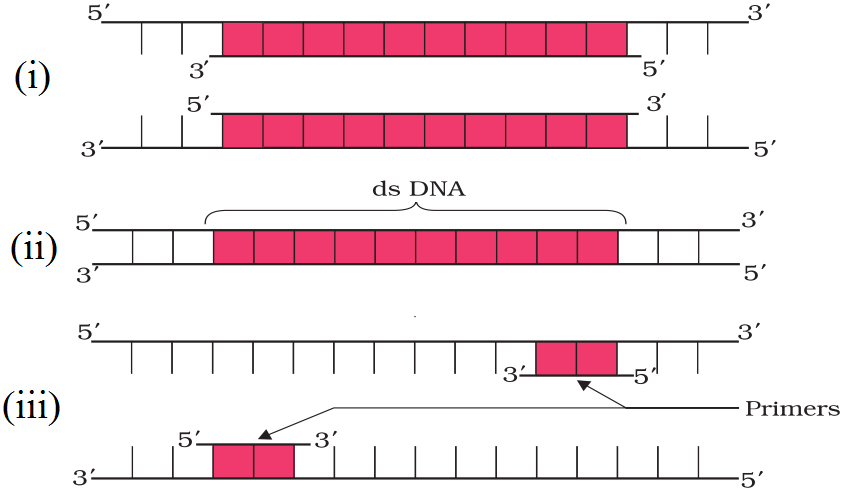
  1. Given below are steps of polymerase chain reaction.


Select the option that correctly mention the sequence in which they occur.
  1. (ii) → (iii) → (i)
  2. (i) → (ii) → (iii)
  3. (iii) → (i) → (ii)
  4. (ii) → (i) → (iii)
Distinguish between: Homologous organs and Analogous organs.
Column AColumn B
(1) Frederick Griffith(a) Test tube assay
(2) Avery, McCarty and MacLeod(b) Streptococcus pneumoniae
(3) Alfred Hershey and Martha Chase(c) E. coli
(4) Meselson and Stahl(d) Bacteriophages
Why are vectors needed for replication of DNA during rDNA technology?
Read the following and answer any four questions from (i) to (v) given below:
Discovery of penicillin by Alexander Fleming in 1928 marked the beginning of the remarkable era in medical field. Penicillin was the first antibiotic extracted from Penicillium notatum. Antibiotics are used to treat bacterial diseases. These can be broad spectrum which can kill diverse group of disease causing bacteria and narrow spectrum which is effective only against one group of pathogenic strain. Antibiotics can act as bactericides or bacteriostatic. Bactericidal antibiotics kill bacteria by - disruption of cell wall synthesis (e.g., penicillin, cephalosporin, etc.), inhibition of SOS ribosome function (e.g.; erythromycin), inhibition of 30S ribosome function (e.g., streptomycin, neomycin), inhibition of amino acid-tRNA binding to ribosome (e.g., tetracyline). etc. Bacteriostatic antibiotics do not kill the bacteria rather they restrict the growth of bacteria. Penicillin belongs to $\beta$-lactum group of antibiotics and it inhibits bacterial cell wall synthesis by binding and inactivating protein. It inhibits transpeptidation of reaction and blocks cross-linking of the cell wall. It is used to treat tonsilitis, sore throat, gonorrhoea, rheumatic fever and some pneumonia types.
  1. The first antibiotic was extracted from a:
  1. Lichen.
  2. Fungus.
  3. Eubacteria.
  4. Acti-nomycetes.
  1. Which of the following kills bacteria by interfering SOS ribosome function?
  1. Cephalosporin.
  2. Erythromycin.
  3. Streptomycin.
  4. Neomycin.
  1. $\beta$-lactum group of antibiotics kill the bacterial pathogen by:
  1. Disruption of plasma membrane.
  2. Inhibition of translation of mRNA.
  3. Inhibition of translation of mRNA
  4. Inhibition of transcription of mRNA.
  1. Penicillin is not used to treat.
  1. Pneumonia.
  2. Tonsilitis.
  3. Rheumatic fever.
  4. Candidiasis.
  1. Assertion: Cephalosporins act by disruption of bacterial cell wall synthesis mechanism.
Reason: Cephalosporins are bacteriostatic antibiotics.
  1. Both assertion and reason are true and reason is the correct explanation of assertion.
  2. Both assertion and reason are true but reason is not the correct explanation of assertion.
  3. Assertion is true but reason is false.
  4. Both assertion and reason are false.