Question
Outcrossing and Crossbreeding.

Answer

OutcrossingCrossbreeding
1. Breeding of animals of the same breed but having no common ancestors for 4 to 6 generations is known as outcrossing.1. Breeding of superior male of one breed with superior female of another breed is known as crossbreeding.
2. Progeny is known as outeross. 2. Progeny is known as hybrid.
3. New breeds are not developed by outcrossing.3. New breeds or hybrids are formed by crossbreeding.
4. An outcross helps to overcome inbreeding depression.4. Hybrids are subjected to inbreeding and new stable breeds are developed by crossbreeding.

Need a full question paper?

Generate a complete, print-ready paper with questions like this in minutes — across 16+ boards, with answer keys.
Start Generating Free

Similar questions

Read the following and answer any four questions from (i) to (v) given below:
Tools used in the formation of recombinant DNA are of three types. These are enzymes, cloning vectors and competent host. lysing enzymes are used to extract DNA for experimental purpose from the cells. Cleaving enzymes break the DNA molecules. TI1ey are of three types : exonucleases, endonucleases and restriction endonucleases. A competent host is required for transformation with recombinant DNA and cloning vectors help to propagate DNA.
  1. Which of the following is an example of natural Iysing activity in a human body?
  1. Lysozyme present in tears dissolve the bacterial cell wall.
  2. Conversion of starch to maltose in the buccal cavity
  3. Absorption of digested food into the intestinal cells.
  4. Conversion of protein molecules into amino acids in the stomach.
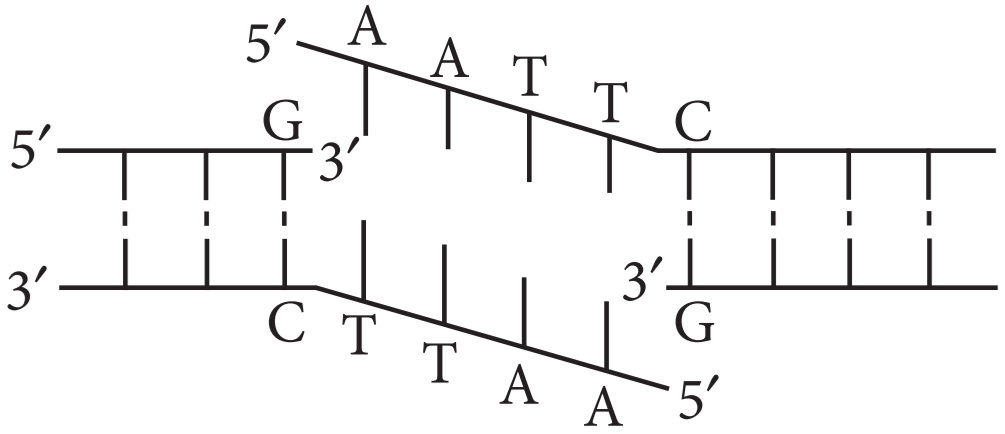
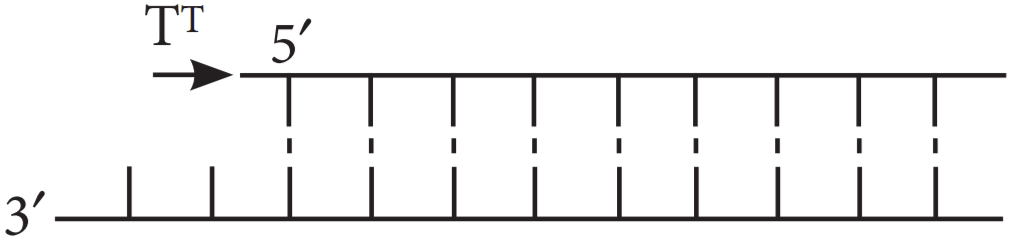
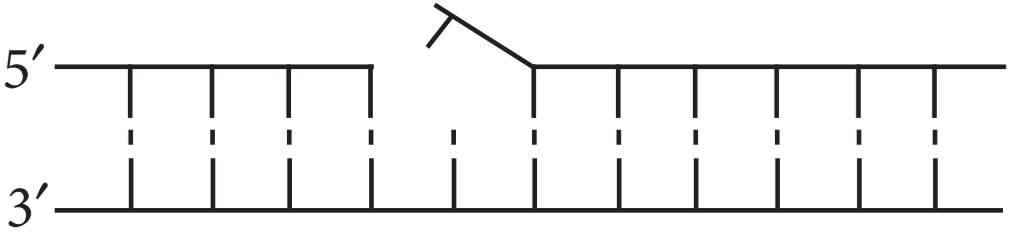
  1. Which of the following depicts exonuclease activity?
  1.  
  1.  
  1.  
  1. All of these
  1. Cloning vectors are the DNA molecules that.
  1. Carry foreign DNA segment but do not replicate inside the host cell.
  2. Carry foreign DNA segment and replicate inside the host cell.
  3. Transfer nuclear DNA form nucleus to the cytoplasm of the same cells.
  4. Help in sealing gaps in DNA segments.
  1. Transfer of DNA into a eucaryotic cell is called:
  1. Transformation.
  2. Transduction.
  3. Transfection.
  4. Electroporation.
  1. Assertion: Type I restriction enzymes are not used in rDNA technology.
Reason: Biotechnology mostly involves cutting and pasting of desired DNA fragments.
  1. Both assertion and reason are true and reason is the correct explanation of assertion.
  2. Both assertion and reason are true but reason is not the correct explanation of assertion.
  3. Assertion is true but reason is false.
  4. Both assertion and reason are false.
Respiratory surfaceOrganism
(1) Plasma membrane(a) Insect
(2) Lungs(b) Salamander
(3) External gills(c) Bird
(4) Internal gills(d) Amoeba
(e) Fish
Column A (Adaptation)Column B (Type of pollination)
(1) Sticky, spiny pollen grains non-fragrant flowers(a) Anemophily
(2) Feathery stigma and versatile anther(b) Chiropterophily
(3) Presence of nectar glands and sweet smell(c) Ornithophily
(4) Dull coloured flowers with strong fragrance(d) Entomophily
Read the following and answer any four questions from (i) to (v) given below:
Rajesh, Ravi, and Rohit are roommates. 'They are doing their graduation. Few months back Ravi fell ill. it took him around 3 weeks to recover. Both his friends were absolutely healthy at that time. After sometime, Rajesh also fell ill from some other disease. This time Ravi and Rohit both contracted the same illness. Based on the above information, answer the following questions.
  1. Which of the following holds true for Ravi's illness?
  1. Ravi was suffering from a communicable disease that is transmitted through vector.
  2. Ravi was suffering from a communicable disease that is transmitted through faecal oral route.
  3. Ravi was suffering from a non-communicable disease like anaemia.
  4. Ravi was suffering from a non-communicable disease like Down's syndrome.
  1. Select the correct statement.
  1. Ravi contracted a disease caused by air borne microbes.
  2. Ravi could have suffered a nutritional disorder.
  3. Ravi suffered a non-contagious disease.
  4. Both (b) and (c)
  1. Which could be correctly said for Rajesh's illness?
  1. Rajesh's illness was due to a microbial infection.
  2. Rajesh's illness could be contagious or non-contagious.
  3. Rajesh's illness could be cured by antibiotics.
  4. All of these
  1. Which of the following may depicts Ravi's and Rajesh's illness?
S.no
Ravi
Rajesh
(a)
Which of the following may depicts Ravi's and Rajesh's illness?
Myocardial infection
(b)
Whooping cough
Tetanus
(c)
Gastritis
Rhinitis
(d)
Hypertensio
Thyroid
  1. Assertion: Diabetes mellitus is a non-communicable disease which can be completely cured.
Reason: Diabetes mellitus is caused by deficiency of aldosterone hormone.
  1. Both assertion and reason are true, and reason is the correct explanation of assertion.
  2. Both assertion and reason are true, but reason is not the correct explanation of assertion.
  3. Assertion is true, but reason is false.
  4. Both assertion and reason are false.
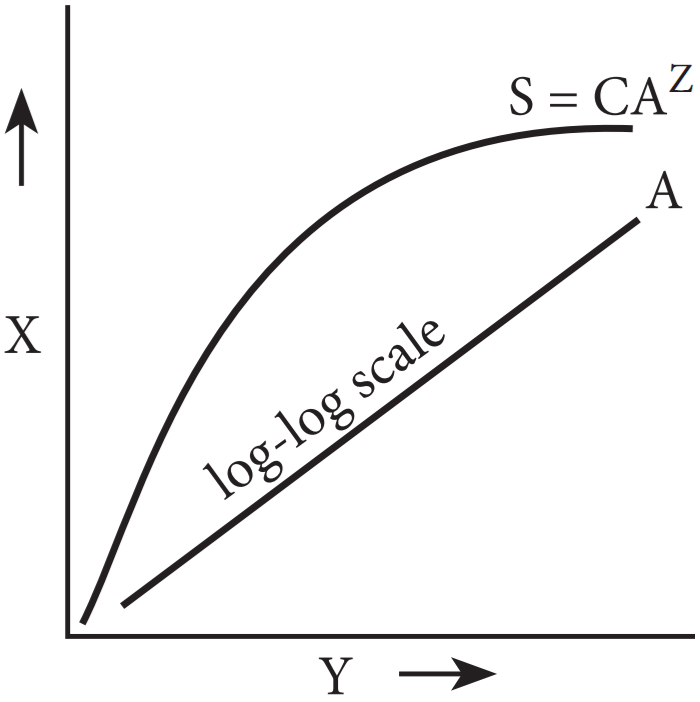
Read the following and answer any four questions from (i) to (v) given below: Within a region, species richness increases with increasing explored area, but only upto a limit. TI1e given graph explains this relationship.
  1. What does the given figure show?
  1. Rivet-popper hypothesis.
  2. Species-area relationship.
  3. Proportionate number of species of major taxa.
  4. $\alpha-\text{ecological diversity }$
  1. Equation for relationship (A) between species richness and area is:
  1. $\log\text{ S}=\log\text{ C}+\text{Z }\log\text{ A}$
  2. $\log\text{ C}=\log\text{ S}+\text{Z }\log\text{ A}$
  3. $\text{Z }\log\text{ A}=\log\text{ S}+\log\text{ C}$
  4. $\log\text{ S}=\log\text{ C}+\log\text{ A}$
  1. What is the value of slope of line or regression coefficient Z for frugivorous birds?
  1. 0.1 - 0.2
  2. 1.15
  3. 0.01 - 0.1
  4. 0.6 - 1.2
  1. The shape of curve for relationship between species richness and areas for wide variety of taxa is:
  1. Straight line.
  2. Parabola.
  3. Rectangular hyperbola.
  4. Bell shaped.
  1. Who gave this concept of increase in species richness with increasing offered area?
  1. Humboldt.
  2. Odum.
  3. Edward Wilson.
  4. Paul Ehrlich.
Distinguish between : T. S. of artery and T.S. of vein.
What is the cause of frameshift mutation?
Read the following and answer any four questions from (i) to (v) given below: A relevant portion of $\beta$ chain of haemoglobin of a normal human is as follows:

The codon for the sixth amino acid is GAG. The sixth codon GAG mutates to GAA as a result of mutation X and into GUG as a result of mutation Y.
  1. Which of the following is incorrect statement?
  1. Mutation X carries no change in shape of red blood cells.
  2. Mutation Y causes change in shape of red blood cell shape.
  3. Both mutations X and Y causes change in shape of red blood cell shape.
  4. Both (a) and (b)
  1. Due to mutation Y the shape of RB Cs under oxygen tension will be.
  1. Biconcave disc like
  2. Elongated and curve
  3. Circular
  4. Spherical.
  1. GUG is code for.
  1. Valine
  2. Proline
  3. Glutamic acid
  4. Leucine.
  1. Which of the following genotype shows diseased phenotype due to mutation Y?
  1. $Hb^S Hb^S$
  2. $Hb^A Hb^S$
  3. $Hb^A Hb^A$
  4. Both (a) and (b)
  1. Study the given pedigree chart for sickle-cell anaemia and select the most appropriate option for the genotypes.
S.No
Genotypes of parents
Genotypes of $1^{St}$ and $3^{rd}$ child in $F_1$
(a)
$Hb^A Hb^S Hb^A Hb^A$
$Hb^A Hb^A Hb^A Hb^S$
(b)
$Hb^A Hb^S Hb^A Hb^S$
$Hb^A Hb^A Hb^A Hb^A$
(c)
$Hb^A Hb^A Hb^A Hb^S$
$Hb^A Hb^A Hb^S Hb^S$
(d)
$Hb^A Hb^S Hb^A Hb^S$
$Hb^A Hb^S Hb^S Hb^S$
Read the following and answer any four questions from (i) to (v) given below:
Organism P has thick lips and tongue so that it can easily feed on the commonly available spiny plants. Organism Q has thick layer of insulating fat under the skin. It was strong hooves to walk steadily on steep surfaces and lives in burrows during winters. Organism R has bright colours and sticky pads on its fingers and toes. It lives on trees.
  1. Which of the following is correct habitat for organisms P regarding its adaptation?
  1. Grassland biome.
  2. Desert biome.
  3. Tropical rainforest.
  4. Tropical deciduous forest.
  1. Which of the following is correct match regarding organism Q and its habitat?
  1. Tundra - Polar bear.
  2. Tropical rain forest - Deer.
  3. Grassland - Bighorn sheep.
  4. Desert - Camel.
  1. Which of the following is incorrect regarding organisms R's habitat?
  1. The vegetation shows stratification.
  2. Epiphytic growth is rich.
  3. Standing crop is highest.
  4. Deep rooted shrubs are common due to abundant sunlight.
  1. The dominant plants in habitat where P lives could be:
  1. Opuntia
  2. Nymphaea
  3. Deodar
  4. both (a) and (c).
  1. Organisms P, Q and R respectively most likely occur in:
  1. F, B and A.
  2. C, A, E.
  3. A, F and C.
  4. B, D and A.
Column AColumn B
(1) Walter Rosen(a) Popularisation of term biodiversity
(2) David Tillman(b) Rivet Popper Hypothesis
(3) Paul Ehrlich(c) Productivity Stability Hypothesis
(4) Edward Wilson(d) Coined