Question
Distinguish between: Morula and Blastula.

Answer

MorulaBlastula
1. Morula is the embryonic stage formed after the completion of cleavage.1. Blastula is the embryonic stage formed after the completion of blastulation.
2. Morula is formed 4 to 6 days after the fertilization.2. Blastula is formed 6 to 7 days after the fertilization.
3. Morula consists of 16 cells.3. Blastula consists of more than 64 cells.
4. Morula is solid ball of cells.4. Blastula is a hollow ball of cells.
5. Morula stage is passed in fallopian tube, once it reaches uterus, it starts developing into the next stage.5. Blastula after reaching the uterus is implanted on the wall of uterus.
6. Morula does not have any distinction of its inner cell structure.6. Blastula has a blastocoel, trophoblast and inner cell mass.

Need a full question paper?

Generate a complete, print-ready paper with questions like this in minutes — across 16+ boards, with answer keys.

Start Generating Free

Similar questions

Column I (Structure Before seed formation)Column II (Structure After seed formation)
A. Funiculusi. Hilum
B. Scar of Ovuleii. Tegmen
C. Zygoteiii. Testa
D. Inner Integumentiv. Stalk of Seed
 v. Embryo
Distinguish between: Asexual Reproduction – Sexual Reproduction
Read the following and answer any four questions from (i) to (v) given below:
Kangaroo rat seldom drinks water. It has thick coat to minimise evaporative desiccation. TI1e animal seldom comes out of its comparatively humid and cool burrow during the day time. 90% of its water requirement is met from metabolic water (water produced by respiratory breakdown of fats) while 10% is obtained from its food. Loss of water is minimised by producing nearly solid urine and faeces. As the animal faces acute water scarcity, it develops two types of adaptations : reducing water loss and ability to tolerate desert conditions.
  1. Kangaroo rat is a:
  1. Partial regulators
  2. Partial conformer
  3. Regulator
  4. Conformer
  1. Metabolic water refers to:
  1. Water required for metabolic activities.
  2. Water present in intercellular fluid.
  3. Water produced during oxidation of fat or carbohydrate.
  4. Water taken in, to promote metabolism.
  1. Desert animals minimise water loss by:
  1. Producing highly concentrated urine.
  2. Promoting maximum reabsorption of water in kidney tubules.
  3. Possessing one of the longest loop of Henle in kidney tubules.
  4. All of these.
  1. Assertion: Kangaroo rat can tolerate and thrive in wide temperature range and is known as stenothermal.
Reason: Kangaroo rats go into hibernation during winter to escape cold weather.
  1. Both assertion and reason are true and reason is the correct explanation of assertion.
  2. Both assertion and reason are true but reason is not the correct explanation of assertion.
  3. Assertion is true but reason is false.
  4. Both assertion and reason are false.
  1. The adaptations in an organism are meant for:
  1. Optimum primary production.
  2. Optimum life span.
  3. Optimum mobility.
  4. Optimum survival and reproduction.
Read the following and answer any four questions from (i) to (v) given below:
Growth of a population with time shows specific and predictable patterns. Two types of growth pattern of population are exponential and logistic growth. When resources in the habitat are unlimited each species has the ability to realise fully its innate potential to grow in number. Then the population grows in exponential fashion. When the resources are limited growth curve shows an initial slow rate and then it accelerates and finally slows giving the growth curve which is sigmoid.
  1. Which of the following statement is incorrect?
  1. Exponential growth occurs in organism such as lemmings.
  2. Logistic growth is more realistic.
  3. Exponential growth has two phases lag and log.
  4. ln logistic growth, population passes well beyond the carrying capacity of ecosystem.
  1. Which of the following equations correctly represents the exponential population growth curve?
  1. $\text{dN}/\text{dt}=\text{rN}$
  2. $\text{dN}/\text{dt}=\text{rN}\Big(\frac{\text{K-N}}{\text{K}}\Big)$
  3. $\text{N}_\text{t}=\text{N}_\text{o}\text{e}^\text{rt}$
  4. Both (a) and (c).
  1. Which of the following equations correctly represents Verhulst-Pearl logistic growth?
  1. $\text{dN}/\text{dt}=\text{rN}\Big(\frac{\text{K-N}}{\text{K}}\Big)$
  2. $\text{dN}/\text{dt}=\frac{\text{rN}}{\text{K}}$
  3. $\text{dN}/\text{dt}=\frac{\text{N}(\text{K}-\text{N})}{\text{K}}$
  4. $\text{dN}/\text{dt}=\frac{\text{r}(\text{K}-\text{N})}{\text{K}}$
  1. The population growth is generally described by the following equation:
$\frac{\text{dN}}{\text{dt}}=\text{rN}\Big(\frac{\text{K}-\text{N}}{\text{K}}\Big)$

What does 'r' represent in the given equation?
  1. Population density at time 't'.
  2. Intrinsic rate of natural increase.
  3. Carrying capacity.
  4. The base of natural logarithm.
  1. Study the population growth curves (A and B) in the given graph and select the incorrect option.
  1. Curve 'A: shows exponential growth, represented by equation $\frac{\text{dN}}{\text{dt}}=\text{rN}$.
  2. Curve 'B' shows logistic growth, represented by equation $\frac{\text{dN}}{\text{dt}}=\text{rN}\Big(\frac{\text{K}-\text{N}}{\text{K}}\Big)$
  3. Exponential growth curve is considered as more realistic than the logistic growth curve.
  4. Curve 'A' can also be represented by equation $\text{N}_\text{t}=\text{N}_\text{o}\text{e}^\text{rt}$.
Read the following and answer any four questions from (i) to (v) given below:
The endosperm makes the main source of food for the embryo. Generally the endosperm nucleus divides after the division of the oospore, but in several cases the endosperm is formed to a great extent even before the first division of the oospore. There are three general types of endosperm formation: (a) nuclear type, (b) cellular type and (c) helobial type. The endosperm is usually triploid, but haploid endosperm is also found. Endosperm may either be completely consumed by the developing embryo before seed maturation, or it may persist in the mature seed.
  1. Haploid endosperm is found in:
  1. Pin us.
  2. Cauliflower.
  3. Sunflower.
  4. Pea.
  1. Persistent endosperm is found in:
P. Pea Q. Castor R. Bean S. Coconut T. Groundnut.
  1. Q and S.
  2. P and T.
  3. R, S and T.
  4. P, S and T.
  1. Milk of tender coconut represents (A) and the surrounding white coconut meal represents (B).
S. No
A
B
(a)
Cellular endosperm
Free- nuclear endosperm
(b)
Free-nuclear endosperm
Cellular endosperm
(c)
Helobial endosperm
Cellular endosperm
(d)
Free-nuclear endosperm
Helobial endosperm
  1. If an endosperm cell of a gymnosperm contains 12 chromosomes, the number of chromosomes in each cell of the root will be:
  1. 4
  2. 24
  3. 16
  4. 6
  1. In angiosperms, normally after fertilization:
  1. The zygote divides earlier than the primary endosperm nucleus.
  2. The primary endosperm nucleus divides earlier than the zygote.
  3. Both the zygote and primary endosperm nucleus divide simultaneously.
  4. Both the zygote and primary endosperm nucleus undergo a resting period.
Read the following and answer any four questions from (i) to (v) given below:
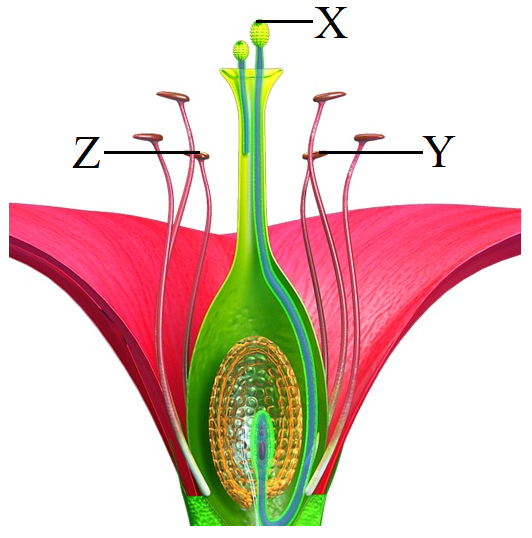
Cross pollination is the transfer of pollen grains from the anther of a one flower to the stigma of a genetically different flower. It is performed with the help of an external agency which may be abiotic (e.g., wind, water) or biotic (e.g., insects, birds, bats, snails). The diagram shows the carpel of an insect pollinated flower.
  1. What is the most likely reason for non germination of pollen grain Z?
  1. Pollen grains X and Y were brought to the stigma earlier, therefore, their germination inhibited the germination of pollen grain Z.
  2. Pollen grain Z was brought to the flower by wind, while pollen grains X and Y were brought to the flower by insect.
  3. Pollen grain Z lacks protrusions that allow it to adhere properly onto the stigma surface.
  4. Pollen grain Z comes from a flower of an incompatible species.
  1. Which of the following best describes the function of the pollen tube?
  1. It acts as a conduit to transport male gametes from the anther to the ovule.
  2. It acts as a conduit to transport male gametes from the stigma to the ovule.
  3. It contains key nutrients that serve to nourish the newly-formed zygote.
  4. It digests the tissues of the stigma, style, and ovary.
  1. Pollination of a flower in which the pollen is carried by an insect is called:
  1. Anemophily.
  2. Ornithophily.
  3. Entomophily.
  4. Malacophil.
  1. Refer to the given characteristics of some flowers.
  1. The stamens hang out of the flower, exposing the anthers to the wind.
  2. The pollen grains are tiny and light.
  3. The flower has a sweet scent.
  4. The flower petals are brightly colored.
  1. Pollenkitt is generally found in:
  1. Anemophilous flowers.
  2. Entomophilous flowers.
  3. Ornithophilous flowers.
  4. Malacophilous flowers.
Read the following and answer any four questions from (i) to (v) given below:
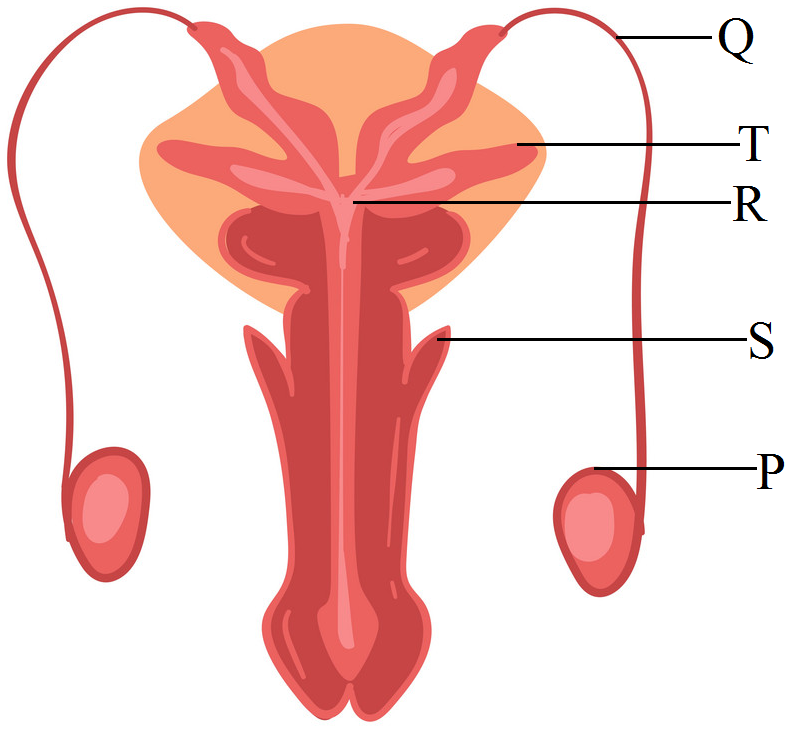
Human male reproductive system comprises of a pair of testes, primary sex organs associated with formation of gametes and production of sex hormone. Study the given figure of human male reproductive system and answer the following questions.
  1. Which of the following is correct for labelled part P?
  1. P is rete testis which transports sperms to outside.
  2. P is epididymis which secretes fluid that nourish the sperms.
  3. P is epididymis that carry sperms and secretion of seminal vesicles.
  4. P is rete testis, which lies along inner side of each testis and stores the sperms.
  1. Identify the correctly matched pair.
  1. Q - Vasa efferentia.
  2. R - Ejaculatory duct.
  3. S - Seminal vesicle.
  4. T - Cowper's gland.
  1. Which statement is incorrect for Q?
  1. It carries spermatozoa from epididymis to ejaculatory duct.
  2. Q are only 2 in number.
  3. It arises from rete testis.
  4. It constitutes male sex accessory duct.
  1. Which structure passes through the prostate gland and carries sperms and secretion of seminal vesicle?
  1. P.
  2. T.
  3. S.
  4. R.
  1. Assertion: Mucus present in secretion of bulbourethral gland decreases the number of sperms damaged during ejaculation.
Reason: Mucus lubricates the end of penis and lining of the urethra.
  1. Both assertion and reason are true, and reason is the correct explanation of assertion.
  2. Both assertion and reason are true, but reason is not the correct explanation of assertion.
  3. Assertion is true, but reason is false.
  4. Both assertion and reason are false.
Distinguish between : T. S. of artery and T.S. of vein.
Image
Read the following and answer any four questions from (i) to (v) given below:
IUCN maintains a Red Data Book or Red List which is a catalogue of taxa facing risk of extinction. The IUCN Red List (2004) documents the extinction of 784 species in the last 500 years. Some examples of recent extinctions include the dodo, quagga, thylacine and Steller's sea cow. The last twenty years alone have witnessed the disappearance of 27 species. Red List has eight categories of species.
  1. Dodo, an extinct taxon, belongs to which country?
  1. Mauritius
  2. Africa
  3. Australia
  4. Russia
  1. To which of the following categories of IUCN, Berberis nilghiriensis belongs?
  1. Extinct.
  2. Extinct in wild.
  3. Endangered.
  4. Critically endangered.
  1. Steller's sea cow and passenger pigeon became extinct due to:
  1. Alien species invasion.
  2. Over-exploitation.
  3. Coextinctions.
  4. Intensive agriculture.
  1. Bali, Javan and Caspian are:
  1. Species of tiger.
  2. Species of cheetah.
  3. Subspecies of cheetah.
  4. Subspecies of tiger.
  1. Select the correct term for the following definitions (i, ii, iii, iv).
  • The taxon is liable to become extinct if not allowed to realise its full biotic potential by providing protection from exotic species/ human exploitation/habitat deterioration/depletion of food.
  • The taxon has been completely eliminated or died out from earth, e.g., Dodo.
  • The taxon is facing a high risk of extinction in the wild in the near future due to decrease in its habitat, excessive predation or poaching.
  • They are species with naturally small populations, either localised or thinly scattered, which are always at risk from pests/ pathogens/ predators/ exotic species.
 
(i)
(ii)
(iii)
(iv)
(a)
Threatened
Extinct
Endangered
Rare
(b)
Endangered
Extinct
Threatened
Rare
(c)
Extinct
Rare
Threatened
Endangered
(d)
Threatened
Extinct
Rare
Endangered