Question
Column I (Structure Before seed formation)Column II (Structure After seed formation)
A. Funiculusi. Hilum
B. Scar of Ovuleii. Tegmen
C. Zygoteiii. Testa
D. Inner Integumentiv. Stalk of Seed
 v. Embryo

Answer

A-iv, B-i, C-v D-ii

Need a full question paper?

Generate a complete, print-ready paper with questions like this in minutes — across 16+ boards, with answer keys.

Start Generating Free

Similar questions

Read the following and answer any four questions from (i) to (v) given below:
A desert lizard (an ectotherm) and a mouse (an endotherm) are placed inside a chamber at 15ºC and their body temperature [T(L) for the lizard and T(M) for the mouse] and metabolic rates [M(L) for lizard and M(M) for the mouse] are monitored.
  1. Which of the following is correct regardingT(L), M(L), T(M) and M(M)?
  1. T(L) and M(L) will fall while T(M) and M(M) will increase.
  2. T(L) and M(L) will increase while T(M) and M(M) will fall.
  3. T(L) and M(L) will fall, T(M) will remain same and M(M) will increase.
  4. T(L) and M(L) will remain same, T(M) and M(M) will decrease.
  1. It can be said that some animals in their evolutionary development preferred to be ectotherms than endotherms. Which of the following can be the best suited reason for it?
  1. The metabolic reactions of these organisms can occur at a very wide range of temperature.
  2. Maintaining homeostasis is an energetically expensive process.
  3. The enzymes of these organisms are functional at high temperatures.
  4. Both (b) and (c).
  1. Organisms that can maintain a constant internal temperature are called.
  1. Homoeothermic
  2. Poikilothermic
  3. Oligothennic
  4. Heterothennic
  1. An animal that survives at temperature of 10ºC and 40ºC both can be placed under the category of:
  1. Ectotherm.
  2. Endotherm.
  3. Modifiers.
  4. Migratory organisms.
  1. Study the graph carefully and select the correct option.
  1. X could be desert lizard.
  2. Y could be mouse.
  3. Z could be desert lizard.
  4. Both (a) and (b).
Read the following and answer any four questions from (i) to (v) given below:
Embryo develops at the micropylar end of the embryo sac, where the zygote is situated. Most zygotes divided only after certain amount of endosperm is formed. The early stages of embryo development are similar in both monocotyledons and dicotyledons. The zygote gives rise to the proembryo and subsequently to the globular heart-shaped and mature embryo. A typical dicotyledonous embryo consists of an embryonal axis and two cotyledons. Embryo of monocotyledons possess only one cotyledon.
  1. True embryo develops as a result of fusion of:
  1. Two polar nuclei of embryo sac.
  2. An egg cell and a male gamete.
  3. Synergid and male gamete.
  4. A male gamete and antipodals.
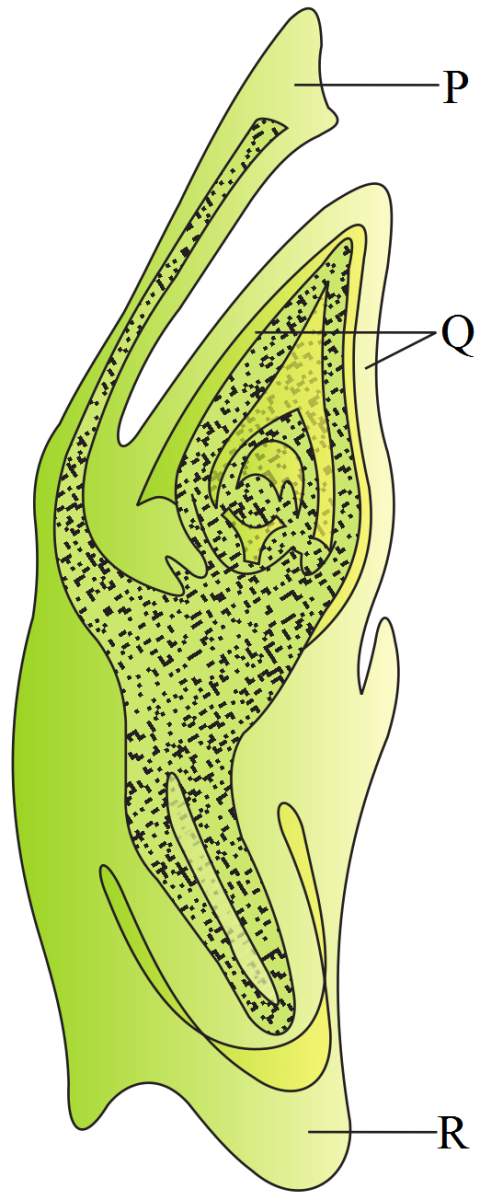
  1. Refer to the given diagram of the embryo of an angiospermous plant with parts labelled P, Q and R. Select the correct statement(s) regarding this.
  1. Part 'P' supplies nutrition to the developing embryo.
  2. Part 'Q' is the protective sheath of radicle and root cap.
  3. Part 'R' is the protective sheath of shoot apex and leaf primordia.
  4. The embryo shown in the diagram is present in members of Family Poaceae.
  1. (IV) only.
  2. (II) and (III) only.
  3. (I) and (IV) only.
  4. (I), (II), (III) and (IV).
  1. Which of the given statements are true?
  1. During the development of a dicot embryo, heart-shaped embryo is followed by globular embryo.
  2. The part of embryonal axis above the level of cotyledons is epicotyl, while the part below the level of cotyledons is hypocotyl.
  3. Monocot seeds possess a single cotyledon, represented by scutellum.
  1. (I) and (II).
  2. (II) and (III).
  3. (I) and (III).
  4. (I), (II) and (III).
  1. Consider the following parts of an embryonal axis of a dicot seed.
  1. Hypocotyl.
  2. Epicotyl.
  3. Radicle.
  4. Plumule.
In which of the following the above parts are correctly arranged from top to base?
  1. (III) → (I) → (II) → (IV).
  2. (II) → (I) → (III) → (IV).
  3. (IV) → (II) → (I) → (III).
  4. (III) → (IV) → (II) → (I).
  1. In grass family, the cotyledon, is called:
  1. Epiblast.
  2. Plumule.
  3. Scutellum.
  4. Perisperm.
Column AColumn B
Q.1. Neurons(a) Earthworm
Q.2. Ladder type(b) Hydra
Q.3. Ganglion(c) Flatworm
Q.4. Nerve net(d) Human
Column AColumn B
(1) Walter Rosen(a) Popularisation of term biodiversity
(2) David Tillman(b) Rivet Popper Hypothesis
(3) Paul Ehrlich(c) Productivity Stability Hypothesis
(4) Edward Wilson(d) Coined
Read the following and answer any four questions from (i) to (v) given below.
Prashant wanted to find the genotype of a pea plant bearing purple coloured flowers in his kitchen garden. For this, he crossed purple flowered plant with white flowered plant. As a result, all plants which were produced had purple flower only. Upon selfing these plants, 75 purple flower plants and 25 white flower plants were produced. Now, he can determine the genotype of a purple flowered plant by crossing it with a white flowered plant.
  1. Which of the following cannot be derived from the crosses done by Prashant?
  1. Mendel's law of segregation.
  2. Mendel's law of dominance.
  3. Mendel's law of independent assortment.
  4. Both (a) and (c).
  1. To determine the genotype of a purple flowered plant, Prashant crossed this plant with a white flowered plant. This cross represents a?
  1. Test cross.
  2. Dihybrid cross.
  3. Reciprocal cross.
  4. Trihybrid cross.
  1. In white flowered plant, allele is expressed in?
  1. Heterozygous condition only.
  2. Homozygous condition only.
  3. F3 generation.
  4. Both homozygous and heterozygous condition.
  1. The character, i.e., purple colour of the flowers that appeared in the first filial generation is called?
  1. Recessive character.
  2. Dominant character.
  3. Dominant character.
  4. Lethal character.
  1. Assertion: A geneticist crossed two plants and he obtained 50% purple flowered plants and 50% white flowered plants.
Reasons: Purple coloured flower plant might be heterozygous.
  1. Both assertion and reason are true and reason is the correct explanation of assertion.
  2. Both assertion and reason are true but reason is not the correct explanation of assertion.
  3. Assertion is true but reason is false.
  4. Both assertion and reason are false.
Column AColumn B
(1) Rooted floating angiosperm(a) Cyperus
(2) Free-floating plant(b) Typha
(3) Reed swamp(c) Pistia
(4) Marsh-meadow(d) Lotus
Read the following and answer any four questions from (i) to (v) given below:
Disposal of untreated sewage into the river or freshwater pond causes huge water pollution. Four water samples from different sources (A, B, C, D) are collected and tested for BOD value in a lab to assess their quality. The BOD values are presented in the given table. Water samples are collected from primary effluent, secondary effluent, untreated sewage and river water. Study the given table and answer the following.
Sample BOD
A 20mg/ L
B 5mg/ L
C 300mg/ L
D 400mg/ L
  1. The source of sample 'C' is:
  1. River water.
  2. Primary effluent.
  3. Secondary effluent.
  4. Untreated sewage water.
  1. If sewage in untreated condition is disposed off in a freshwater body then.
  1. BOD and dissolved oxygen both will increase.
  2. BOD will increase and dissolved oxygen will decreas.
  3. BOD will decrease and dissolved oxygen will increase.
  4. BOD and dissolved oxygen both will decrease.
  1. A large number of pathogenic microbes can be present in water sample of:
  1. C
  2. A
  3. D
  4. Both (a) and (c).
  1. High value of BOD in sample O is due to:
  1. High amount of organic wastes and aerobic microbes.
  2. High amount of inorganic wastes and anaerobic microbes.
  3. High amount of organic wastes and anaerobic microbes.
  4. High amount of inorganic wastes and aerobic microbes.
  1. River water is represented by the sample.
  1. A
  2. B
  3. C
  4. D
Read the following and answer any four questions from (i) to (v) given below: A relevant portion of $\beta$ chain of haemoglobin of a normal human is as follows:

The codon for the sixth amino acid is GAG. The sixth codon GAG mutates to GAA as a result of mutation X and into GUG as a result of mutation Y.
  1. Which of the following is incorrect statement?
  1. Mutation X carries no change in shape of red blood cells.
  2. Mutation Y causes change in shape of red blood cell shape.
  3. Both mutations X and Y causes change in shape of red blood cell shape.
  4. Both (a) and (b)
  1. Due to mutation Y the shape of RB Cs under oxygen tension will be.
  1. Biconcave disc like
  2. Elongated and curve
  3. Circular
  4. Spherical.
  1. GUG is code for.
  1. Valine
  2. Proline
  3. Glutamic acid
  4. Leucine.
  1. Which of the following genotype shows diseased phenotype due to mutation Y?
  1. $Hb^S Hb^S$
  2. $Hb^A Hb^S$
  3. $Hb^A Hb^A$
  4. Both (a) and (b)
  1. Study the given pedigree chart for sickle-cell anaemia and select the most appropriate option for the genotypes.
S.No
Genotypes of parents
Genotypes of $1^{St}$ and $3^{rd}$ child in $F_1$
(a)
$Hb^A Hb^S Hb^A Hb^A$
$Hb^A Hb^A Hb^A Hb^S$
(b)
$Hb^A Hb^S Hb^A Hb^S$
$Hb^A Hb^A Hb^A Hb^A$
(c)
$Hb^A Hb^A Hb^A Hb^S$
$Hb^A Hb^A Hb^S Hb^S$
(d)
$Hb^A Hb^S Hb^A Hb^S$
$Hb^A Hb^S Hb^S Hb^S$
Diffusion and Osmosis.
Distinguish between: Primary sex organs and Secondary sex organs.