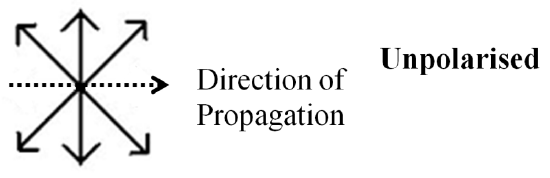
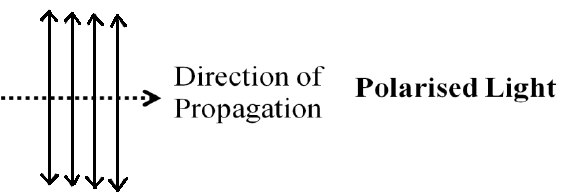
Distinguish between polarised and unpolarized light. Does the intensity of polarised light emitted by a Polaroid depend on its orientation? Explain briefly.
The vibrations in a beam of polarised light make an angle of 60° with the axis of the polaroid sheet. What percentage of light is transmitted through the sheet?
CBSE FOREIGN - SET 2 2016
Download our app for free and get started
If the direction of vibration of electric field vector/plane of vibration of electric field vector, does not change with time, the light is polarised. Whereas, if the direction of vibration of electric field vector/plane of vibration of electric field vector changes randomly in very short intervals of time/with time, the light is unpolarised.
Yes, it depends upon orientation of Polaroid because electric field vibrations, that are not in the direction of pass axis of Polaroid, are absorbed. Hence, intensity changes. $I=I_0\cos^2\theta$ = angle between vibrations in light and axis of polaroid sheet) $I=I_0\cos^260^\circ=\frac{I_0}{4}$ $\Longrightarrow\frac{I}{I_0}\times100=\frac{1}{4}\times100=25\text{%}$
Download our app
and get started for free
Experience the future of education. Simply download our apps or reach out to us for more information. Let's shape the future of learning together!No signup needed.*
A Young's double slit apparatus has slits separated by 0.28mm and a screen 48cm away from the slits. The whole apparatus is immersed in water and the slits are illuminated by the red light ($\lambda=700\text{nm}$ in vacuum). Find the fringe-width of the pattern formed on the screen.
The refractive index of a material is. What is the angle of refraction if the unpolarised light is incident on it at the polarising angle of the medium?
Answer the following question:
In a single slit diffraction experiment, the width of the slit is made double the original width. How does this affect the size and intensity of the central diffraction band?
White light is used in a Young's double slit experiment. Find the minimum order of the violet fringe $(\lambda=400\text{nm}),$ which overlaps with a red fringe $(\lambda=700\text{nm}).$
The short wavelength limit for the Lyman series of the hydrogen spectrum is 913·4 $\mathring{\text{A}}$ Calculate the short wavelength limit for Balmer series of the hydrogen spectrum.
When are two objects just resolved? Explain. How can the resolving power of a compound microscope be increased? Use relevant formula to support your answer.
A convex lens of diameter 8.0cm is used to focus a parallel beam of light of wavelength 620nm. If the light be focused at a distance of 20cm from the lens, what would be the radius of the central bright spot formed?