Question
Distinguish between: Proliferative Phase and Secretory Phase.

Answer

Proliferative PhaseSecretory Phase
1. Proliferative phase begins with the repair of endometrium.1. Secretory phase begins with ovulation.
2. Time required for proliferative phase is 5th to 13th day of menstrual cycle.2. Time required for secretory phase is 15th to 28th day of menstrual cycle.
3. Proliferative phase always ends with ovulation.3. Secretory phase ends with menstruation if egg is not fertilized. It continues further if egg is fertilized.
4. Proliferative phase is in uterus which coincides . with follicular phase in ovary during which there is formation of Graafian follicle.4. Secretory phase is in uterus which coincides with luteal phase in ovary during which there is formation of corpus luteum.
5. Proliferative phase is controlled by FSH from anterior pituitary.5. Secretory phase is controlled by LH from anterior pituitary.
6. Hormone estrogen is secreted during this phase.6. Hormone progesterone is secreted during this phase.
7. It causes the development of blood vessels and thickening of endometrium of uterus.7. It causes further thickening and secretory activity of the glands of endometrium of uterus.

Need a full question paper?

Generate a complete, print-ready paper with questions like this in minutes — across 16+ boards, with answer keys.

Start Generating Free

Similar questions

Indian region showsNumber
(1) Biosphere reserves(a) 448
(2) National parks(b) 14
(3) Wildlife sanctuaries(c) 90
Distinguish between : S.A. Node and A.V. Node.
Valves in heartLocation
(1) Bicuspid/Mitral valve(a) Opening of inferior vena cava
(2) Tricuspid valve(b) Opening of coronary sinus
(3) Eustachian valve(c) Left atrioventricular aperture
(4) Thebesian valve(d) Right atrioventricular aperture
Column AColumn B
(1) Tansley(a) 10% law
(2) C. Elton(b) Ecosystem services
(3) R. Lindemann(c) Ecological pyramids
(4) Millennium Ecosystem Assessment report(d) Ecosystem
Distinguish Between: Monohybrid cross and Dihybrid cross.
Distinguish Between: Homozygous and Heterozygous.
Read the following and answer any four questions from S(i) to S(v) given below:
Rajat is a student of biotechnology. His professor tells him that for transformation with recombinant DNA the bacterial cells must be made capable of taking up DNA as DNA do not pass through membrane. While doing experiment in the lab, Rajat noticed that bacterial cells were not taking up the foreign DNA even after treating it with sodium ion. He asked his professor, the reason behind this. His professor explained that he should check the valency and charge of the ion that he is using for the treatment.
  1. It is difficult for DNA to pass through the membrane as
  1. It is a hydrophilic molecule.
  2. It is a hydrophobic molecule.
  3. It is a circular molecule.
  4. It changes its shape when it comes in contact with host cell.
  1. What type of ions are used for DNA mediated gene transfers?
  1. Divalent anions.
  2. Divalent cations.
  3. Monovalent cations.
  4. Monovalent anions.
  1. rDNA stands for,
  1. reduced DNA
  2. red DNA
  3. recombinant DNA
  4. related DNA.
  1. Which of the following statements with regard to DNA is correct?
  1. DNA is a positively charged molecule having two polynucleotide chains.
  2. Nitrogen bases of two polynucleotide chain form complementary pairs, i.e., A opposite G and T opposite C.
  3. Backbone of DNA chain is built up of alternate deoxyribose sugar and phosphate group.
  4. Both (a) and (c)
  1. Assertion: Competent host is essential for transformation with rDNA.
Reason: Transfer of DNA in a prokaryotic cell is called transfection.
  1. Both assertion and reason are true and reason is the correct explanation of assertion.
  2. Both assertion and reason are true but reason is not the correct explanation of assertion.
  3. Assertion is true but reason is false.
  4. Both assertion and reason are false.
Read the following and answer any four questions from (i) to (v) given below:
In recombinant DNA technology, the fragments of DNA generated after cutting the DNA by restriction enzymes are separated according to their size or length by gel electrophoresis. Gel electrophoresis is performed in a gel matrix so that molecules of similar electric charges can be separated on the basis of size. Most commonly used matrix in gel electrophoresis is agarose. The fragments are separated under the influence of electric field. The separated DNA fragments can be seen only after staining the DNA with compound known as ethidium bromide (EtBr) followed by exposure to UV radiation as bright orange band.
  1. Gel electrophoresis is used for the separation of
  1. DNA only.
  2. DNA and RNA only.
  3. DNA and proteins only.
  4. DNA, RNA and proteins.
  1. Most commonly used matrix is _____ which is a ______ extracted from _______.
  1. (i) agarose (ii) polysaccharide (iii) sea weed
  2. (i) agarose (ii) protein (iii) sea weed
  3. (i) EtBr (ii) polysaccharide (iii) sea weed
  4. (i) EtBr (ii) protein (iii) bacteria
  1. A DNA molecule was treated with a restriction endonuclease and three fragments of size (i) 426kb, (ii) 129kb and (iii) 46kb were obtained. Identify the order in which these bands will arrange themselves in the gel plate after gel electrophoresis is completed. (Assuming that negative part of electrode is towards the well)
  1. (iii) → (ii) → (i)
  2. (i) → (ii) → (iii)
  3. (i) → (iii) → (ii)
  4. (iii) → (i) → (ii)
  1. Which of the following statements regarding gel electrophoresis is incorrect?
  1. Separated DNA fragments can be seen only after staining DNA with EtBr.
  2. DNA fragments are separated according to their size.
  3. Under the influence of electric field, positively charged molecules move towards the anode and negatively charged molecules move towards the cathode.
  4. None of these.
  1. The factor that will not affect the rate of DNA migration in gel electrophoresis is:
  1. Size of DNA molecule.
  2. Concentration of DNA.
  3. Voltage supplied.
  4. Concentration of the gel.
Read the following and answer any four questions from $7(i)$ to $7(v)$ given below:
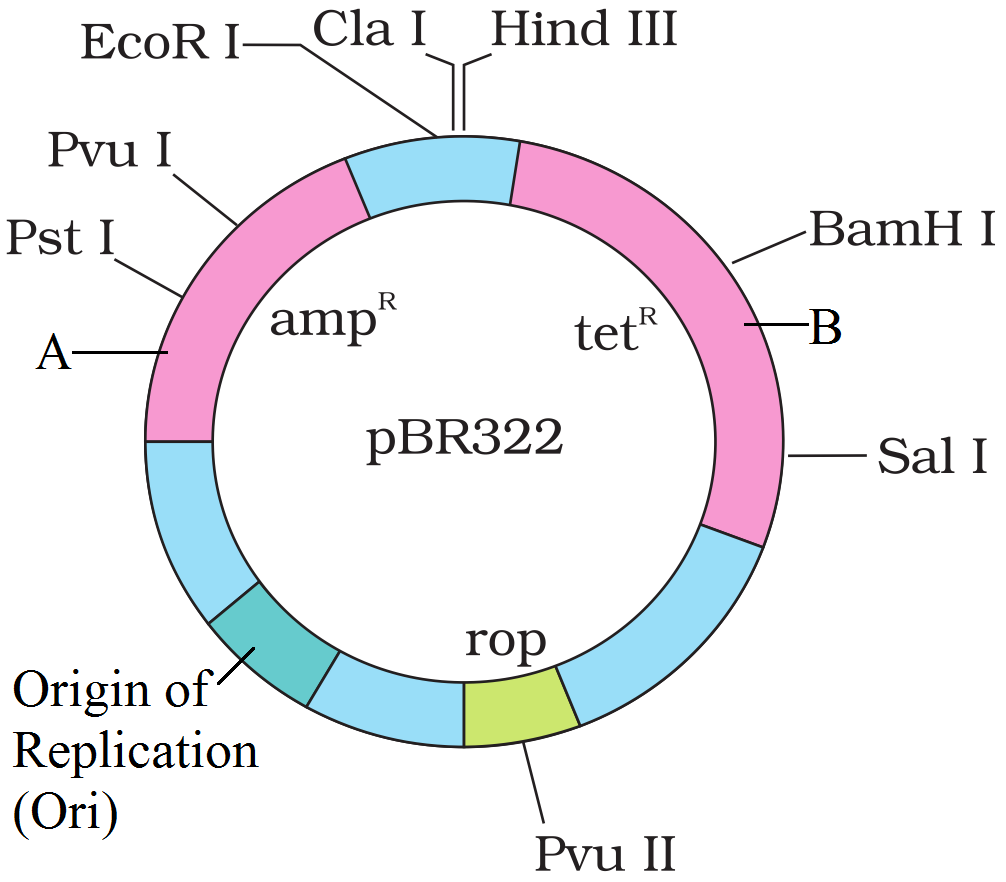
The vectors are DNA molecules that can carry a foreign DNA segment and replicate inside the host cell. Vectors may be plasmids, bacteriophages (viruses that attack bacteria), cosmids, yeast artificial chromosomes (YACs), Bacterial artificial chromosomes (BACs) and viruses. The most widely used, versatile, easily manipulated vector $pBR\ 322$ is an ideal plasmid vector. Features that are required to facilitate cloning into a vector includes origin of replication (Ori) which is a specific sequence of DNA bases responsible for initiating replication, selectable marker genes and cloning sites
  1. Pin $pBR\ 322$ denotes that it is a:
  1. plasmid
  2. prokaryote
  3. protist
  4. plant cell.
  1. Ori is a specific DNA sequence that help in.
  1. Attachment of primers.
  2. Initiation of replication.
  3. Extension of DNA base.
  4. Initiation of denaturation.
  1. A and B shown in the figure respectively indicates:
  1. Pvu II and Cla I.
  2. ROP and Sal I.
  3. amp$^R$ and tet$^R$.
  4. tet$^R$ and amp$^R$.
  1. Selectable markers in vector,
  1. Are responsible for replication.
  2. Help in selecting transformants from non-transform ants.
  3. Code for proteins involved in the replicating plasmids.
  4. Contain unique recognition sites.
  1. Plasmid vectors are:
  1. dsDNA molecule
  2. Extra-chromosomal
  3. Present in bacteria and yeast
  4. All of these.
Distinguish between: Asexual Reproduction – Sexual Reproduction