Question
Distinguish between straight line method and written down value method of calculating depreciation.

Answer

Basis of Difference
Straight Line Method
Written Down Value Method
Basis for calculation
Depreciation is calculated on the original cost of an asset.
Depreciation is calculated on the reducing balance, i.e., the book value of an asset.
Amount of depreciation
Equal amount is charged each year over the effective life of the asset.
Diminishing amount of depreciation (on the written down value of asset) is charged each year over the effective life of the asset.
Book value of asset
Book value of the asset becomes zero at the end of its effective life.
Book value of the asset can never be zero.
Suitability
It is suitable for the assets like patents, copyright, land and buildings, etc., which have lesser possibility of obsolescence and lesser repair charges.
It is suitable for assets that needs more repair in the later years like, plant and machinery, car, etc.
Effect of depreciation and repair on profit and loss account
Unequal effect over the life of the asset, as depreciation remains same over the years but repair cost increases in the later years.
Equal effect over the life of the asset, as depreciation cost is high and repairs are less in the initial years but in the latter years the repair costs increase and depreciation cost decreases.
Recognition under Income Tax Act
It is not recognised under the income tax act.
It is recognised under the income tax act.

Need a full question paper?

Generate a complete, print-ready paper with questions like this in minutes — across 16+ boards, with answer keys.
Start Generating Free

Similar questions

Explain the following terms:
  1. Revenue.
  2. Trade Payables.
  3. Fictitious Assets.
  4. Working Capital.
Working Capital = Current Assets - Current Liabilities.
Y started a business on $1^{\text {st }}$ April, $2013 $with a Capital of $₹ 2,00,000$ and a loan of $₹ 75,000$ from the bank. During the year, he had introduced additional capital of ₹ $60,000 $and had withdrawn ₹ $36,000 $for personal purposes. On $31^{\text {st }}$ March, $2014 $his assets were ₹ $3,80,000$. Find out his Capital as on $31^{\text {st }}$ March, $2014$ and profit earned during the year $2013-14$.
Darshan sold goods for ₹ 40,000 to Varun on 8.1.2017 and drew upon him a bill of exchange payable after two months. Varun accepted the bill and returned the same to Darshan. On the due date the bill was met by Varun. Record the necessary Journal entries in the books of Darshan and Varun in the following circumstances:
When the bill was retained by Darshan till the date of its maturity.
When Darshan immediately discounted the bill @6% p.a. with his bank.
When the bill was endorsed immediately by Darshan in favour of his creditor Suresh.
When three days before its maturity, the bill was sent by Darshan to his bank for collection.
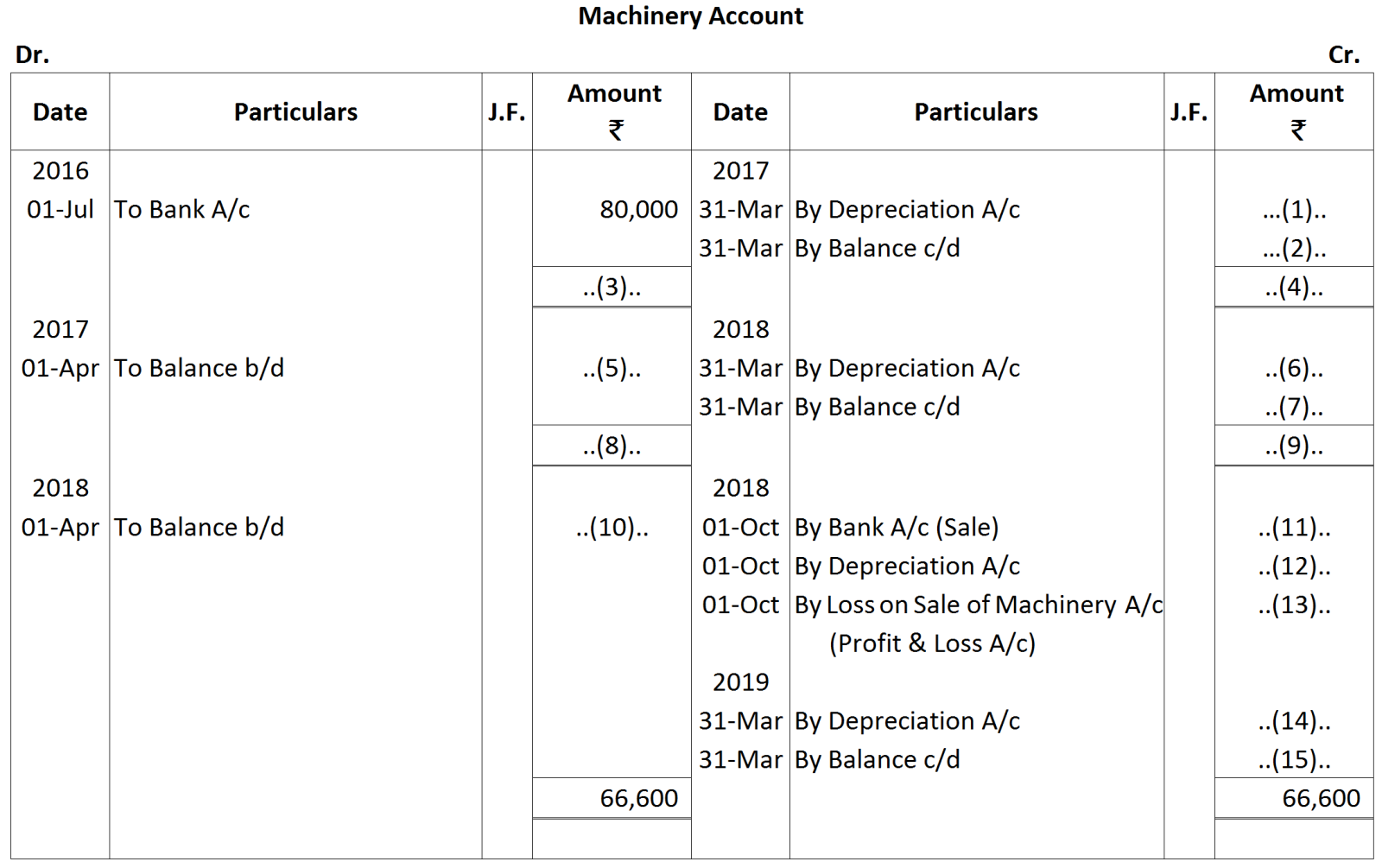
In the following Machinery Account, determine the missing values, if depreciation is to be charged @ 10% p.a. per Diminishing Balance Method. On 1st October, 2018, a part of the machinery valued in the books of the firm at ₹ 16,000 on 1st July, 2016 was sold for ₹ 10,000.
On 31st December, 2014, pass book shows debit balance of ₹ 7,500. From the following particulars, prepare a Bank Reconciliation Statement:
  1. Cheques paid in for collection amounted to ₹ 20,600 but cheques of ₹ 7,800 were credited on 3rd January, 2015.
  2. A cheque of ₹ 1,000 debited in cash book was omitted to be banked.
  3. Cheques of ₹ 7,800 were drawn on 27th December of which cheques of ₹ 2,400 were cashed upto 31st December.
  4. A cheque of ₹ 800 was banked and credited, but omitted to be recorded in cash book.
  5. Bank charged interest on Overdraft ₹ 650.
Journalise the following in the books of Hari.
Sohan informs Hari that Mohan's acceptance for ₹ 13,000, endorsed in favour of Sohan by Hari, has been dishonoured. Sohan agrees to accept ₹ 3,000 in cash and an acceptance at 3 months together with interest @ 12% per annum.
State any six reasons when the balance as per Cash Book will be higher than the balance as per Bank Pass Book or Bank Statement.
What is Sub-division of Journal?
Discuss the Accounting Convention based on the premise 'Do not anticipate profits but provide for all losses.'
Define the purpose of maintaining subsidiary journal.