Question
Distinguish between: Zona pellucida and Corona radiata.

Answer

Zona pellucidaCorona radiata
1. Zona pellucida is inner, thin and transparent layer surrounding the secondary oocyte.1. Corona radiata is the outer thick layer surrounding the secondary oocyte.
2. Zona pellucida is a non-cellular layer.2. Corona radiata is a cellular layer.
3. Zona pellucida is secreted by the ovum itself.3. Corona radiata is formed by follicular cells which are glued together by hyaluronic acid.
4. Zona pellucida is retained for more time after fertilization till the ovum gets implanted in the uterus.4. Corona radiata is retained till the ovum gets fertilized.
5. Zona pellucida is digested by zona lysine or acrosin at the time of fertilization.5. Corona radiata is digested by hyaluronidase enzyme at the time of fertilization.

Need a full question paper?

Generate a complete, print-ready paper with questions like this in minutes — across 16+ boards, with answer keys.

Start Generating Free

Similar questions

Column IColumn II
(1) Graafian follicle(a) Site of implantation
(2) Uterus(b) Birth canal
(3) Fallopian tube(c) Site of fertilization
(4) Vagina(d) Release of secondary oocyte
Water body ASalinity values B
(1) Streams(a) 340 ppt
(2) Indian Ocean(b) 5 ppt
(3) Hyper saline lagoon(c) 30-35 ppt
(4) Dead sea(d) 100 ppt
Read the following and answer any four questions from (i) to (v) given below:
Aditya went to his hometown located in countryside along with his parents during his summer vacations. His grand parents' house is surrounded by farmland from all sides. Lots of crops were growing nearby and Aditya was very excited to visit the crop fields. He seeked permission from his mother to play in farmland along with his friends and then went to play in the fields. On returning back he had running nose, watering eyes and continuous sneezing which was very frequent. TI1e symptoms worsened with time. Based on the above information, answer the following questions.
  1. What could be the possible reason for Aditya's condition?
  1. Allergy
  2. Infection
  3. Malnutrition
  4. Genetic disorder
  1. How can allergy be diagnosed in a person?
  1. Presence of large amount of IgE antibodies in the blood.
  2. Presence of large number of bacteria in the blood.
  3. Presence of bilirubin and bilirubin pigments in the stool.
  4. Presence of sickle shaped RBCs in the blood
  1. The symptoms which Aditya developed on account of being allergic are consequence of?
  1. Inflammation of membrane lining the nose and conjunctiva
  2. Swelling up of tissue surrounding bronchioles of lungs
  3. Dilation of all arteries so that large amount of fluid passes from blood to tissues.
  4. All of these.
  1. Name the type of allergy that Aditya developed.
  1. Asthma
  2. Anaphylaxis
  3. Hay fever
  4. Urticaria
  1. Assertion : Hay fever is the form of allergy due to pollens of grasses and other plants.
Reason : Hay fever symptoms are due to release of histamines and often respond well to treatment with antihistamines.
  1. Both assertion and reason are true, and reason is the correct explanation of assertion.
  2. Both assertion and reason are true, but reason is not the correct explanation of assertion.
  3. Assertion is true, but reason is false.
  4. Both assertion and reason are false.
Read the following and answer any four questions from (i) to (v) given below:
The pollen grains or microspores are the male reproductive bodies of a flower and are contained in the pollen sac or microsporangia. Each pollen grain consists of a single microscopic cell, possessing two coats: the exine and the in tine. The exine of a pollen grain is made of chemically stable material. Because of this, pollen grains are often very well preserved for thousands of years in soil and sediments.
  1. One of the most resistant biological material present in the exine of pollen grain is:
  1. Pectocellulose.
  2. Sporopollenin.
  3. Suberin.
  4. Cellulose.
  1. The exine possesses one or more thin places known as:
  1. Raphe.
  2. Germ pores.
  3. Hilum.
  4. Endothecium.
  1. What is the function of germ pore?
  1. Emergence of radicle.
  2. Absorption of water for seed germination.
  3. Initiation of pollen tube.
  4. All of these.
  1. What is the key advantage to the plant for having such strong pollen grain walls?
  1. It protects the vital genetic material in the pollen grain.
  2. It allows pollen to serve as a valuable fossil record for the study of ancient plants.
  3. It prevents the pollen tube from growing out before the pollen grain reaches the stigma of a compatible species.
  4. It gives weight to the pollen grain, allowing it to cling better to the body surfaces of insect pollinators.
  1. The number of germ pores in dicots and monocots respectively are:
  1. One and three.
  2. Three and two.
  3. Two and three.
  4. Three and one.
Read the following and answer any four questions from (i) to (v) given below:
Riya studies in 11 standard in a government school. She belongs to a backward family and her parents did not get her properly vaccinated according to immunisation programme. Once while playing in school playground she fell down due to weakness and developed high fever, headache and stiffness in her neck. identify the illness she could be suffering from and answer the following questions.
  1. The microbe responsible for Riya's illness could be.
  1. Vibrio cholerae
  2. Enterovirus
  3. Plasmodium
  4. Mycobacteriurn.
  1. Which vaccine, if administered earlier, would have saved Riya from the illness she unfortunately contracted?
  1. Salk vaccine
  2. MMR vaccine
  3. BCG vaccine
  4. Varicella vaccine
  1. The disease that Riya has contracted spreads through.
  1. Bite of an infected mosquito
  2. Bite of an infected dog
  3. Faecal oral route
  4. Direct contact with the infected person.
  1. Riya can spread her illness to other children through.
  1. Her faeces
  2. Direct contact
  3. Coughing and sneezing in open
  4. Vectors.
  1. Assertion: Polio produces inflammation of the nervous system.
Reason : Stiffness of the neck, paralysis of particular skeletal muscle, is an important symptom of polio.
  1. Both assertion and reason are true, and reason is the correct explanation of assertion.
  2. Both assertion and reason are true, but reason is not the correct explanation of assertion.
  3. Assertion is true, but reason is false.
  4. Both assertion and reason are false.
Highlight five areas where biotechnology has influenced our lives.
How is a transgenic tobacco plant protected against Meloidogyne incognita? Explain the procedure.
Read the following and answer any four questions from (i) to (v) given below:
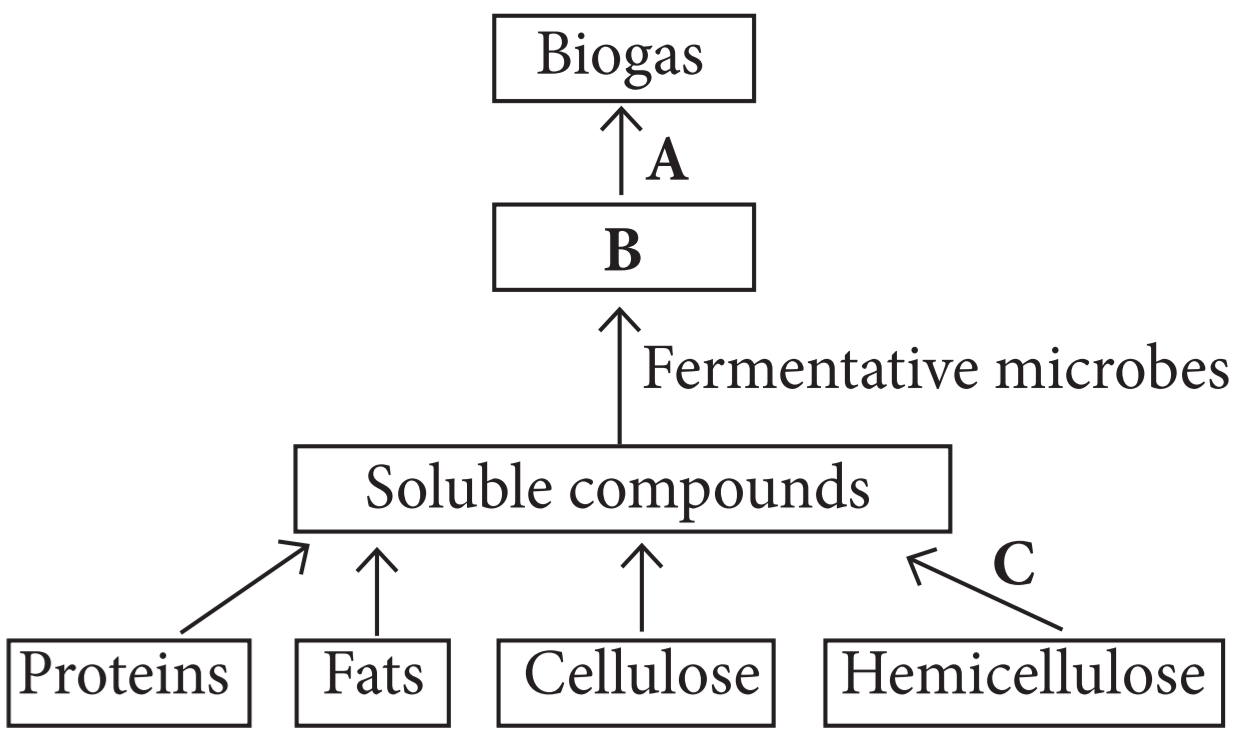
Villagers in a place near Chambur started planning to make power supply for agricultural purposes from cow dung. 'Tiley have started a biogas plant for the purpose. Study the flow chart for biogas production given below and answer the following questions.
  1. Biagas is composed of majorly:
  1. Methane, $CO_2$ and $O_2$​​​​​​​
  2. $CO_2, H_2S$ and H
  3. Methane, $CO_2​​​​​​​$
  4. $H_2S, H$ and $O_2​​​​​​​$
  1. In the given flow chart, 'A' denotes:
  1. Aerobic bacteria.
  2. Methanogenic bacteria.
  3. Cellulose degrading bacteria.
  4. Yeast and protozoa.
  1. What is represented by 'B' in the flow chart?
  1. Carbohydrates.
  2. Protein polymers.
  3. Organic acids.
  4. Fat globules.
  1. 'C' in the given flow chart causes:
  1. Aerobic breakdown of complex organic compounds.
  2. Anaerobic digestion of complex organic compounds.
  3. Fermentation of organic compounds.
  4. Fermentation of monomers.
  1. If 'A' is not added in the procedure.
  1. Methane will not be formed.
  2. $CO_2​​​​​​​$​​​​​​​ will not be formed.
  3. Organic compounds will not be converted to $H_2S$
  4. $O_2​​​​​​​$ will not be formed.
Read the following and answer any four questions from (i) to (v) given below:
Organism P has thick lips and tongue so that it can easily feed on the commonly available spiny plants. Organism Q has thick layer of insulating fat under the skin. It was strong hooves to walk steadily on steep surfaces and lives in burrows during winters. Organism R has bright colours and sticky pads on its fingers and toes. It lives on trees.
  1. Which of the following is correct habitat for organisms P regarding its adaptation?
  1. Grassland biome.
  2. Desert biome.
  3. Tropical rainforest.
  4. Tropical deciduous forest.
  1. Which of the following is correct match regarding organism Q and its habitat?
  1. Tundra - Polar bear.
  2. Tropical rain forest - Deer.
  3. Grassland - Bighorn sheep.
  4. Desert - Camel.
  1. Which of the following is incorrect regarding organisms R's habitat?
  1. The vegetation shows stratification.
  2. Epiphytic growth is rich.
  3. Standing crop is highest.
  4. Deep rooted shrubs are common due to abundant sunlight.
  1. The dominant plants in habitat where P lives could be:
  1. Opuntia
  2. Nymphaea
  3. Deodar
  4. both (a) and (c).
  1. Organisms P, Q and R respectively most likely occur in:
  1. F, B and A.
  2. C, A, E.
  3. A, F and C.
  4. B, D and A.
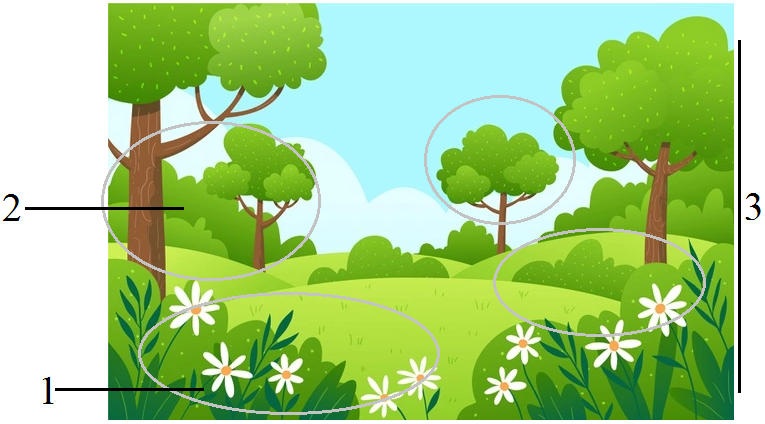
Read the following and answer any four questions from (i) to (v) given below: Ecosystem diversity is the variety of forms in the ecosystem due to diversity of niches, trophic levels and ecological processes like nutrient recycling, food webs, energy flow, etc. Study the given figure.
  1. Identify different types of diversity denoted by 1, 2 and 3 in the given figure.
 
1
2
3
(a)
Alpha diversity
Beta diversity
Gamma diversity
(b)
Gamma diversity
Alpha diversity
Beta diversity
(c)
Gamma diversity
Beta diversity
Alpha diversity
(d)
Beta diversity
Alpha diversity
Gamma diversity
  1. Alpha diversity is biodiversity present.
  1. Within conununity.
  2. Between conununities.
  3. In ranges of communities.
  4. None of these.
  1. Diversity represented by diversity of habitats over a total landscape area is:
  1. $\alpha-\text{diversity}$
  2. $\gamma-\text{diversity}$
  3. $\beta-\text{diversity}$
  4. $\delta-\text{diversity}$
  1. Concept of three types of ecological diversity was given by:
  1. Elton
  2. Odum
  3. Edward Wilson
  4. Whittaker
  1. The diversity of organisms sharing the same habitat or conununity is termed as:
  1. Alpha diversity.
  2. beta diversity.
  3. gamma diversity.
  4. delta diversity.