Question
Do all the gametes formed from a parent organism have the same genetic composition? Analyse the situation with the background of gametogenesis and provide suitable explanation.

Answer

Gametes do not have the same genetic composition formed by the parent organism.
Gametogenesis:
  • When male and female gametes are similar in appearance and it is not possible to differentiate between them, they are called homogametes or isogametes.
  • When the male and female gametes are morphologically distinct, they are called heterogametes.
  • Among heterogametes, the male reproductive unit is called antherozoid or sperm and female reproductive unit is called egg or ovum.
  • Unisexual male flowers bearing stamens are called staminate flowers.
  • Unisexual female flowers bearing pistils are called pistillate flowers.

Need a full question paper?

Generate a complete, print-ready paper with questions like this in minutes — across 16+ boards, with answer keys.
Start Generating Free

Similar questions

Justify the following statement in terms of ecosystem dynamics. “Nature tends to increase the gross primary productivity, while man tends to increase the net primary productivity”.
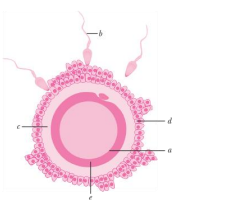
Study the illustration given and answer the questions that follow:

Draw a diagram of ‘b’ separately and label the parts:
  • That help its entry into ‘a’;
  • That carry genetic material;
  • That help in its movement.
‘There is a paternity dispute for a child’. Which technique can solve the problem. Discuss the principle involved.
When does oogenesis start in humans? Name the three hormones and their source, linked with oogenesis. How do they influence the process of oogenesis? Explain.
What is Pulse Polio Programme of Government of India? What is OPV? Why is it that India is yet to eradicate Polio?
Differentiate between an inbred line and a hybrid variety of crop. Explain the steps involved in the production of the hybrid variety.
Answer the following questions:
You are given tall pea plants with yellow seeds whose genotypes are unknown. How would you find the genotype of these plants? Explain with the help of cross.
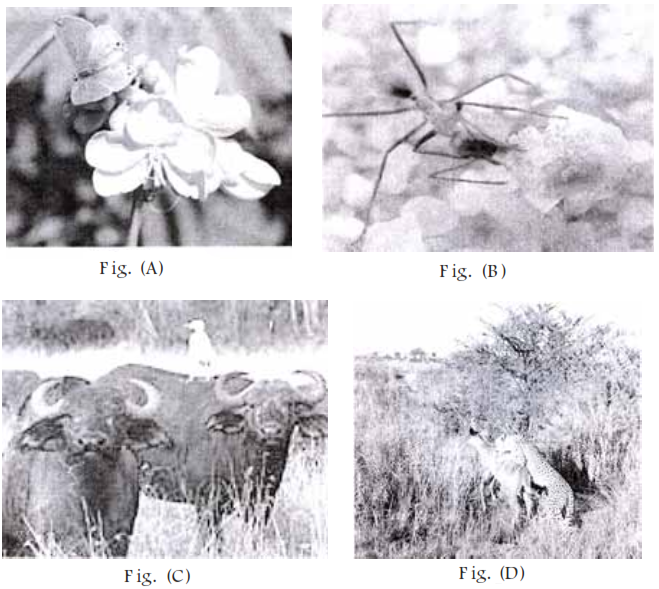
Observe the set of 4 figures A, B, C and D and, answer the following questions,
  1. Which one of the figures shows mutualism?
  2. What kind of association is shown in D?
  3. Name the organisms and the association in C.
  4. What role is the insect performing in B?
​​​​​​​
What essential features must be present in a cloning vector?
Write two differences between spermatogenesis and oogenesis.