Question
Do permeability and relative permeability have the same dimensions?

Answer

Magnetic permeability $(\mu)$ is the ratio of magnatic flux density (B) to the megnatising field strength (H).
$\mu=\frac{\text{B}}{\text{H}}$
In CGS (centimeter-gram-second) dimension of B and H is same. Hence, magnetic permeability is dimensionless. But in SI unit, dimension of B and H is not same. Thus, permeability is not dimensionless.
Relative ​permeability is defined as the ratio of magnetic permeability of any medium to the permeability of the vaccum. Hence, it is dimensionless. Thus, permeability and relative permeability have the same dimensions in CS system.

Need a full question paper?

Generate a complete, print-ready paper with questions like this in minutes — across 16+ boards, with answer keys.
Start Generating Free

Similar questions

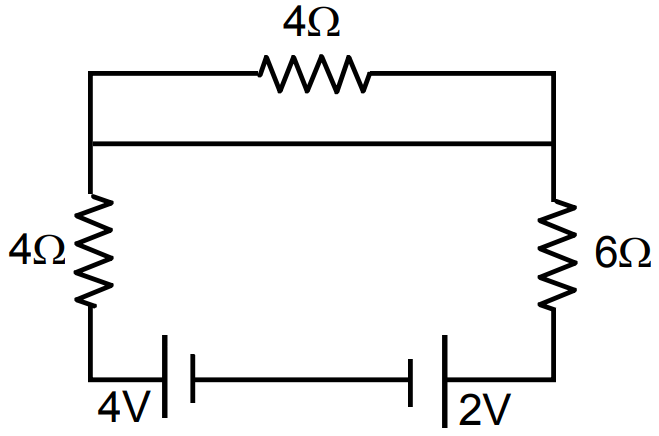
Find the currents through the three reaiators shown in figure.

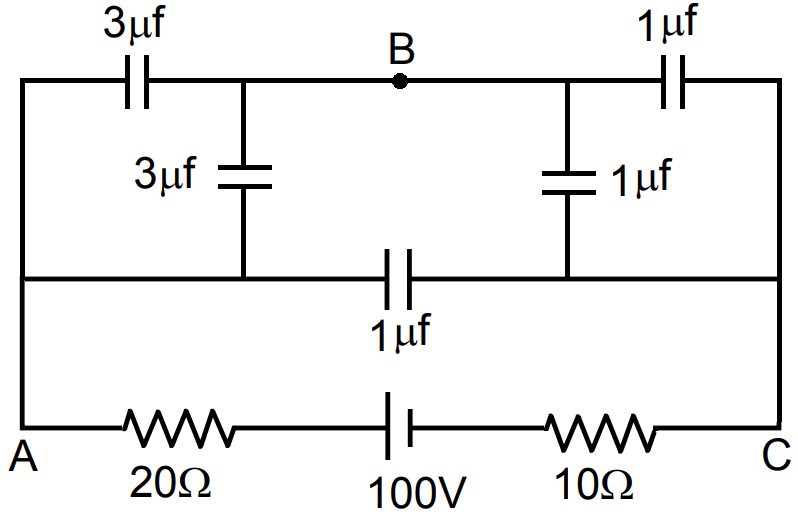
Find the potential difference between the points A and B and between the points B and C of the figure. in steady state.

A bullet of mass 20g moving horizontally at a speed of 300m/s is fired into a wooden block of mass 500g suspended by a long string. The bullet crosses the block and emerges on the other side. If the centre of mass of the block rises through a height of 20.0cm, find the speed of the bullet as it emerges from the block.
Which one of the following cannot emit radiation and why? Excited nucleus, excited electron.
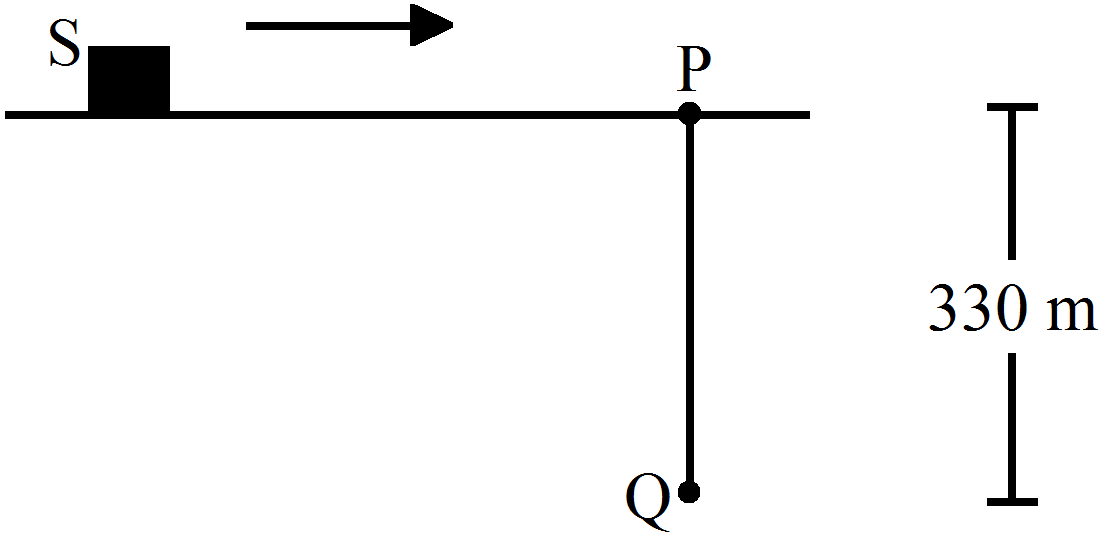
Figure, shows a source of sound moving along the X-axis at a speed of 22m/s continuously emitting a sound of frequency 2.0kHz which travels s in air at a speed of 330m/s. A listener Q stands on the Y-axis at a distance of 330 m from the origin. At t = 0, the source crosses the origin P.

  1. When does the sound emitted from the source at P reach the listener Q?
  2. What will be the frequency heard by the listener at this instant?
  3. Where will the source be at this instant?


Find an expression for the electric field strength at a distant point situated (i) on the axis and (ii) along the equatorial line of an electric dipole.

OR

Derive an expression for the electric field intensity at a point on the equatorial line of an electric dipole of dipole moment $\vec{\text{p}}$ and length 2a. What is the direction of this field?
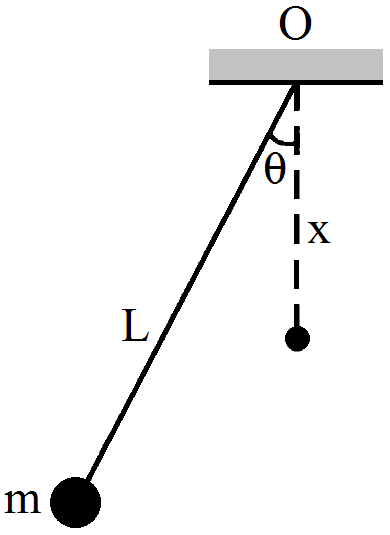
A simple pendulum of length L having a bob of mass m is deflected from its rest position by an angle $\theta$ and released (figure). The string hits a peg which is fixed at a distance x below the point of suspension and the bob starts going in a circle centred at the peg.

  1. Assuming that initially the bob has a height less than the peg, show that the maximum height reached by the bob equals its initial height.
  2. If the pendulum is released with $\theta=90^\circ$ and $\text{x}=\frac{\text{L}}{2}$ find the maximum height reached by the bob above its lowest position before the string becomes slack.
  3. Find the minimum value of $\frac{\text{x}}{\text{L}}$ for which the bob goes in a complete circle about the peg when the pendulum is released from $\theta=90^\circ.$

A sound wave of frequency 100Hz is travelling in air. The speed of sound in air is 350m/s.
  1. By how much is the phase changed at a given point in 2.5ms?
  2. What is the phase difference at a given instant between two points separated by a distance of 10.0cm along the direction of propagation?
Answer the following questions:
  1. Explain qualitatively on the basis of domain picture the irreversibility in the magnetisation curve of a ferromagnet.
  2. The hysteresis loop of a soft iron piece has a much smaller area than that of a carbon steel piece. If the material is to go through repeated cycles of magnetisation, which piece will dissipate greater heat energy?
  3. ‘A system displaying a hysteresis loop such as a ferromagnet, is a device for storing memory?’ Explain the meaning of this statement.
  4. What kind of ferromagnetic material is used for coating magnetic tapes in a cassette player, or for building ‘memory stores’ in a modern computer?
  5. A certain region of space is to be shielded from magnetic fields. Suggest a method.
A beam of monochromatic light of wavelength $\lambda$ ejects photoelectrons from a cesium surface $\big(\Phi=1.9\text{eV}\big).$ These photoelectrons are made to collide with hydrogen atoms in ground state. Find the maximum value of $\lambda$ for which (a) hydrogen atoms may be ionized, (b) hydrogen atoms may get excited from the ground state to the first excited state and (c) the excited hydrogen atoms may emit visible light.