Question
Do permeability and relative permeability have the same dimensions?

Answer

Magnetic permeability $(\mu)$ is the ratio of magnatic flux density (B) to the megnatising field strength (H).
$\mu=\frac{\text{B}}{\text{H}}$
In CGS (centimeter-gram-second) dimension of B and H is same. Hence, magnetic permeability is dimensionless. But in SI unit, dimension of B and H is not same. Thus, permeability is not dimensionless.
Relative ​permeability is defined as the ratio of magnetic permeability of any medium to the permeability of the vaccum. Hence, it is dimensionless. Thus, permeability and relative permeability have the same dimensions in CS system.

Need a full question paper?

Generate a complete, print-ready paper with questions like this in minutes — across 16+ boards, with answer keys.
Start Generating Free

Similar questions

A town has a population of 1 million. The average electric power needed per person is 300W. A reactor is to be designed to supply power to this town. The efficiency with which thermal power is converted into electric power is aimed at 25%.
  1. Assuming 200MeV to thermal energy to come from each fission event on an average, find the number of events that should take place every day.
  2. Assuming the fission to take place largely through $^{235}U,$ at what rate will the amount of $^{235}U$ decrease? Express your answer in kg per day.
  3. Assuming that uranium enriched to 3% in $^{235}U$ will be used, how much uranium is needed per month (30 days)?
Define the term magnetic moment of a current loop. Write the expression for the magnetic moment when an electron revolves at a speed v around an orbit of radius ‘r’ in hydrogen atom.
A calorimeter contains 50g of water at $50^\circ C$. The temperature falls to $45^\circ C$ in 10 minutes. When the calorimeter contains 100g of water·at $50^\circ 0$, it takes 18 minutes for the temperature to become $45^\circ C$. Find the water equivalent of the calorimeter.
A particle A having a charge of $2.0 \times 10^{-6}C$ and a mass of 100g is placed at the bottom of a smooth inclined plane of inclination 30°. Where should another particle B, having same charge and mass, be placed on the incline so that it may remain in equilibrium?
Explain motion of a charged particle in a magnetic field in the following circumstances :

(a) When a positively charged particle ( $+q$ ) enters perpendicularly in a uniform magnetic field (B) with velocity $v$.

(b) When a positively charged particle enters a magnetic field (B) at an angle $\theta\left(0^{\circ}<\theta<90^{\circ}\right)$.
Consider a neutron and an electron bound to each other due to gravitational force. Assuming Bohr's quantization rule for angular momentum to be valid in this case, derive an expression for the energy of the neutron-electron system.
A parallel beam of white light is incident normally on a water film $1.0 \times 10^{-4}$cm thick. Find the wavelength in the visible range (400nm - 700nm) which are strongly transmitted by the film. Refractive index of water = 1.33.
Two waves, each having a frequency of 100Hz and a wavelength of 2.0cm, are travelling in the same direction on a string. What is the phase difference between the waves,
  1. If the second wave was produced 0.015s later than the first one at the same place.
  2. If the two waves were produced at the same instant but the first one was produced a distance 4.0cm behind the second one?
  3. If each of the waves has an amplitude of 2.0mm, what would be the amplitudes of the resultant waves in part (a) and (b)?
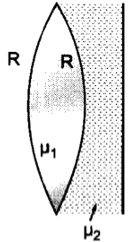
A biconvex lens with its two faces of equal radius of curvature $R$ is made of a transparent medium of refractive index $\mu_1$. It is kept in contact with a medium of refractive index $\mu_2$ as shown in the figure.
Image

$a.$ Find the equivalent focal length of the combination.
$b.$ Obtain the condition when this combination acts as a diverging lens.
$c.$ Draw the ray diagram for the case $\mu_1>\frac{\left(\mu_2+1\right)}{2}$, when the object is kept far away from the lens. Point out the nature of the image formed by the system.
A thin lens made of a material of refractive index $\mu_2$ has a medium of refractive index $\mu_1$ on one side and a medium of refractive index $\mu_3$ on the other side. The lens is biconvex and the two radii of curvature have equal magnitude R. A beam of light travelling parallel to the principal axis is incident on the lens. Where will the image be formed if the beam is incident from:
  1. The medium $\mu_1$
  2. From the medium $\mu_3?$