Question
Does a nucleus lose mass when it suffers gamma decay?

Answer

Gamma rays consist of photons that are produced when a nucleus from its excited state comes to its ground state releasing energy. Since gamma rays are chargeless and massless particles, the nucleus does not suffer any loss in mass during the gamma decay.

Need a full question paper?

Generate a complete, print-ready paper with questions like this in minutes — across 16+ boards, with answer keys.
Start Generating Free

Similar questions

ls it always true that for two sources of equal intensity, the number of photons emitted in a given time are equal?
An electric dipole with dipole moment 4 × 10⁻⁹ Cm is aligned at 30° with the direction of a uniform electric field of magnitude 5 × 10⁴ NC-1. Calculate the magnitude of the torque acting on the dipole.
Derive an expression for the axial magnetic field of a finite solenoid of length 2l and radius r carrying current I. Under what condition does the field become equivalent to that produced by a bar magnet?
A proton and an alpha particle are accelerated through the same potential. Which one of the two has (i) greater value of de-Broglie wavelength associated with it, and (ii) less kinetic energy? Justify your answers.
A wire of length l carries a current i long the x-axis. A magnetic field exists, which is given $\overrightarrow{\text{B}}=\text{B}_0(\overrightarrow{\text{i}}+\overrightarrow{\text{j}}+\overrightarrow{\text{k}})\text{T}.$ Find the magnitude of the magnetic force acting on the wire.
Consider a 10cm long piece of a wire which carries a current of 10A. Find the magnitude of the magnetic field due to the piece at a point which makes an equilateral triangle with the ends of the piece.
Suppose, one wishes to construct a 1.0 farad capacitor using circular discs. If the separation between the discs be kept at 1.0mm, what would be the radius of the discs?
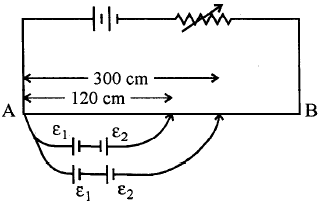
In the figure a long uniform potentiometer wireABis having a constant potential gradient along its length. The null points for the two primary cells of emfs $\varepsilon_{1}$ and $\varepsilon_{2}$
connected in the manner shown are obtained at a distance of 120 cm and 300 cm from the end A. Find (i) $\varepsilon_{1}$/$\varepsilon_{2}$and (ii) position of null point for the cell $\varepsilon_{1}$. How is the sensitivity of a potentiometer increased?

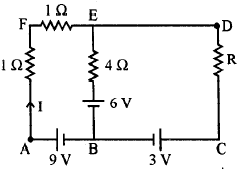
Using Kirchoffs rules determine the value of unknown resistance R in the circuit so that no current flows through 4 $\Omega$ resistance.Also find the potential difference between A and D.

(i) If $f=0.5 m$ for a glass lens, what is the power of the lens? (ii) The radii of curvature of the faces of a double convex lens are $10 cm$ and $15 cm$. Its focal length is $12 cm$. What is the refractive index of glass? (iii) A convex lens has $20 cm$ focal length in air. What is focal length in water? (Refractive index of air-water $=1.33$, refractive index for air-glass $=1.5$.)
Write Gauss's law and explain.