Questions · Page 1 of 2

3 Marks Question

🎯

Test yourself on this topic

50 questions · timed · auto-graded

Question 13 Marks
The normal activity of living carbon-containing matter is found to be about 15 decays per minute for every gram of carbon. This activity arises from the small proportion of radioactive $ ^{14}_6\text{C}$ present with the stable carbon isotope $^{12}_6\text{C}.$ When the organism is dead, its interaction with the atmosphere (which maintains the above equilibrium activity) ceases and its activity begins to drop. From the known half-life (5730 years) of $^{14}_6\text{C },$ and the measured activity, the age of the specimen can be approximately estimated. This is the principle of  $^{14}_6\text{C}$ datingused in archaeology. Suppose a specimen from Mohenjodaro gives an activity of 9 decays per minute per gram of carbon. Estimate the approximate age of the Indus-Valley civilisation.
Answer
Decay rate of living carbon-containing matter, R = 15 decay/min
Let N be the number of radioactive atoms present in a normal carbon- containing matter.
Half life of $^{14}_6\text{C },\ \text{T}_{1/2}=5730\text{ Years}$
The decay rate of the specimen obtained from the Mohenjodaro site:
R' = 9 decays/min
Let N' be the number of radioactive atoms present in the specimen during the Mohenjodaro period.
Therefore, we can relate the decay constant, Aand time. t as:
$\frac{\text{N}}{\text{N}'}=\frac{\text{R}}{\text{R}'}=\text{e}^{-\lambda\text{t}}$
$\text{e}^{-\lambda\text{t}}=\frac{9}{15}=\frac{3}{5}$
$-\lambda\text{t}=\log_\text{e}\frac{3}{5}=-0.5108$
$\therefore\ \text{t}=\frac{0.5108}{\lambda}$
But $\lambda=\frac{0.693}{\text{T}_{1/2}}=\frac{0.693}{5730}$
$\therefore\ \text{t}=\frac{0.5108}{\frac{0.693}{5730}}=4223.5\text{ Years}$
Hence, the approximate age of the Indus-Valley civilisation is 4223.5 years.
View full question & answer
Question 23 Marks
The radionuclide 11C decays according to
$^{11}_{6}\text{C}\rightarrow^{11}_{5}\text{B}+\text{e}^{+}+\text{v}:\ \text{T}_{1/2}=20.3 \text{ min}$
The maximum energy of the emitted positron is 0.960 MeV.
Given the mass values:
$\text{m}(^{11}_{6})=10=11.011434\text{ u and m}(^{11}_{6}\text{B})=11.009305\text {u}.$
calculate Q and compare it with the maximum energy of the positron emitted.
Answer
For the given reaction, mass defect is,
$\Delta\text{m}=[\text{m}(^{11}_{6}-6\text{m}_\text{e})]-[\text{m}(^{11}_{5}\text{B})-5\text{ m}_\text{e}+\text{m}_\text{e}]$
$=\text{m}(^{11}_{6}\text{C})-\text{m}(^{11}_{5}\text{B})-2\text{m}_\text{e}$
= 11.011434 u -11.009305 u - 2 × 0.000548 u
= 0.001033 u
Now, Q-value is,
Q = 0.001033 × 931.5 MeV
= 0.962 MeV
which, is the maximum energy of the positron.
We have,
$\text{Q}=\text{E}_\text{d}+\text{E}_\text{e}+\text{E}_\text{v}$
The daughter nucleus is too heavy compared to eand v. So, it carries negligible energy $(\text{E}_\text{d}\approx0).$ If the kinetic energy (Ev) carried by the neutrino is minimum (i.e., zero), the positron carries maximum energy, and this is practically all energy Q.
Hence, maximum $\text{E}_\text{e}\approx\text{Q}.$
View full question & answer
Question 33 Marks
In a periodic table the average atomic mass of magnesium is given as 24.312 u. The average value is based on their relative natural abundance on earth. The three isotopes and their masses are $^{24}_{12}\text{Mg }23.98504\text{u}),^{25}_{12}\text{Mg }(24.98584\text{u})\text{ and }^{26}_{12}\text{Mg }(25.98259\text{u}).$ The natural abundance of $^{24}_{12}\text{Mg}\text{ is }78.99\%$ by mass. Calculate the abundances of other two isotopes.
Answer
Average atomic mass of magnesium, m = 24.312 u
mass of magnesium isotope $^{24}_{12}\text{Mg },\text{m}_1=23.98504\text{ u}$ 
mass of magnesium isotope $^{25}_{12}\text{Mg },\text{m}_2=24.98584\text{ u}$
mass of magnesium isotope $^{26}_{12}\text{Mg },\text{m}_3=25.98259\text{ u}$
Abundance of $^{24}_{12}\text{Mg },\eta_1=78.99\%$
Abundance of $^{25}_{12}\text{Mg },\eta_2=\text{x}\%$
Hence, abundance of $^{26}_{12}\text{Mg },\eta_3=100-\text{x}-78.99\%=(21.01-\text{x})\%$
We have the relation for the average atomic mass as:
$\text{m}=\frac{\text{m}_1\eta_1+\text{m}_2\eta_2+\text{m}_3\eta_3}{\eta_1+\eta_2+\eta_3}$
$24.312=\frac{23.98504\times78.99+24.98584\times\text{x}+25.98259\times(21.01=\text{ x})}{100}$
2431.2 = 1894.5783096 + 24.98584x + 545.8942159 = 25.98259x
0.99675x = 9.2725255
And $\therefore\ \text{x}\approx9.3\%$
Hence, the abundance of $^{25}_{12}\text{Mg}$ is 9.3% and that of $^{26}_{12}\text{Mg}$ is 11.71%.
View full question & answer
Question 43 Marks
A 1000 MW fission reactor consumes half of its fuel in 5.00 y. How much $^{235}_{92}\text{U}$ did it contain initially? Assume that the reactor operates 80% of the time, that all the energy generated arises from the fission of $^{235}_{92}\text{U}$ and that this nuclide is consumed only by the fission process.
Answer
Given,
Power of reactor = 1000 MW = 103 MW
= 109 W
= 109 Js-1
Energy generated by reactor in 5 Years = 5 × 365 × 24 × 60 × 60 × 109 J
Average energy generated = 200 MeV
= 200 × 1.6 × 10-13 J
Number of fission taking place or number of $\text{U}^{235}$ nuclei required,
$=\frac{5\times365\times24\times60\times60\times10^9}{200\times1.6\times10^{-13}}$
= 8.2125 × 1026 × 6
= 49.275 × 1026
Mass of 6.023 × 1023 nuclei of U = 235 gm = 235 × 10-3 kg
Mass of 8.2125 × 1026 nuclei of U,
$=\frac{235\times10^{-3}}{6.023\times10^{23}}\times6\times8.2125\times10^{26}$
= 1932 kg
$\frac{1}{2}$ of fuel = 1932 kg
Tatal fuel = 3864 kg.
View full question & answer
Question 53 Marks
From the relation $\text{R}=\text{R}_0\text{A}^{1/3}$ where R0 is a constant and A is the mass number of a nucleus, show that the nuclear matter density is nearly constant (i.e. independent of A).
Answer
we have the expression for nuclear radius as:
$\text{R}=\text{R}_0\text{A}^{1/3}$
Where,
R0 = Constant.
A = Mass number of the nucleus
Nuclear matter density, $\rho=\frac{\text{Mass of the nucleus}}{\text{Volume of the nucleus}}$
Let m be the average mass of the nucleus.
Hence, mass of the nucleus = mA
$\therefore\ \rho\frac{\text{mA}}{\frac{4}{3}\pi\text{R}^3}=\frac{3\text{mA}}{4\pi\Big(\text{R}_0\text{A}^{\frac{1}{3}}\Big)^3}=\frac{3\text{mA}}{4\pi\text{R}^3_0\text{A}}=\frac{3\text{m}}{4\pi\text{R}^3_0}$
Hence, the nuclear matter density is Independent of A. It is nearly constant.
View full question & answer
Question 63 Marks
The nucleus $^{23}_{10}\text{Ne}$ decays by $\beta$ emission. Write down the $\beta$-decay equation and determine the maximum kinetic energy of the electrons emitted. Given that:
$\text{m}(^{23}_{10}\text{Ne})=22.994466\text{ u}.$
$\text{m}(^{23}_{10}\text{Na})=22.089770\text{ u}.$
Answer
The $\beta$-decay of $^{23}_{10}\text{Ne}$ may be represented as:
$^{23}_{10}\text{Ne}\rightarrow\ ^{23}_{11}\text{Na }\ -\ ^{0}_{-1}\text{e }\ +\ \overline{\text{v}}\ +\ \text{Q}$
Ignoring the rest mass of antineutrino $(\overline{\text{v}})$ and electron, we get Mass defect,
$\Delta\text{m}=\text{m}(^{23}_{10}\text{Ne})-\text{m}(^{23}_{11}\text{Na})$
= 22.994466 - 22.989770
= 0.004696 u
$\therefore\ \text{Q}=0.004696\times931\text{ MeV}=4.372\text{ MeV}.$
This energy of 4.3792 MeV, is shared by e- and $\overline{\text{v}}$ pair because, $^{23}_{11}\text{Na}$ is very massive.
The maximum K.E. of e- = 4.372 MeV, when energy carried by $\overline{\text{v}}$ is zero.
View full question & answer
Question 73 Marks
Obtain approximately the ratio of the nuclear radii of the gold isotope $^{197}_{79}\text{Au}$ and the silver isotope $^{107}_{47}\text{Ag}.$
Answer
Using the relation between the radius of nucleus and atomic mass,
$\text{R}\approx\text{ A}^{1/3}$
Atomic mass of gold, A1 = 197
Atomic mass of silver, A2 = 107
$\therefore\ \frac{\text{R}_1}{\text{R}2}=\Big(\frac{\text{A}_1}{\text{A}_2}\Big)^{1/3}$
$=\Big(\frac{197}{107}\Big)^{1/3}=\big(1.84\big)^{1/3}$
Now, taking log on both sides
$\Rightarrow\ \log_{10}\Big(\frac{\text{R}_1}{\text{R}_2}\Big)=\log_{10}\big(1.84\big)^{1/3}$
$\Rightarrow\ \log_{10}\Big(\frac{\text{R}_1}{\text{R}_2}\Big)=\frac{1}{3}\log_{10}\big(1.84\big)$
$=\frac{1}{3}\times0.2648$
$=0.08827$
$\Rightarrow\ \frac{\text{R}_1}{\text{R}_2}=\text{ antilog}(0.08827)$
= 1.23, which is the required ratio of the nucleii.
View full question & answer
Question 83 Marks
Write nuclear reaction equations for
  1. $\alpha\text{-decay of }\ ^{226}_{88}\text{Ra}$
  2. $\alpha-\text{decay of }\ ^{226}_{94}\text{Pu}$
  3. $\beta\text{-decay of }\ ^{32}_{15}\text{P}$
  4. $\beta\text{-decay of }\ ^{210}_{83}\text{Bi}$
  5. $\beta\text{-decay of }\ ^{11}_{6}\text{C}$
  6. $\beta^+\text{-decay of }\ ^{97}_{43}\text{Tc}$
  7. $\text{Electron capture of }\ ^{120}_{54}\text{Xe}$
Answer
a is a nucleus of helium $(_2\text{He}^4)$ and $\beta$ is an electron $(\text{e}^{-}\text{for}\beta\text{ and }\text{e}^{+}\text{for}\beta^{+}).$ In every adecay,there is a loss of 2 protons and 4 neutrons. $\beta^{+}$ -decav, there is a loss of 1 proton and a neutrino isemitted from the nucleus. In every $\beta^{-}$ -decay, there is a gain of 1 proton and an antineutrino is emitted from the nucleus.
For the given cases, the various nuclear reactions can be written as:
  1. $_{88}\text{Ra}^{226}\xrightarrow{\ \ \ \ \ \ \ } \ _{86}\text{Rn}^{222}+_2\text{He}^4$
  2. $^{242}_{94}\xrightarrow{\ \ \ \ \ \ \ } \ ^{86}_{92}\text{U }+\ ^4_2\text{He}$
  3. $^{32}_{15}\text{P}\xrightarrow{\ \ \ \ \ \ \ } \ ^{32}_{16}\text{S }+\ \text{e}^{-}+ _\text{V}^{-}$
  4. $^{210}_{83}\text{B}\xrightarrow{\ \ \ \ \ \ \ } \ ^{210}_{84}\text{PO }+\ \text{e}^{-}+\ _\text{V}^{-}$
  5. $^{11}_{6}\text{C}\xrightarrow{\ \ \ \ \ \ \ } \ ^{11}_{5}\text{B }+\ \text{e}^{+}+\ \text{V}$
  6. $^{97}_{43}\text{Tc}\xrightarrow{\ \ \ \ \ \ \ } \ ^{97}_{42}\text{MO }+\ \text{e}^{+}+ \text{V}$
  7. $^{120}_{54}\text{Xe}+\text{e}^{+}\xrightarrow{\ \ \ \ \ \ \ } \ ^{120}_{53}\text{I }+\ \text{V}$
View full question & answer
Question 93 Marks
Calculate the height of the potential barrier for a head on collision of two deuterons. (Hint: The height of the potential barrier is given by the Coulomb repulsion between the two deuterons when they just touch each other. Assume that they can be taken as hard spheres of radius 2.0 fm.)
Answer
Suppose, the two particles are fired at each other with the same kinetic energy K.E, so that they are brought to rest by their mutual Coulomb repulsion when they are just touching each other.
Distance between the centres of two deutrons, during head on collision, r = 2 × radius
Therefore,
r = 4 fm = 4 × 10-15 m
Charge on each deutron, e = 1.6 × 10-19 C
Now, potential energy $=\frac{\text{e}^2}{4\pi\varepsilon_0\text{r}}$
$=\frac{9\times10^9(1.6\times10^{-19})^2}{4\times10^{-15}}$
$=\frac{9\times1.6\times1.6\times10^{-14}}{4\times1.6\times10^{-16}}\text{ keV}$
= 360 keV
Now, since, potential energy is equal to twice the kinetic energy of deutron.
This implies,
K.E of each deutron = $\frac{360}{2}=180\text{ keV}$
which is a measure of the height of the coulomb barrier.
View full question & answer
Question 103 Marks
Obtain the binding energy (in MeV) of a nitrogen nucleus  $(^{14}_7\text{N})$, given m $(^{14}_7\text{N})$ = 14.010307 u
Answer
Atomic mass of nitrogen $\big(_7\text{N}^{14}\big)$, m = 14.00307 u
A nucleus of nitrogen $_7\text{N}^{14}$ contains 7 protons and 7 neutrons.
Hence, the mass defect of this nucleus, $\Delta\text{m}=7\text{m}_\text{H}+7\text{m}_\text{n}-\text{m}$
Where,
Mass of a proton, mH = 1.007825 u
Mass of a neutron, mn = 1.008665 u
$\therefore\ \Delta\text{m}=7\times1.007825+7\times1.008665-14.00307$
= 7.054775 + 7.06055 - 14.00307
= 0.11236 u
But 1 u = 931.5 MeV/c2
$\therefore\ \Delta\text{m}=0.11236\times931.5\text{Me/Vc}^2$
Hence, the binding energy of the nucleus is given as
$\text{E}_\text{b}=\Delta\text{Mc}^2$
Where,
c = Speed of light
$\therefore\ \text{E}_\text{b}=0.11236\times931.5\Big(\frac{\text{MeV}}{\text{c}^2}\Big)\times\text{c}^2$
= 104.66334 MeV
Hence, the binding energy of a nitrogen nucleus is 104.66334 MeV.
View full question & answer
Question 113 Marks
The fission properties of $^{239}_{94}\text{Pu}$ are very similar to those of $^{235}_{92}\text{U}.$ The average energy released per fission is 180 MeV. How much energy, in MeV, is released if all the atoms in 1 kg of pure $^{239}_{94}\text{Pu}$ undergo fission?
Answer
Given,
Average amount of energy released per fission, $^{239}_{94}\text{Pu}=180=\text{MeV}$
Quantity of fissionable material = 1 kg
In 239 gm Pu, number of fissionable atom or nuclei = 6.023 × 1023
In 1 g of Pu, number of fissionable atom or nuclei $=\frac{6.023\times10^{23}}{239}$
In 1000 gm of Pu, number of fissionable atom or nuclei,
$=\frac{6.023\times10^{23}}{239}\times1000$
$=25.2\times10^{23}$
Therefore,
Total energy released in fission of 25.2 × 1023 Pu nucleus or in fission of 1 kg pure Pu is,
= 180 × 25.2 × 1023
= 4536 × 1023 MeV
= 4.5 × 1026 MeV.
View full question & answer
Question 123 Marks
Boron has two stable isotopes, $^{10}_5\text{B }\text{ and }\ ^{11}_5\text{B}.$ Their respective masses are 10.01294 u and 11.00931 u, and the atomic mass of boron is 10.811 u. Find the abundances of $^{10}_5\text{B }\text{ and }\ ^{11}_5\text{B}.$
Answer
Mass of boron isotope $^{10}_5\text{B },\ \text{m}_1=10.01294\text{ u}$
Mass of boron isotope $^{11}_5\text{B },\ \text{m}_2=11.00931\text{ u}$
Abundance of $^{10}_5\text{B },\ \text{n}_1=\text{x}\%$
Abundance of $^{11}_5\text{B },\ \text{n}_2=(100-\text{x})\%$
Atomic mass of boron, m = 10.811 u
The atomic mass of boron atom is given as:
$\text{m}=\frac{\text{m}_1\text{n}_1+\text{m}_2\text{n}_2}{\text{n}_1+\text{n}_2}$
$10.811=\frac{10.01294\times\text{ x }+11.00931\times(100-\text{ x})}{\text{ x }+100-\text{ x}}$
1081.11 = 10.01294x + 1100.9312 - 11.00931x
$\therefore\ \text{x}=\frac{19.821}{0.99637}=19.89\%$
And 100 - X = 80.11%
Hence, the abundance of $^{10}_5\text{B is }19.89\%\text{ and that of }^{11}_5\text{B is }80.11\%.$
View full question & answer
Question 133 Marks
How long can an electric lamp of 100W be kept glowing by fusion of 2.0 kg of deuterium? Take the fusion reaction as:
$^2_1\text{H}+^2_1\text{H}\rightarrow\ ^3_2\text{He}+\text{n}+3.27\text{ MeV}$
Answer
Power of the electric lamp = 100 W
When two nuclei of deuterium fuse together, energy released = 3.2 MeV
Number of deuterium atoms in 2 kg is,
$=\frac{6.023\times10^{23}}{2}\times2000$
$= 6.023\times10^{26}$
Energy released when 6.023 × 1026 nuclei of deuterium fuse together,
$=\frac{3.2}{2}\times6.023\times10^{26}\text{ MeV}$
$=\frac{3.2}{2}\times6.023\times10^{26}\times1.6\times10^{-13}\text{ J}$
$=1.54\times10^{14}\text{ J or Ws}$
If the lamp glows for time t, then the electrical energy consumed by the lamp is 100 t,
$\therefore\ 100\text{t}=1.54\times10^{14}$
$\text{t}=1.54\times10^{12}\text{ S}$
$=\frac{1.54\times10^{12}}{3.154\times10^{7}}\text{ Years}$
$=4.88\times10^4\text{ Years}.$
which is the life span of an electric lamp.
View full question & answer
Question 143 Marks
Find the Q-value and the kinetic energy of the emitted α-particle in the $\alpha $-decay of

  1.  $^{226}_{88}\text{Ra}$ and  
  2. $^{220}_{86}\text{Rn}.$

Given

$\text{m}(^{226}_{88}\text{Ra})=226.02540\text{ u}.$ $\text{m}(^{222}_{86}\text{Rn})=222.01750\text{ u}.$

$\text{m}(^{222}_{86}\text{Rn})=220.01137\text{ u}.$ $\text{m}(^{216}_{84}\text{Po})=216.00189\text{ u}.$

Answer
  1. The reaction invoved is,

$^{226}_{88}\text{Ra}\ \rightarrow^{222}_{86}\text{Rn }\ + \ ^{4}_{2}\text{He}$

The difference in mass between the original nucleus and the decay products = 226.02540 u - (222.01750 u + 4.00260 u)

= + 0.0053 u

$\therefore\ $Energy equivalent or Q-value = 0.0053 × 931.5 MeV

= 4.93695 MeV

= 4.94 MeV

The decay products would emerge with total kinetic energy 4.94 MeV.

Momentum is conserved. If the parent nucleus is at rest, the daughter and the a-particle have momenta of equal magnitude p but, in the opposite direction.

Kinetic energy, $\text{K}=\frac{\text{p}^2}{2\text{m}}.$

Since, p is the same for the two particles therefore the kinetic energy divides inversely as their masses.

The $\alpha$-particle gets $\frac{222}{222+4}$ of the total i.e., $\frac{222}{226}\times4.94\text{ MeV }\text{ or }4.85\text{ MeV}.$

  1. The difference in mass between the original nucleus and the decay products = 220.01137 u - (216.00189 u + 4.00260 u)

= 0.00688 u

$\therefore\ $Q-value or Energy equivalent = 0.00688 × 931.5 MeV

= 6.41 MeV

Energy of the alpha particle, $\text{E}_\alpha=\frac{216}{216+4}\times6.41\text{ MeV}=6.29\text{ MeV}.$

View full question & answer
Question 153 Marks
The Q value of a nuclear reaction A + b → C + d is defined by

Q = [ mA + mb – mC – md]c2

where the masses refer to the respective nuclei. Determine from the given data the Q-value of the following reactions and state whether the reactions are exothermic or endothermic.

  1. $^1_1\text{H}+^3_1\text{H}\rightarrow^2_1\text{H}+^2_1\text{H}$
  2. $^{12}_6\text{C}+^{12}_6\text{C}\rightarrow^{20}_{10}\text{Ne}+^4_2\text{He}$

Atomic masses are given to be

$\text{m}(^2_1\text{H})=2.014102\text{ u}$

$\text{m}(^3_1\text{H})=3.016049\text{ u}$

$\text{m}(^{12}_6\text{C})=12.000000\text{ u}$

$\text{m}(^{20}_{10}\text{Ne})=19.992439\text{ u}$

Answer
  1. Considering the first reaction,

$^1_1\text{H}\ +\ ^3_1\text{H}\rightarrow\ ^2_1\text{H}\ +\ ^2_1\text{H}$

Q-value is given by,

$\text{Q}=\Delta\text{m}\times931.5\text{ MeV}$

$=[\text{m}(^1_1\text{H})+\text{m}(^3_1\text{H}-2\text{m}(^2_1\text{H})]\times931\text{ MeV}$

$=[1.007825+3.016049-2\times2.014102]\times931\text{ MeV}$

$=-4.03\text{ MeV}$

Since, Q-value is negative, this reaction is endothermic.

  1. The second reaction is,

$^{12}_6\text{C}\ +\ ^{12}_6\text{C}\rightarrow\ ^{20}_{10}\text{Ne}\ +\ ^4_2\text{He}$

Q-value is given by,

$\text{Q}=\Delta\text{m}\times931\text{ MeV}$

$=[2\text{m}(^{12}_6\text{C})-\text{m}(^{20}_{10}\text{Ne})-\text{m}(^4_2\text{He})]\times931\text{ MeV}$

$=[24.000000-19.992439-4.002603]\times931\text{ MeV}$

$=+\ 4.61\text{ MeV}$

Since, the Q-value is positive, the reaction is exothermic.

View full question & answer
Question 163 Marks
  1. Write the basic nuclear process involved in the emission of$\beta^{+}$ in a symbolic form, by a radioactive nuclear.
  2. in the reactions given below:
  1. $^{11}_{6}\text{C}\rightarrow ^{\text{z}}_{\text{y}}\text{B} + \text{x} + \text{v}$
  2. $^{12}_{6}\text{C}\rightarrow ^{12}_{6}\text{C}\rightarrow^{20}_{\text{a}}\text{Ne} + ^{c}_{b}\text{He}$

Find the values of x,y, and z and a,b and c.

Answer
  1. Basic nuclear reaction.

$\text{P}\rightarrow\text{n} + \text{e}^{+} + \text{v}$

  1.  
  1. $\text{x} = \beta^{+}/^{o}_{1}\text{e} , \text{y} = 5 , \text{z} =11 $
  2. $\text{a} = 10 , \text{b}= 2 , \text{c} = 4.$
View full question & answer
Question 173 Marks
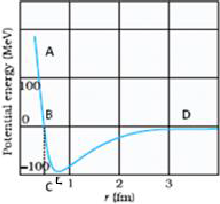
Draw a plot of potential energy of a pair of nucleons as a function of their separations. Mark the regions where the nuclear force is (i) attractive and (ii) repulsive. Write any two characteristic features of nuclear forces.
Answer

For r < OB, repulsive.

For r > OB force is attractive.

Nuclear forces are.

  1. Very strong.
  2. Charge independent.
  3. Show saturation.
  4. Spin-dependent.
View full question & answer
Question 183 Marks
  1. Write symbolically the β decay process of$\frac{15}{32}$P.
  2. Derive an expression for the average life of a radionuclide. Give its relationship with the half-life.
Answer
β decay process
$^{32}_{15}\text{P}\rightarrow^{32}_{16}\text{S} + \text{e}^{-} + \overline{\text{v}}\text{ or }^{32}_{15}\text{P}\rightarrow^{32}_{15}\text{X} + _{-1}\text{e}^{0} + \overline{\text{v}}$
Derivation of average life:
$\tau=\frac{\lambda\text{N}_{0}\int\limits_{0}^{\infty}\text{te}^{-\lambda\text{t}}\text{dt}}{\text{N}_{0}} = \lambda\int\limits_{0}^{\infty}\text{te}^{-\lambda\text{t}}\text{dt}$
$\Rightarrow\tau = 1/ \lambda$
Relation of average life with half life:
$\text{T}_{1/2} = \frac{\ell\text{n}2}{\lambda} = \tau\ell\text{n} 2$
View full question & answer
Question 193 Marks
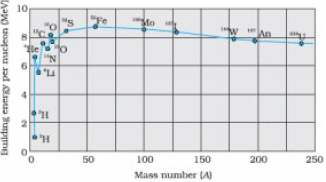
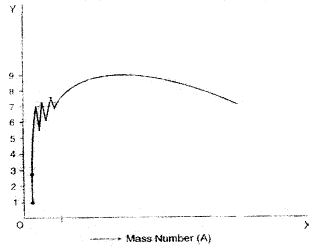
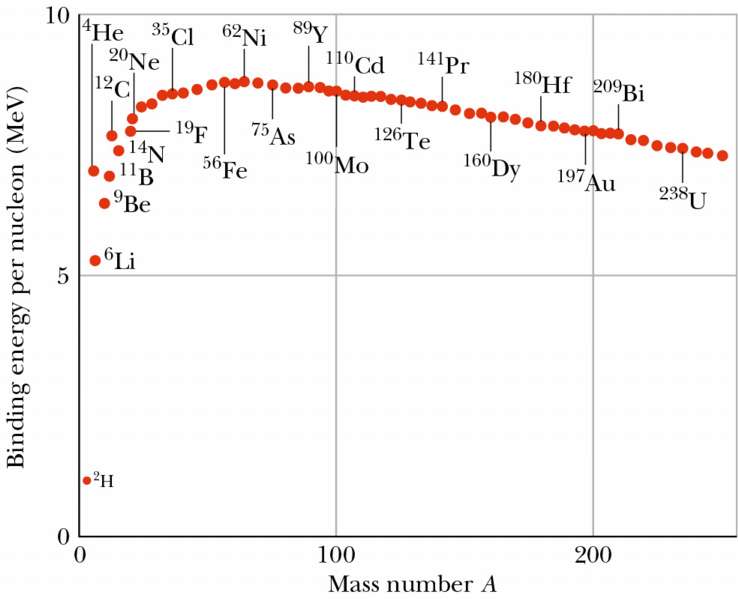
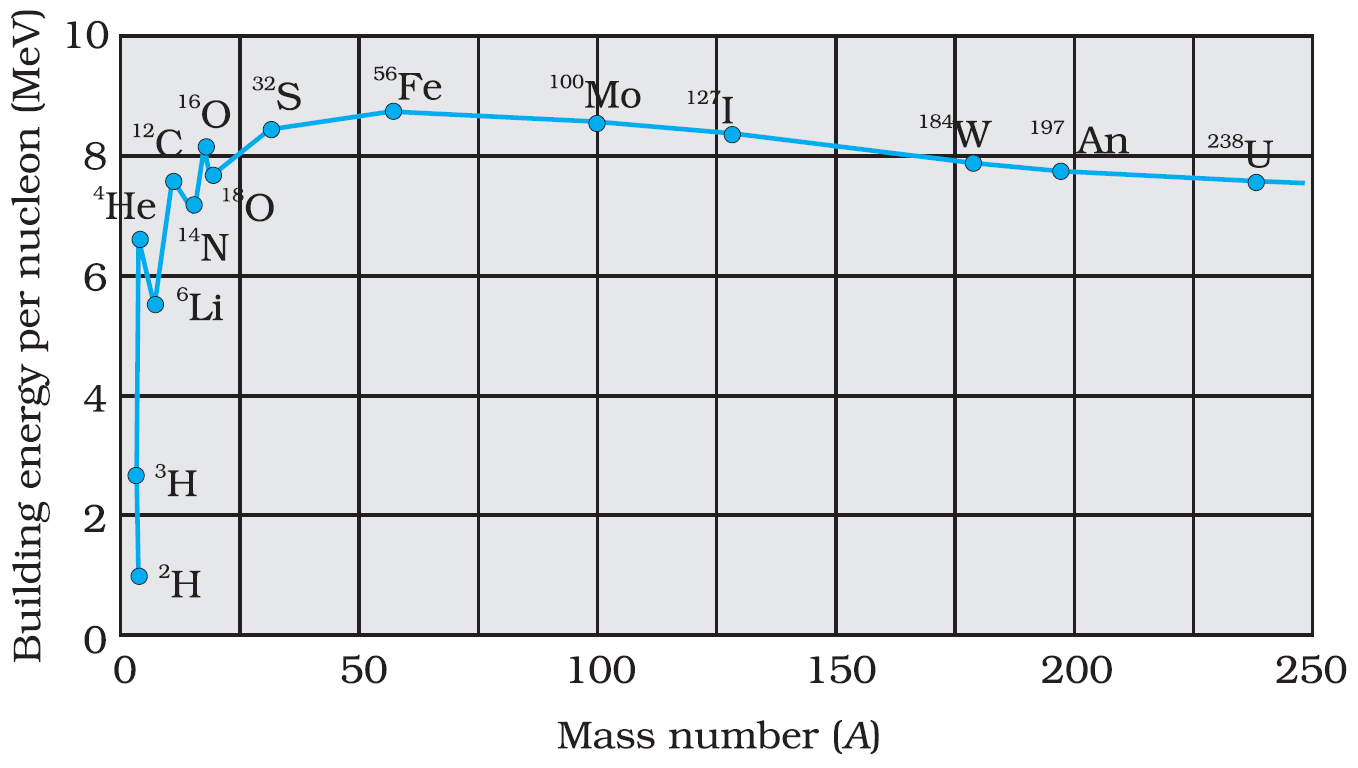
Draw a plot showing the variation of binding energy per nucleon versus the mass number A. Explain with the help of this plot the release of energy in the processes of nuclear fission and fusion.
Answer
Plot:

Explanation: A very heavy nucleus, say A = 240, has lower binding energy per nucleon compared to that of a nucleus with A = 120. Thus if a nucleus A = 240 breaks into two A = 120 nuclei, nucleons get more tightly bound.
This implies energy would be released in the process of fission.
Consider two very light nuclei  $({\text{A}}\leq 10) $ joining to form a heavier nucleus. The binding energy per nucleon of the fused heavier nuclei is more than the binding energy per nucleon of the lighter nuclei. This means that the final system is more tightly bound than the initial system. Again energy would be released in such a process of fusion.
View full question & answer
Question 203 Marks
Draw the graph to show variation of binding energy per nucleon with mass number of different atomic nuclei. Calculate binding energy/nucleon of $^{40}_{20}\text{Ca}$ nucleus.

Given:

mass of  $^{40}_{20}\text{Ca} = 39.962589\text{u}$.

mass of proton = 1.007825 u.

mass of neutron = 1.008665 u. 

and 1 u = 931 MeV/C2.

Answer
Graph:

Calculation of $\bigtriangleup\text{m}$ for $^{40}_{20}\text{Ca}$.

m = (20×1.007825 +20 × 1.008665)-39.962589

= 0.367211 amu.

BE = 0.367211× 931Mev.

  = 341.87 Mev.

BE per nucleon = 8.547Mev.

View full question & answer
Question 213 Marks
A neutron is absorbed by a $^{6}_{3}\text{Li}$ nucleus with the subsequent emission of an alpha particle.
  1. Calculate the energy released, in MeV, in this reaction.
  2. Write the corresponding nuclear reaction.
Given: mass $^{6}_{3}\text{Li} =6015126 $ u; mass (neutron) =1.0086654 u; mass (alpha particle) = 4.0026044 u and mass (triton) = 3.0100000 u. Take 1 u = 931 MeV/C2
Answer
$^{6}_{3}\text{Li} + ^{1}_{0}\text{n}\rightarrow^{3}_{1}\text{He} + \text{Q}$
∆m = (mass of $^{6}_{3}\text{Li}$ + mass of neutrons ) – (mass of α particle + mass of $^{3}_{1}\text{H}$)
∆m = 0.011187u
Energy released $\text{Q} =\bigtriangleup\text{m}\times931$
$ = 10.415\text{MeV.}$
View full question & answer
Question 223 Marks
Define the terms half-life period and decay constant of a radioactive substance. Write their S.I.units. Establish the relationship between the two.
Answer
Half life–It is the time at which number/amount of radioactive nuclei/sample at any time reduces to one half its initial value.

Unit – second

Decay constant – It is the ratio of the rate at which the number of atoms  will decay to the total number of atoms present at that time.

or

It is the reciprocal of time in which the radioactive sample reduces to $\bigg(\frac{1}{\text{e}}\bigg)^{\text{th}}$of its intial value.

Unit – second-1

Derivation:

$\text{N}\big(\text{t}\big) =\text{N}_\circ\text{e}^{-\lambda\text{t}}$

$\text{R} = - \frac{\text{dN}}{\text{dt}} =\lambda\text{N}_{\circ}\text{e}^{-\lambda\text{t}}$..........................................(1)

$\text{N} =\frac{\text{N}_{\circ}}{2}$ at $\text{t} = \text{T}_{1/2}$

$\therefore \text{T}_{1/2} = \frac{\text{log}_{e}2}{\lambda} = \frac{0.693}{\lambda}$.


View full question & answer
Question 233 Marks
  1. Derive the relation between the decay constant and half life of a radioactive substance.
  2. A radioactive element reduces to 25% of its initial mass in 1000 years. Find its half life.
Answer
  1. ${N}(t)=N_0\text{ }e^{-\lambda{t}}$

When $t=T_{1/2}\Rightarrow{N}(t)=\frac{N_0}{2}$

$\therefore {\text{ }} \frac{N_0}{2}=N_0\text{ }e^{-\lambda}T_{1/2}$

$\Rightarrow\frac{1}{2}=e^{-\lambda}T_{1/2}$

$\Rightarrow-{\lambda}T_\frac{1}{2}=-ln2$

$\Rightarrow\text{ }T_\frac{1}{2}=\frac{ln2}{\lambda}$

$\Rightarrow\frac{0.693}{\lambda}$

  1. $\frac{N}{N_0}=\bigg(\frac{1}{2}\bigg)^n\text{ }\text{ }\text{ }\text{ }n=\frac{t}{T_{1/2}}$

$\text{Given}\text{ }\frac{N}{N_0}=\frac{1}{4}=\bigg(\frac{1}{2}\bigg)^n $

$\bigg(\frac{1}{2}\bigg)^n=\bigg(\frac{1}{2}\bigg)^2$​​​​​​​

$\therefore \text{Number of half lives}=2$

$\Rightarrow\frac{1000}{T_{1/2}}=2$

$\Rightarrow{T}_\frac{1}{2}=\frac{1000}{2}=500 \text{ }\text{years}$

[𝑨𝒍𝒕𝒆𝒓𝒏𝒂𝒕𝒊𝒗𝒆𝒍𝒚

1000 years = 2 half lives

$\therefore$ Half life = 500 years]

View full question & answer
Question 243 Marks
  1. Write the process of $\beta$ decay. How can radioactive nuclei emit $\beta$-particles even though they do not contain them? Why do all electrons emitted during $\beta$-decay not have the same energy? 
  2. A heavy nucleus splits into two lighter nuclei. Which one of the two - parent nucleus or the daughter nuclei has more binding energy per nucleon?
Answer
  1. A nucleus, that spontaneously decays by emitting an electron, or a positron, is said to undergo $\beta$ decay

[Alternatively $ ^{A}_{Z}\text{X}\longrightarrow^{\text{ }\text{ }\text{ }\text{ }\text{ }A}_{Z+1}\text{Y}+e^-+\bar{v}$

$ ^{A}_{Z}\text{X}\longrightarrow^{\text{ }\text{ }\text{ }\text{ }\text{ }A}_{Z-1}\text{Y}+e^++v$ (antineutrino)

During β decay, nucleons undergo transformation. We can have:

${n}\text{ }{\longrightarrow}\text{ }{p}+e^-+{\bar{v}}$

$ \longrightarrow$ A neutron converts into a proton and an electron [Alternatively

${p}\longrightarrow{n}+e^++v$

[A proton converts into a neutron and a positron] It is because the neutrinos, or antineutrino, carry off different amounts of energy.

  1. The daughter nuclei have more binding energy per nucleon.
View full question & answer
Question 253 Marks
A proton and an $\alpha$-particle move perpendicular to a magnetic field. Find the ratio of radii of the circular paths described by them when both (i) have equal momenta, and (ii) were accelerated through the same potential difference.
Answer
  1. $\frac{mv^{2}}{r}=𝑞𝑣𝐵$.

$\therefore{r}=\frac{mv}{𝑞𝐵}=\frac{𝑝}{𝑞𝐵}\text{ }\text{ }\text{ }\text{ }\text{ }\text{ }\text{ }\text{ }(p = mv)$

For proton $r_p=\frac{p}{q_p{B}}$

For $\alpha$ particles ${r}_{\alpha}=\frac{p}{q_{\alpha}{B}}$

$\therefore\text{ }\frac{r_p}{r_{\alpha}}=\frac{q_{\alpha}}{q_p}=2$

  1. $r=\frac{𝑚𝑣}{𝑞𝐵}=\frac{1}{B}\sqrt{\frac{2𝑚𝑉}{𝑞}}$

for proton $r_p=\frac{1}{B}\sqrt\frac{2m_p{V}}{q_p}$

and for $\alpha$ particles $r_\alpha=\frac{1}{B}\sqrt\frac{2m_{\alpha}{V}}{q_{\alpha}}$

$ \therefore\frac{r_p}{r{\alpha}}=\sqrt{\frac{m_p}{q_p}\frac{q_{\alpha}}{m{\alpha}}}$

$\sqrt{\frac{2}{4}}=\frac{1}{\sqrt{2}}$

View full question & answer
Question 263 Marks
  1. Define ‘activity’ of a radioactive substance.
  2. Two different radioactive elements with half lives T1 and T2 have N1 and N2 undecayed atoms respectively present at a given instant. Derive an expression for the ratio of their activities at this instant in terms of N1 and N2.
Answer
  1. Number of radioactive nuclei decaying per second at any time.
  2. $R_1=\lambda_1N_1=\frac{0.693}{T_1}N_1$

$R_2=\lambda_2N_2=\frac{0.693}{T_2}N_2$

$\frac{R_1}{R_2}=\frac{N_1}{N_2}\times\frac{T_2}{T_1}$

View full question & answer
Question 273 Marks
  1. State the law of radioactive decay. Write the SI unit of ‘activity’.
  2. There are $4\sqrt{2}\times10^6$ radioactive nuclei in a given radioactive sample. If the half life of the sample is 20 s, how many nuclei will decay in 10 s?
Answer
  1. Statement: Rate of decay of a given radioactive sample is directly propotional to the total number of undecayed nuclei present in the sample.

  2. $N=N_0e^{-\lambda t}/\frac{N}{N_0}=\Big(\frac{1}{2}\Big)^n$

$\text{n}=\frac{t}{T_{1/2}}=\frac{10}{20}=\frac{1}{2}$

$\Rightarrow N=4\sqrt{2}\times10^{6}\times\Big(\frac{1}{2}\Big)^{\frac{1}{2}}$

$=4\times10^6$ nuclei.

View full question & answer
Question 283 Marks
  1. A radioactive nucleus 'A' undergoes a series of decays as given below:

$\text{A}\xrightarrow\alpha\text{A}_1\xrightarrow\beta\text{A}_2\xrightarrow\alpha\text{A}_3\xrightarrow\gamma\text{A}_4$

The mass number and atomic number of A2 are 176 and 71 respectively. Determine the mass and atomic numbers of A4 and A.

  1. Write the basic nuclear process underlying $\beta+$ and $\beta-$ decays.
Answer
$\text{A}^{180}_{74}\xrightarrow\alpha\text{A}^{176}_{72}\xrightarrow\beta\text{A}^{176}_{71}\xrightarrow\alpha\text{A}^{172}_{69}\xrightarrow\gamma\text{A}^{172}_{69}$
The mass number and atomic number of A4 is 172 and 69, respectively.
The mass number and atomic number of A is 180 and 74, respectively.
Basic process underlying $\beta+$ and $\beta-$ decay are
During a weak interaction an atomic nucleus converts into a nucleus with one higher atomic number while emitting one electron and an electron antineutrino this is called beta minus decay.
$X^A_Z\rightarrow Y^A_{Z+1}+e^-+\bar{ve}$
During a weak interaction an atomic nucleus converts into a nucleus with one lower number while emitting a positron and electron neutrino this is called beta Plus decay.
$X^A_Z\rightarrow Y^A_{Z-1}+e^++\bar{ve}$
View full question & answer
Question 293 Marks
Answer the following:
  1. Name the em waves which are produced during radioactive decay of a nucleus. Write their frequency range.
  2. Welders wear special glass goggles while working. Why? Explain.
  3. Why are infrared waves often called as heat waves? Give their one application.
Answer
  1. $\gamma-rays$

Range: 1019 to 1023 Hz

  1. To protect the eyes from large amount of UV radiations produced by welding arcs.
  2. Because water molecules present in the materials readily absorb the infra red rays get heated up.
View full question & answer
Question 303 Marks
  1. Deduce the expression, N = N0 $\text{e}^{-\lambda\text{t}}$, for the law of radioactive decay.
  2.  
  1. Write symbolically the process expressing the B+ decay of $^{22}_{11}\text{Na},$ Also write the basic nuclear process underlying this decay.
  2. Is the nucleus formed in the decay of the nucleus $^{22}_{11}\text{Na},$isotope or isobar?
Answer
  1.  

$\frac{\text{dN}}{\text{dt}} = -\lambda\text{N}$

$\int_{N_{0}}^{N}\frac{\text{dN}}{\text{N}} = \int_{0}^{t} - \lambda\text{dt}$

$[\log_{e}\text{N}]_{N_{0}}^{N} = - \lambda[\text{t}]_{0}^{t}$

$\log_{e}\frac{\text{N}}{\text{N}_{0}} = - \lambda\text{t}$

$\text{N} = \text{N}_{0}\text{e}^{-\lambda\text{t}}$

  1.  
  1. $^{22}_{11}\text{Na}\rightarrow^{22}_{11}\text{Ne} + \text{e}^{+} + \text{v}$ Also accept, if a student does not identify the product nucleus and writes as

$^{22}_{11}\text{Na}\rightarrow^{22}_{10}\text{X} + \text{e}^{+} + \text{v}$

Basic process

$\text{p}\rightarrow\text{n} + \text{e}^{+} +\text{v}$

  1. Isobar.
View full question & answer
Question 313 Marks
  1. In a typical nuclear reaction, e.g.  

$^{2}_{1}\text{H} +^{2}_{1}\text{H}\rightarrow^{3}_{2}\text{He} + \text{n} + 3.27\text{MeV}$ 

although number of nucleons is conserved, yet energy is released. How? Explain.

  1. Show that nuclear density in a given nucleus is independent of mass number A.
Answer
  1. In nuclear reaction

$^{2}_{1}\text{H} +^{2}_{1}\text{H}\rightarrow^{3}_{2}\text{He} + \text{n} + 3.27\text{MeV}$

Cause of the energy released:

  1. Binding energy per nucleon of$^{3}_{2}\text{ He}$ becomes more than the (BE/A) of $^{2}_{1}\text{ H}.$
  2. Mass defect between the reactant and product nuclei.

$\Delta\text{E} = \Delta\text{mC}^{2}$

$ = \big[2\text{m}(^{2}_{1}\text{H}) - \text{m}(^{3}_{2}\text{He}) + \text{m}(\text{n})\big]\text{C}^{2}$

  1. The radius of nucleus of mass number A is given by R = R0A1/3

Volume of the nucleus $\text{V} = \frac{4}{3}\pi\text{R}^{3} = \frac{4}{3}\pi\text{R}_{0}^{3}\text{A}$

Density of the matter in the nucleus

$\rho = \frac{\text{Mass}}{\text{Volume}} = \frac{\text{A}{(u)}}{\frac{4}{3}\pi\text{R}_{0}^{3}\text{A}}$

$\rho = \frac{1}{\frac{4}{3}\pi\text{R}_{0}^{3}} = \frac{3}{4\pi\text{R}_{0}^{3}}$

The expression of the density is independent of mass number A.

View full question & answer
Question 323 Marks
  1. What characteristic property of nuclear force explains the constancy of binding energy per nucleon (BE/A) in the range of mass number 'A' lying 30 <A < 170?
  2. Show that the density of nucleus over a wide range of nuclei is constantindependent of mass numberA.
Answer
  1. Saturation/short range nature of nuclear forces.
  2. We have

$\text{R} = \text{R}_{0}\text{A}^{1/3}$

$\therefore\text{ Density} \rho=\frac{\text{mA}}{\frac{4}{3}\pi\big(\text{R}_{0}\text{A}^{1/3}\big)^{3}}$

$ =\frac{\text{m}}{\frac{4}{3}\pi\text{R}_{0}^{3}}$

Hence $\rho$ is independent of A.
(Here m is the mass of the nucleus.)

View full question & answer
Question 333 Marks
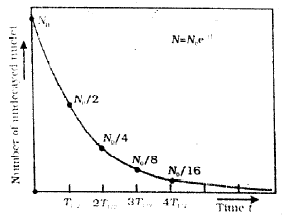
State the law of radioactive decay.
Plot a graph showing the number (N) of undecayed nuclei as a function of time (t) for a given radioactive sample having half life T½.
Depict in the plot the number of undecayed nuclei at (i) t = 3 T½ and (ii) t = 5 T½.
Answer
The number of nuclei undergoing decay per unit time, at any instant, is proportional to the total number of nuclei in the sample at that instant.

Alternate Answer

$-\frac{\text{dN}}{\text{dt}}\alpha\text{N}$

$\Rightarrow\frac{\text{dN}}{\text{dt}} = - \lambda\text{N}$

View full question & answer
Question 343 Marks
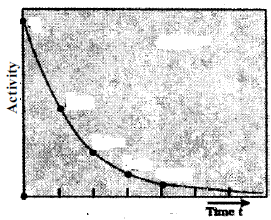
  1. Define ‘activity’ of a radioactive material and write its S.I. unit.
  2. Plot a graph showing variation of activity of a given radioactive sample with time.
  3. The sequence of stepwise decay of a radioactive nucleus is

If the atomic number and mass number of D2 are 71 and 176 respectively, what are their corresponding values for D?

Answer
  1. The total decay rate (of a sample)at the given instant, i.e., the number of radionuclides disintegrating per unit time is called the activity of that sample. The SI unit for activity is becquerel (Bq).
  2. Graph:

  1. 72 and 180.
View full question & answer
Question 353 Marks
Calculate the amount of energy released during the $\alpha - $ decay of $^{238}_{92}\text{U}\to ^{234}_{92}\text{Th} + ^{4} _{2}\text{He}$

Given:

  1. Atomic mass of $^{238}_{92}\text{U}= 238.05079u$
  2. Atomic mass of  $^{234}_{90}\text{Th}= 234.04363u$

  3. Atomic mass of $^{4}_{2}\text{He}= 4.00260\text{ u}$

$\text{1u} = 931.5 \text{MeV/c}^{2}$

Is this decay spontaneous? Give reason.

Answer
$\bigtriangleup\text{m} = \text{M}_{U} - \text{M}_{Th} - \text{M}_{He}$

= 0.00456 u 

Enetgy released  $=\bigtriangleup\text{mc}^{2}$

= 0.00456 X 931.5

 = 4.25 MeV 

Yes

As $\bigtriangleup\text{m}$  is positive.

View full question & answer
Question 363 Marks
Draw a graph showing the variation of binding energy per nucleon with mass number for different nuclei. Explain, with the help of this graph, the release of energy by the process of nuclear fusion.
Answer

In case of nuclei of low atomic number, binding energy per nucleon is quite small; when fuse together, they form a nucleus of higher atomic mass and higher B.E./Nucleon, and hence, they release energy and become more stable.

View full question & answer
Question 373 Marks
Explain, with the help of a nuclear reaction in each of the following cases, how the neutron to proton ratio changes during (i) alpha-decay (ii) beta-decay?
Answer

For  $\alpha$ decay

$^{238}_{92}\text{U}\to^{234}_{90}\text{Th}+ ^{4}_{2}\text{He}+\text{Q}$

(or any other nuclear reaction)

$\text{For} ^{238}_{92}\text{U},\frac{\text{n}}{\text{p}} = \frac { 238 - 92}{92} = \frac{146}{92} =1.587$

$\text{For} ^{234}_{90}\text{Th},\frac{\text{n}}{\text{p}} = \frac { 234 - 90}{90} = 1.6$

$\therefore \frac{\text{n}}{\text{p}} $  increases during $\alpha$ decay.

For $\beta$ decay

$^{60}_{27}\text{Co}\to^{60}_{28}\text{Ni}+ ^{0}_{-1}\text{e}+ \text{Q}$

(or any other nuclear reaction)

$\text{For} ^{60}_{27}\text{Co},\frac{\text{n}}{\text{p}} = \frac{60 - 27 }{27} = 1.22$

$\text{For} ^{60}_{28}\text{Ni},\frac{\text{n}}{\text{p}} = \frac{60 - 28 }{28} = 1.14$

$\therefore \frac{\text{n}}{\text{p}} $ decreases during $\beta$ decay

Alternate Answer 

Full credit to be given if explained in terms of.

$^{\text{A}}_\text{Z}\text{X}\to^{\text{A-4}}_\text{Z-2}\text{Y}+ ^{4}_{2}\text{He}$

and

$^{\text{A}}_\text{Z}\text{X}\to^{\text{A}}_\text{Z+1}\text{Y}+ ^\circ_{1}\text{e} + {\overline{\text{V}}}\big(\text{V}\big)$

$\text{for }\alpha\text{ decay and }\beta\text{ decay}.$

View full question & answer
Question 383 Marks
Why is the mass of a nucleus always less than the sum of the masses of its constituents, neutrons and protons?

If the total number of neutrons and protons in a nuclear reaction is conserved, how then is the energy absorbed or evolved in the reaction? Explain.

Answer
  1. The strong attractive nuclear forces act to bring the nucleons together to form the nucleus. This work is done at the expense of some mass of the (free) nucleons getting converted into energy. This results in a decrease of mass.

Alternate Answer

The binding energy needed to hold the nucleons together to form the nucleus, is obtained at the expense of some mass of the (free) nucleons getting converted into energy.

Alternate Answer

The forces of attraction, holding the nucleons together to form the nucleus gives the system a negative potential energy which is due to the mass lost in the process of formation of the nucleus.

Alternate Answer

When the free nucleons are brought together to form the nucleus, some energy gets released. This energy is released at the expense of the some mass of the free nucleons getting converted into energy.

  1. Even when the total number of neutrons and protons is conserved in a nuclear reaction the sum total of the masses of the products is different (either less or more) than the masses of the reactants. It is the energy equivalent of the mass difference (loss or gain) that gets released or absorbed in the reaction.
View full question & answer
Question 393 Marks
  1. Explain the processes of nuclear fission and nuclear fusion by using the plot of binding energy per nucleon (BE/ A) versus the mass number A.
  2. A radioactive isotope has a half-life of 10 years. How long will it take for the activity to reduce to 3·125%?
Answer
  1.  

Nuclear fission: Binding energy per nucleon is smaller for heavier nuclei (greater than 200) i.e., heavier nuclei are less stable. When a heavier nucleus splits into the lighter nuclei, they become stable, this happens in nuclear fission.

Nuclear fusion: The binding energy per nucleon is small for light nuclei (between 2 to 20), i.e., they are less stable. So when two light nuclei combine to form a heavier nucleus, the higher binding energy per nucleon of the latter results in the release of energy. This is what happens in a nuclear fusion.

  1. $\frac{\text{R}}{\text{R}_0}=\frac{\text{N}}{\text{N}_0}=\Big(\frac{1}{2}\Big)^{\text{n}}$

$\frac{\text{R}}{\text{R}_0}=3.125\%=\frac{3.125}{100}=\frac{1}{32}=\Big(\frac{1}{2}\Big)^5$

$=\Big(\frac{1}{2}\Big)^\text{n}=\Big(\frac{1}{2}\Big)^5\Rightarrow\ \text{n}=5$

$\text{t}=\text{nT}_{\frac{1}{2}}=5\times10=50\text{ year}$

View full question & answer
Question 403 Marks
The nucleus $^{235}_{92}\text{Y},$ initially at rest, decays into $^{231}_{90}\text{X}$ by emitting an $\alpha-$particle
$^{235}_{92}\text{Y}\xrightarrow{ \ \ \ \ \ \ \ \ } \ ^{231}_{90}\text{X}+ \ ^4_2\text{He}+\text{energy}.$
The binding energies per nucleon of the parent nucleus, the daughter nucleus and $\alpha-$particle are 7.8MeV, 7.835MeV and 7.07MeV, respectively. Assuming the daughter nucleus to be formed in the unexcited state and neglecting its share in the energy of the reaction, find the speed of the emitted $\alpha-$particle. (Mass of $\alpha-$particle = 6.68 × 10⁻²⁷kg).
Answer
The binding energies per nucleon of the parent nucleus, the daughter nucleus and $\alpha-$particle are 7.8MeV, 7.835MeV and 7.07MeV, respectively. Assuming the daughter nucleus to be formed in the unexcited state and neglecting its share in the energy of the reaction, find the speed of the emitted $\alpha-$particle. (Mass of $\alpha-$particle 6.68 × 10-27kg),
Energy released = Q = 7.835 × 231 + 7.07 × 4 - 7.8 × 235
⇒ Q = 1809.885 + 28.28 - 1833
= 5.165MeV
= 5.165 × 1.6 × 10-13J
This energy will be taken away by $\alpha-$particle as kinetic energy.
$\therefore\frac{1}{2}\text{mv}^2=\text{Q}$
⇒ Speed of $\alpha-$particle,
$\text{v}=\sqrt{\frac{5.165\times1.6\times10^{-13}\times2}{6.68\times10^{-27}}}$
$=\sqrt{\frac{16.528}{6.68}\times10^{14}}$
$=\sqrt{2.474}\times10^7$
$=1.573\times10^7\text{m/ s}.$
View full question & answer
Question 413 Marks
Define the term ‘decay constant’ of a radioactive sample. The rate of disintegration of a given radioactive nucleus is 10000 disintegrations/ s and 5,000 disintegrations/ s after 20hr. and 30hr. respectively from start. Calculate the half life and initial number of nuclei at t = 0.
Answer
Decay constant is the fraction of the number of atoms that decay in one second. It is denoted by $\lambda.$
Let N0 be the initial number of nuclei,
Let $\lambda$ be the decay constant
Let $\text{t}_\frac{1}{2}$ be the half-life.
The instantaneous activity of radioactive material is given by:
$\text{A}=\text{A}_0\text{e}^{-\lambda\text{t}}$
Where, A0 is activity at t = 0
Here, Activity after 20 hours is 10,000 disintegrations per second
$\Rightarrow10,000=\text{A}_0\text{e}^{-\lambda(20\times3600)}\ ...(1)$
Activity after 30 hours is 5,000 disintegrations per second
$\Rightarrow5,000=\text{A}_0\text{e}^{-\lambda(30\times3600)}\ ...(2)$
On dividing (1) by (2),
$2=\text{e}^{-\lambda\times3600}$
$\Rightarrow\lambda=\frac{\text{In}\ 2}{36000}=1.92\times10^{-5}$
So half-life $\frac{\text{In}\ 2}{1.92\times10^{-5}}=36,000\text{s}=10\ \text{hours}$
We know that, $\frac{\text{dN}}{\text{dt}}=\lambda\text{N}$
$\Rightarrow10,000=(1.92\times10^{-5})\times\text{N}_1$
$\Rightarrow\text{N}_1=\frac{10,000}{1.92\times10^{-5}}=5.208\times10^8$
As the half-life is 10 hours, thus the initial numbers of nuclei, N0 = 2N1
⇒ N0 = 10.416 × 108
View full question & answer
Question 423 Marks
  1. A giant refracting telescope at an observatory has an objective lens of focal length 15 m. If an eyepiece of focal length 1.0 cm is used, what is the angular magnification of the telescope?
  2. If this telescope is used to view the moon, what is the diameter of the image of the moon formed by the objective lens? The diameter of the moon is 3.48 × 10m, and the radius of lunar orbit is 3.8 × 10m.
Answer
Focal length of the objective lens, f0 = 15 m = 15 × 10cm

Focal length of the eyepiece, fe = 1.0 cm 

  1. The angular magnification of a telescope is given as:

$\alpha=\frac{\text{f}_0}{\text{f}_\text{e}}$

$=\frac{15\times10^2}{1.0}=1500$

Hence, the angular magnification of the given refracting telescope is 1500.

  1. Diameter of the moon, d = 3.48 × 10m

Radius of the lunar orbit, r0 = 3.8 × 10⁸ m

Let d' be the diameter of the image of the moon formed by the objective lens.

The angle subtended by the diameter of the moon is equal to the angle subtended by the image.

$\frac{\text{d}}{\text{r}_0}=\frac{\text{d}'}{\text{d}_0}$

$\frac{3.48\times10^6}{3.8\times10^8}=\frac{\text{d}'}{15}$

$\therefore \ \text{d}'=\frac{3.48}{3.8}\times10^{-2}\times15$

= 13.74 × 10⁻² m = 13.74 cm

Hence, the diameter of the moon's image formed by the objective lens is 13.74 cm.

View full question & answer
Question 433 Marks
Distinguish between isotopes and isobars. Give one example for each of the species.
Answer
S. No. Isotopes Isobars
1. The nuclides having the same atomic number (Z). The nuclides having the same atomic mass (A) but.
2. But different atomic masses (A) are called isotopes. Examples: $^1_1\text{H},\ ^2_1\text{H},\ ^3_1\text{H}$ Different atomic numbers (Z) are called isobars. Examples: $^3_1\text{H},\ ^3_2\text{He}$
View full question & answer
Question 443 Marks
$\text{ }^{197}_{80}\text{Hg}$ decay to $\text{ }^{197}_{79}\text{Au}$ through electron capture with a decay constant of 0.257 per day.
  1. What other particle or particles are emitted in the decay?
  2. Assume that the electron is captured from the K shell. Use Moseley's law $\sqrt{\text{v}}=\text{a(Z}-\text{b})$ with $\text{a}=4.95\times10^7\text{s}^{-\frac{1}{2}}$ and b = 1 to find the wavelength of the $\text{K}_{\alpha}$ X-ray emitted following the electron capture.
Answer
  1. $\text{P + e}\rightarrow\text{n + v}$ neutrino $\big[\text{a}\rightarrow4.95\times10^7\text{s}^{-\frac{1}{2}};\text{b}\rightarrow1\big]$
  2. $\sqrt{\text{f}}=\text{a(z}-\text{b})$

$\Rightarrow\sqrt{\frac{\text{c}}{\lambda}}=4.95\times10^7(79-1)=4.95\times10^7\times78$

$\Rightarrow\frac{\text{c}}{\lambda}=(4.95\times78)^2\times10^{14}$

$\Rightarrow\lambda=\frac{3\times10^8}{14903.2\times10^{14}}$

$=2\times10^{-5}\times10^{-6}=2\times10^{-4}\text{m}=20\text{pm}$

View full question & answer
Question 453 Marks
The count rate from a radioactive sample falls from 4.0 × 10⁶ per second to 1.0 × 10per second in 20 hours. What will be the count rate 100 hours after the beginning?
Answer
$\text{A}_0=4\times10^5$ disintegration/sec

$\text{A}'=1\times10^6$ dis/sec; t = 20 hours.

$\text{A}'=\frac{\text{A}_0}{2^{\frac{\text{t}}{\text{t}_{\frac{1}{2}}}}}\Rightarrow2^{\frac{\text{t}}{\text{t}_{\frac{1}{2}}}}=\frac{\text{A}_0}{\text{A}'}\Rightarrow2^{\frac{\text{t}}{\text{t}_{\frac{1}{2}}}}=4$

$\Rightarrow\frac{\text{t}}{\text{t}_{\frac{1}{2}}}=2\Rightarrow\text{t}^{\frac{1}{2}}=\frac{\text{t}}{2}=\frac{20\text{ hours}}{2}=10\text{ hours}.$

$\text{A}''=\frac{\text{A}_0}{2^{\frac{\text{t}}{\text{t}_{\frac{1}{2}}}}}\Rightarrow\text{A}''=\frac{4\times10^6}{2^{\frac{100}{10}}}$

$=0.00390625\times10^6=3.9\times10^3$ dintegrations/sec.

View full question & answer
Question 463 Marks
An ideal diode should pass a current freely in one direction and should stop it completely in the opposite direction. Which is closer to ideal-vacuum diode or a p-n junction diode?
Answer
It should be an ideal vacuum diode. When a p-n junction diode is reverse biassed then a small current called reverse current flows across the diode. As the the p‒n junction diode allows some current in reverse biassed condition also so the given diode cannot be a p-n junction diode.
View full question & answer
Question 473 Marks
radioactive isotope has a half-life of 5 years. After how much time is its activity reduced to 3.125% of its original activity?
Answer
We know $\frac{\text{R}}{\text{R}}_0=\Big(\frac{1}{2}\Big)^\text{}n$
Given $\frac{\text{R}}{\text{R}}_0=3.125\%=\frac{3.125}{100}$
$\therefore \frac{3.125}{100}=\Big(\frac{1}{2}\Big)^\text{n}$
$\frac{1}{32}=\Big(\frac{1}{2}\Big)^\text{n}$
$\Big(\frac{1}{2}\Big)^5=\Big(\frac{1}{2}\Big)^\text{n}$
$\Rightarrow \text{n}=5$
Given T = 5 years
As $\text{n}=\frac{\text{t}}{\text{T}}$
$\therefore \frac{\text{t}}{\text{T}}=5$
$\text{t}=5\times5=25\text{years}$
View full question & answer
Question 483 Marks
The following table shows some measurements of the decay rate of a radionuclide sample. Find the disintegration constant.
Time (min) lnR (Bq)
36 5.08
100 3.29
164 1.54
218 0
Answer
$\text{R}=\text{R}_0\text{e}^{-\lambda\text{t}}$
In $\text{R}=1\text{n}\text{ R}_0^{-\lambda\text{t}}$
In $\text{R}=-\lambda \text{t}+1\text{n}\text{R}_0$
Slope of In $\text{R}\frac{\text{v}}{\text{s}}\text{t}\text{ is } -\lambda'$
$-\lambda =\frac{0-1.52}{218-164}$
$\Rightarrow \lambda= 0.02\text{minute}^{-1}$
View full question & answer
Question 493 Marks
The half-life of $^{14}_6\text{C}$ is 5700 years. What does it mean? Two radioactive nuclei X and Y initially contain an equal number of atoms. Their half-lives are 1 hour and 2 hours respectively. Calculate the ratio of their rates of disintegration after two hours.
Answer
The half-life of $^{14}_6\text{C}$ is 5700 years. It means that one half of the present number of radioactive nuclei of $^{14}_6\text{C}$ will remain undecayed after 5700 years.
Number of nuclei X after 2 hours, NX $=\text{N}_0\Big(\frac{1}{2}\Big)^{\frac{1}{\frac{\text{T}}{2}}}=\frac{\text{N}_0}{4}$
Number of nuclei Y after 2 hours, NY $=\text{N}_0\Big(\frac{1}{2}\Big)^{\frac{2}{2}}=\frac{\text{N}_0}{2}$
$\therefore$ Ratio of rates of disintegration $\frac{\text{R}_\text{X}}{\text{R}_\text{Y}}=\frac{\frac{\text{N}_0}{4}}{\frac{\text{N}_0}{2}}=\frac{1}{2}$
View full question & answer
Question 503 Marks
If three helium nuclei combine to form a carbon nucleus, energy is liberated. Why can't helium nuclei combine on their own and minimise the energy?
Answer
When three helium nuclei combine to form a carbon nucleus, energy is liberated. This energy is greater than the that liberated when these nuclei combine on their own. Hence, formation of carbon nucleus leads to much more stability as compared to the combination of three helium nuclei.
View full question & answer
3 Marks Question - Physics STD 12 Science Questions - Vidyadip