Question
Does a nucleus lose mass when it suffers gamma decay?

Answer

Gamma rays consist of photons that are produced when a nucleus from its excited state comes to its ground state releasing energy. Since gamma rays are chargeless and massless particles, the nucleus does not suffer any loss in mass during the gamma decay.

Need a full question paper?

Generate a complete, print-ready paper with questions like this in minutes — across 16+ boards, with answer keys.

Start Generating Free

Similar questions

A ball is thrown at a speed of $40\ m/s$ at an angle of $60^\circ$ with the horizontal. Find:
  1. The maximum height reached.
  2. The range of the ball. Take $g = 10\ m/s^2$.
A current-carrying circular coil of 100 turns and radius 5.0cm produces a magnetic field of $6.0 \times 10^{-5}T$ at its centre. Find the value of the current.
If a mass of 0.8 kg is moving in simple harmonic motion starting from equilibrium position. The dimensions of the body of mass 1.0 m and if the period is 11/7 sec then 0.6 m. Find velocity of the particle at displacement and also write the equation of motion.
The spring constant of the spring shown in figure is $250N/m.$ Find the maximum compression of the spring.
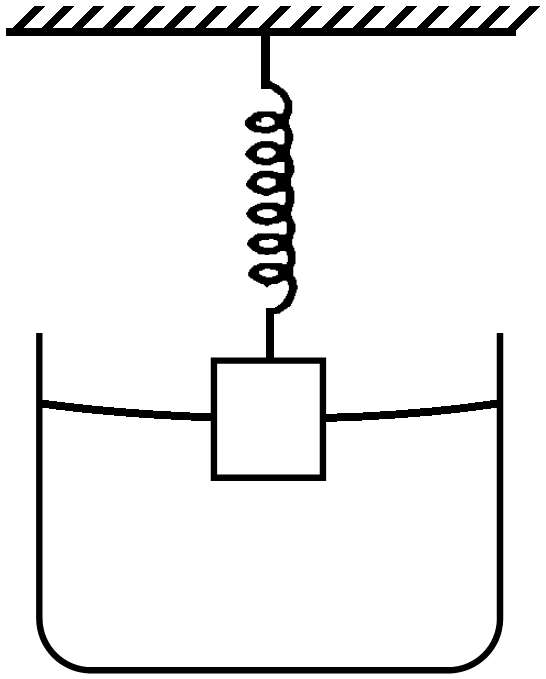
A cylindrical object of outer diameter $10\ cm$, height $20\ cm$ and density $8000\ kg/m^3$ is supported by a vertical spring and is half dipped in water as shown in.
  1. Find the elongation of the spring in equilibrium condition.
  2. If the object is slightly depressed and released, find the time period of resulting oscillations of the object. The spring constant $= 500N/m$.
A block hangs from a string wrapped on a disc of radius 20cm free to rotate about its axis which is fixed in a horizontal position. If the angular speed of the disc is 10rad/s at some instant, with what speed is the block going down at that instant?
A bulb rated 60W at 220V is connected across a household supply of alternating voltage of 220V. Calculate the maximum instantaneous current through the filament.
Pressure decreases as one ascends the atmosphere. If the density of air is $\rho,$ what is the change in pressure dp over a differential height dh?
  1. What is meant by Simple Harmonic Motion $\text{(S.H.M)}$?
  2. At what points is the energy entirely kinetic and potential in $\text{S.H.M}$?
  3. What is the total distance travelled by a body executing $\text{S.H.M}$ in a time equal to its time period, if its amplitude is $A$?
What is Simple Harmonic Motion? Show that in $\text{S.H.M}$., acceleration is directly proportional to its displacement at a given instant.