Question
A cylindrical object of outer diameter $10\ cm$, height $20\ cm$ and density $8000\ kg/m^3$ is supported by a vertical spring and is half dipped in water as shown in.
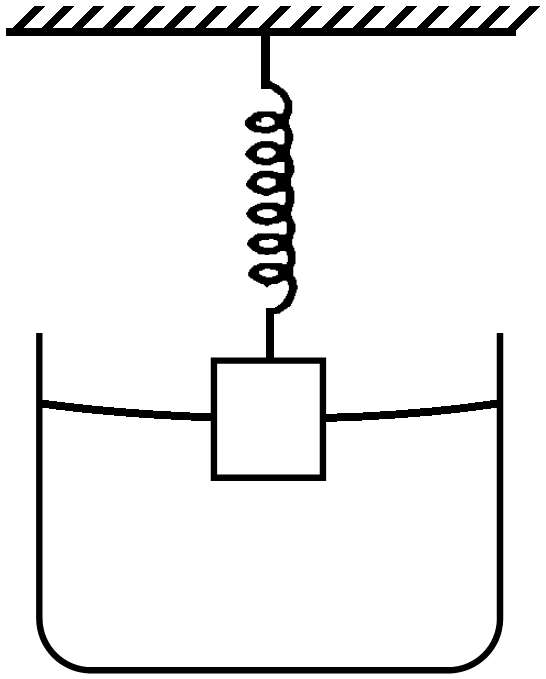
  1. Find the elongation of the spring in equilibrium condition.
  2. If the object is slightly depressed and released, find the time period of resulting oscillations of the object. The spring constant $= 500N/m$.
Answer

The volume of the object $=\pi\times5^2\times20\text{cm}^3=500\pi\text{cm}^3$
The mass of the object $=500\pi\times\frac{8000}{10^6}\text{Kg}$
$=4\pi\text{Kg}$
Since the object is half dipped, the volume of the water displaced
$=\frac{500\pi}{2}$
$=250\pi\text{cm}^3$
The mass of the water displaced $=\frac{250\pi\times1000}{10^6}\text{Kg}$
$=0.25\pi\text{Kg}$
The force of buoyancy $=0.25\pi\text{g}\ \text{N}$
Hence the apparent weight of the object $=(4\pi-0.25\pi)\text{g}\ \text{N}$
$=3.75\pi\text{g}\ \text{N}$
The spring constant $\text{K}=500\text{N}/\text{m}$
  1. Hence the elongation of the spring
$=\frac{3.75\pi\text{g}}{500}\text{m}=3.75\times3.14\times\frac{10}{500}\text{m}$
Taking $g = 10 m/s^2$
$=0.235\text{m}$
$=23.5\text{cm}$
  1. Let the object be dipped to a distance $X m.$ Assuming the axis of the cylindrical object vertical, the extra volume displaced$=\frac{\pi\times5^2\times\text{x}}{10000}\text{m}^3$
The buoyancy force $=\Big(\frac{\pi\times5^2\times\text{x}}{10000}\text{m}^3\Big)\times1000\text{g}\ \text{N}$
$=2.5\pi\text{g}\text{x}\ \text{N}$
The spring force $=\text{KxN}$
Hence the total upward force $=2.5\pi\text{g}\text{x}+500\text{X}\ \text{N}$
Hence the vertical acceleration at the moment $=\frac{\text{Force}}{\text{Mass}}$
$=\frac{\big(2.5\pi\text{x}+500\text{X}\big)}{4\pi}\text{m}/\text{s}^2$
$=\frac{\big(2.5\pi\text{g}+500\big)\text{X}}{4\pi}\text{m}/\text{s}^2$
But also this acceleration $=\omega^2\text{X}\text{m}/\text{s}^2$
Equating, $\omega^2\text{x}=\frac{​​\big(​​​2.5\pi\text{g}+500\big)\text{X}}{4\pi}$
$=46.04\text{X}$
$\rightarrow\omega=\sqrt{(46.04)}=6.785\text{s}^{-1}$
So, the time period
$=\frac{2\pi}{\omega}$
$=\frac{2\pi}{6.785}\text{s}$
$=0.93\text{s}$

Need a full question paper?

Generate a complete, print-ready paper with questions like this in minutes — across 16+ boards, with answer keys.

Start Generating Free

Similar questions

Find moment of inertia of a thin rod about an axis perpendicular to it and passing through its mid-point.
A monkey climbs up a slippery pole for 3 seconds and subsequently slips for 3 seconds. Its velocity at time t is given by v(t) = 2t(3 - t); 0 < t < 3 and v(t) = -(t - 3)(6 - t) for 3 < t < 6s in m/s. It repeats this cycle till it reaches the height of 20m.
How many cycles (counting fractions) are required to reach the top?
Work done by a force is given by $\text{W}=\vec{\text{F}.}\vec{\text{S}}\text{ Where}\vec{\text{ F}}$ is the force and $\vec{\text{S}}$is the displacement. Show that:
  1. Work done is also equal to change in K.E.
  2. Work done is also equal to change in potential energy using this expression.
A semicircular rod is joined at its end to a straight rod of the same material and the same cross-sectional area. The straight rod forms a diameter of the other rod. The junctions are maintained at different temperatures. Find the ratio of the heat transferred through a cross section of the semicircular rod to the heat transferred through a cross section of the straight rod in a given time.
A body falls towards earth in air. Will its total mechanical energy be conserved during the fall? Justify
Mercury has an angle of contact equal to $140^{\circ}$ with soda-lime glass. A narrow tube of radius 1.00 mm made of this glass is dipped in a trough containing mercury. By what amount does the mercury dip down in the tube relative to the liquid surface outside? Surface tension of mercury at the temperature of the experiment is 0.465 N $m ^{-1}$. Density of mercury $=13.6 \times 10^3 kgm ^{-3}$. .
When a system is taken through the process abc shown in figure. 80J of heat is absorbed by the system and 30J of work is done by it. If the system does 10J of work during the process adc, how much heat flows into it during the process?
The acceleration due to gravity on the moon is only one-sixth of that on earth. Suppose the average density of both are same, what would be the ratio of the radii of the moon and the earth?
What is the position at any time, for a body starting from rest, with an acceleration $a = at^2$?
What is the ratio of maxmimum acceleration to the maximum velocity of a simple harmonic oscillator?