Question
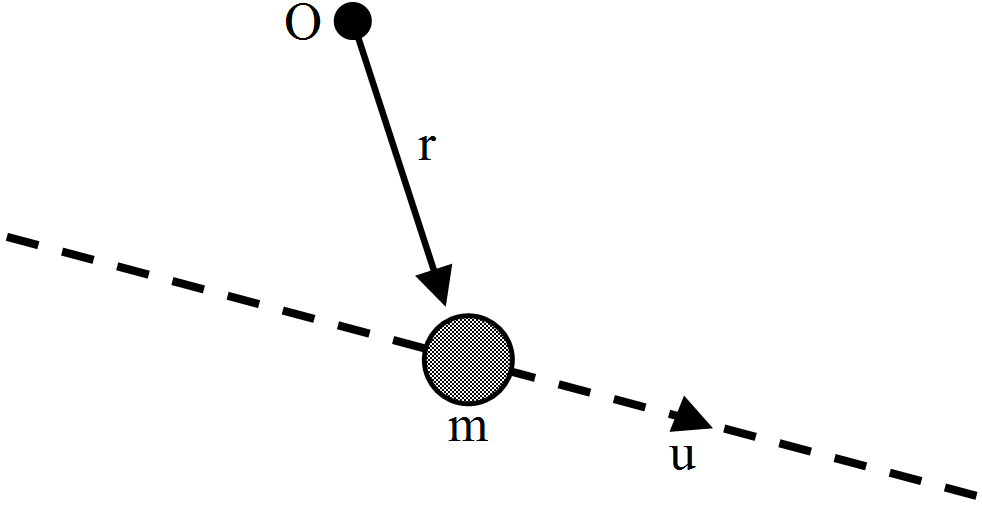
Does angular momentum of a body in translatory motion is zero?
Answer

Angular momentum of a body is measured with respect to certain origin. So, a body in translatory motion can have angular momentum It will be zero, if origin lies on the line of motion of particle.

Need a full question paper?

Generate a complete, print-ready paper with questions like this in minutes — across 16+ boards, with answer keys.

Start Generating Free

Similar questions

The centre of gravity of a body on the earth coincides with its centre of mass for a ‘small’ object whereas for an ‘extended’ object it may not. What is the qualitative meaning of ‘small’ and ‘extended’ in this regard?
For which of the following the two coincides? A building, a pond, a lake, a mountain?
A horizontal force of $500N$ pulls two masses $10kg$ and $20kg$ (lying on a frictionless table) connected by a light string as shown. What is the tension in the string? Does the answer depend on which mass the pull is applied?
A pendulum having a bob of mass $m$ is hanging in a ship sailing along the equator from east to west. When the ship is stationary with respect to water the tension in the string is $T_0$.
  1. Find the speed of the ship due to rotation of the earth about its axis.
  2. Find the difference between $T_0$ and the earth's attraction on the bob.
  3. If the ship sails at speed $v,$ what is the tension in the string? Angular speed of earth's rotation is $\omega$ and radius of the earth is $R.$
Find the value of $C_v$ and $C_p$ for nitrogen (given $R = 8.3J mole^{-1} K^{-1}​​​​​​​$, also for a diatomic gas, $\text{C}_\text{V}=\frac52\text{R}.$
$\text{ }^{197}_{80}\text{Hg}$ decay to $\text{ }^{197}_{79}\text{Au}$ through electron capture with a decay constant of $0.257$ per day.
  1. What other particle or particles are emitted in the decay?
  2. Assume that the electron is captured from the $K$ shell. Use Moseley's law $\sqrt{\text{v}}=\text{a(Z}-\text{b})$ with $\text{a}=4.95\times10^7\text{s}^{-\frac{1}{2}}$ and $b = 1$ to find the wavelength of the $\text{K}_{\alpha} X-$ray emitted following the electron capture.
Mathematically establish the third equqtion of rotational motion $\omega^2-\omega^2_0=2\alpha\theta$
A free atom of iron emits $\text{K}_\alpha$ X-rays of energy 6.4keV. Calculate the recoil kinetic energy of the atom. Mass of an iron atom = $9.3 \times 10^{-26}kg$.
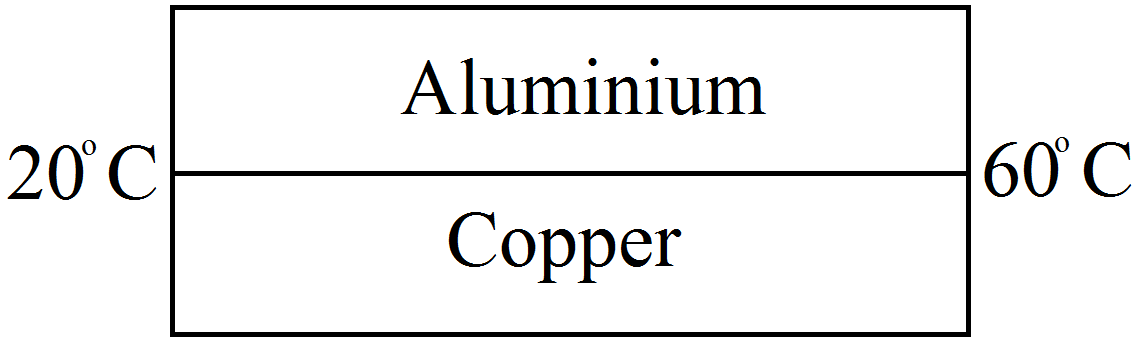
An aluminium rod and a copper rod of equal length 1.0m and cross-sectional area $1cm^2$ are welded together as shown in figure. One end is kept at a temperature of 20°C and the other at 60°C. Calculate the amount of heat taken out per second from the hot end. Thermal conductivity of aluminium = $200Wm^{-1^\circ}C^{-1}$ and of copper = $390Wm^{-1^\circ}C^{-1}$.
A boy travelling in an open car moving on a levelled road with constant speed tosses a ball vertically up in the air and catches it back. Sketch the motion of the ball as observed by a boy standing on the footpath. Give explanation to support your diagram.
The flow rate of water is $0.58 L / mm$ from a tap of diameter of 1.30 cm . After some time, the flow rate is increased to $4 L / min$. Determine the nature of the flow for both the flow rates. The coefficient of viscosity of water is $10^{-3} Pa- s$ and the density of water is $10^3 kg / m ^3$.