Question
Does the force on a charge due to another charge depend on the charges present nearby?

Answer

Coulomb's Law states that the force between two charged particle is given by,
$\text{F}=\frac{\text{q}_1\text{q}_2}{4\pi\in_0\text{r}^2}$
Where,
$q_1$ and $q_2$ are the charges on the charged particles .
r = separation between the charged particles.
$\in_0$ = parmittivity of free space.
According to the Law of Superposition, the electrostatic force between two charged particles are unaffected due to the presence of other charges.

Need a full question paper?

Generate a complete, print-ready paper with questions like this in minutes — across 16+ boards, with answer keys.

Start Generating Free

Similar questions

Figure shows a 11.7ft wide ditch with the approach roads at an angle of 15° with the horizontal. With what minimum speed should a motorbike be moving on the road so that it safely crosses the ditch?
Assume that the length of the bike is 5ft, and it leaves the road when the front part runs out of the approach road.
Find the Q-value and the kinetic energy of the emitted α-particle in the $\alpha $-decay of
  1. $^{226}_{88}\text{Ra}$ and
  2. $^{220}_{86}\text{Rn}.$
Given

$\text{m}(^{226}_{88}\text{Ra})=226.02540\text{ u}.$ $\text{m}(^{222}_{86}\text{Rn})=222.01750\text{ u}.$

$\text{m}(^{222}_{86}\text{Rn})=220.01137\text{ u}.$ $\text{m}(^{216}_{84}\text{Po})=216.00189\text{ u}.$
An object P is focused by a microscope M. A glass slab of thickness 2.1cm is introduced between P and M. If the refractive index of the slab is 1.5, by what distance should the microscope be shifted to focus the object again?
Define the terms threshold frequency and stopping potential in relation to the phenomenon of photoelectric effect. How is the photoelectric current affected on increasing the (1) frequency (2) intensity of the incident radiations and why?
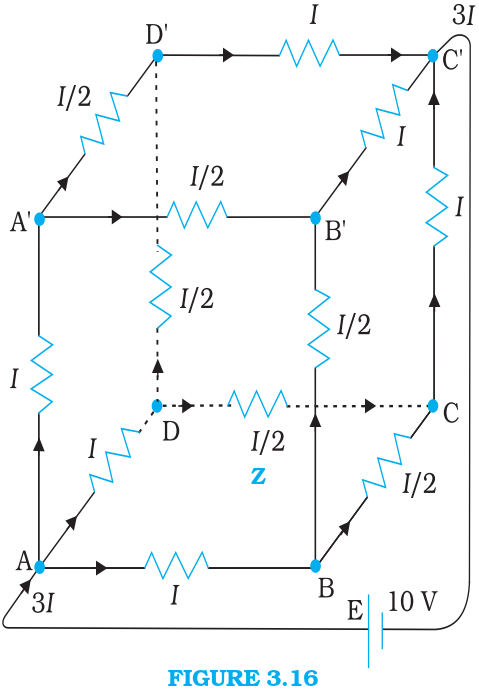
A battery of $10 V$ and negligible internal resistance is connected across the diagonally opposite corners of a cubical network consisting of 12 resistors each of resistance $1 \Omega$ (Fig. 3.16). Determine the equivalent resistance of the network and the current along each edge of the cube.
Image
  1. Define self inductance. Write its S.I. units.
  2. Derive an expression for self inductance of a long, solenoid of length l, cross sectional area A having N number of turns.
A solid sphere rolling on a rough horizontal surface with a linear speed v collides elastically with a fixed, smooth, vertical wall. Find the speed of the sphere after it has started pure rolling in the backward direction.
A proton and an α-particle move perpendicular to a magnetic field. Find the ratio of radii of the circular paths described by them when both (i) have equal momenta, and (ii) were accelerated through the same potential difference.
A proton and an alpha particle are accelerated through the same potential. Which one of the two has (i) greater value of de-Broglie wavelength associated with it, and (ii) less kinetic energy? Justify your answers.
A solenoid of length 1.0m, radius 1cm and total turns 1000 wound on it, carries a current of 5A. Calculate the magnitude of the axial magnetic field inside the solenoid. If an electron was to move with a speed of $104ms^{–1}$ along the axis of this current carrying solenoid, what would be the force experienced by this electron?