Question
Does the polarising angle for any transparent medium depend on the wavelength of light?

Answer

Yes, Reason: Angle of polarisation $\text{i}_\text{B}=\tan^{-1}(\text{n})$ and since refractive index varies as inverse of square of wavelength so angle of polarisation decreases with increase of wavelength.

Need a full question paper?

Generate a complete, print-ready paper with questions like this in minutes — across 16+ boards, with answer keys.
Start Generating Free

Similar questions

Show that the radius of the orbit in hydrogen atom varies as n2, where n is the principal quantum number of the atom.
A long narrow horizontal slit is placed 1mm above a horizontal plane mirror. The interference between the light coming directly from the slit and that after reflection is seen on a screen 1.0m away from the slit. Find the fringe-width if the light used has a wavelength of 700nm.
Radioactive $^{131}I$ has a half-life of 8.0 days. A sample containing $^{131}I$ has activity $20\mu\text{Ci}$ at $t = 0.$
  1. What is its activity at t = 4 days?
  2. What is its decay constant at t = 4.0 days?
Evaluate Rydberg constant by putting the values of the fundamental constants in its expression.
A simple microscope using a single lens often shows coloured image of a white source. Why?
An $\alpha-\text{particle}$ and a proton of the same kinetic energy are in turn allowed to pass through a magnetic field $\overrightarrow{\text{B}},$acting normal to the direction of motion of the particles. Calculate the ratio of radii of the circular paths described by them.
Several capacitors of capacitance $C$ are connected in infinite number as shown in the figure. Find the value of total capacitance between points $A$ and $B$.
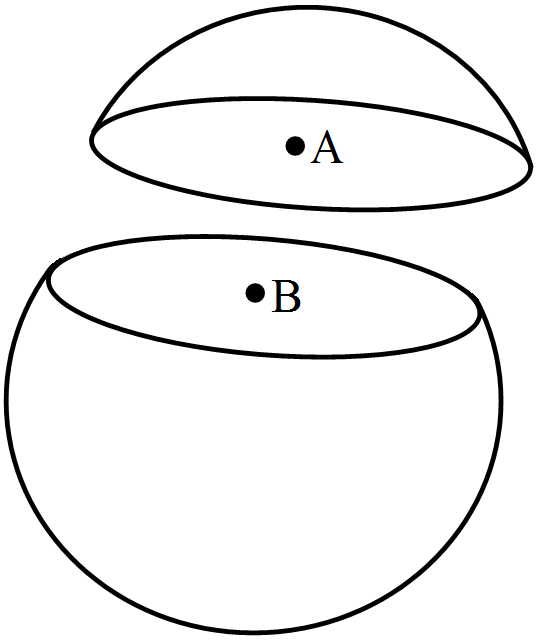
A thin spherical shell having uniform density is cut in two parts by a plane and kept separated as shown in figure (11-E3). The point A is the centre of the plane section of the first part and B is the centre of the plane section of the second part. Show that the gravitational field at A due to the first part is equal in magnitude to the gravitational field at B due to the second part.
The selling rate of a radioactive isotope is decided by its activity. What will be the second-hand rate of a one month old $\text{ }^{32}\text{P}\big(\text{t}_{\frac{1}{2}}=14.3\text{days}\big)$ source if it was originally purchased for 800 rupees?
An extended object is placed at a distance of 5.0cm from a convex lens of focal length 8.0cm.
  1. Draw the ray diagram (to the scale) to locate the image and from this, measure the distance of the image from the lens.
  2. Find the position of the image from the lens formula and see how close the drawing is to the correct result.