Question
Does the temperature of a body depend on the frame from which it is observed?

Answer

No, the temperature of a body is not dependent on the frame from which it is observed. This is because atoms/ molecules of matter move or vibrate in all possible directions. Increase in velocity at a particular direction of the container/ matter does not increase or decrease the overall velocity of the molecules/ atoms because of the random collisions the entities suffer. So, there is no net rise in temperature of the system.

Need a full question paper?

Generate a complete, print-ready paper with questions like this in minutes — across 16+ boards, with answer keys.

Start Generating Free

Similar questions

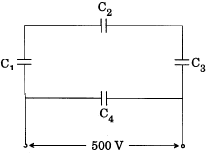
A network of four capacitors each of 12 μF capacitance is connected to a 500 V supply as shown in the figure. Determine (a) equivalent capacitance of the network and (b) charge on each capacitor.
A wire carries an alternating current $\text{i}=\text{i}_0\sin\omega\text{t}.$ Is there an electric field in the vicinity of the wire?
For a CE-transistor amplifier, the audio signal voltage across the collected resistance of 2k Ω is 2 V. Suppose the current amplification factor of the transistor is 100, find the input signal voltage and base current, if the base resistance is 1k Ω.
  1. How are electromagnetic waves produced? Explain.
  2. A plane electromagnetic wave is travelling through a medium along the +ve z-direction. Depict the electromagnetic wave showing the directions of the oscillating electric and magnetic fields.
What is the nature of electrostatic force between two point electric charges $q_1$ and $q_2$ if:
  1. $q_1 + q_2 > 0?$
  2. $q_1 + q_2 < 0?$
Find the angle of minimum deviation for an equilateral prism made of a material of refractive index 1.732. What is the angle of incidence for this deviation?
Figure, shows an aluminium rod joined to a copper rod. Each of the rods has a length of 20cm and area of cross section $0.20cm^2$. The junction is maintained at a constant temperature $40^\circ C$ and the two ends are maintained at $80^\circ C.$ Calculate the amount of heat taken out from the cold junction in one minute after the steady state is reached. The conductivities are KAI ${= 200wm^{-1}}{^\circ C^{-1}}$ and ${K_{cu} = 400wm^{-1}}^\circ C^{-1}.$
In what way is Gauss’s law in magnetism different from that used in electrostatics? Explain briefly. The Earth’s magnetic field at the Equator is approximately 0.4 G. Estimate the Earth’s magnetic dipole moment. Given: Radius of the Earth = 6400 km.
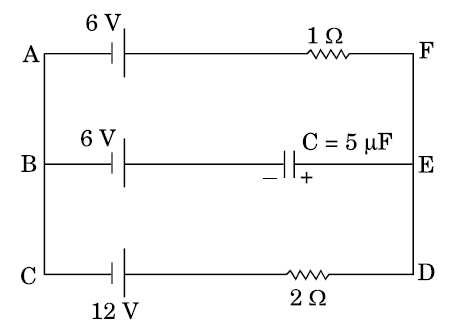
In the given circuit, with steady current, calculate the potential difference across the capacitor and the charge stored in it.
A 12 pF capacitor is connected to a 50 V battery. How much electrostatic energy is stored in the capacitor? If another capacitor of 6 pF is connected in series with it with the same battery connected across the combination, find the charge stored and potential difference across each capacitor.