Question
  1. How are electromagnetic waves produced? Explain.
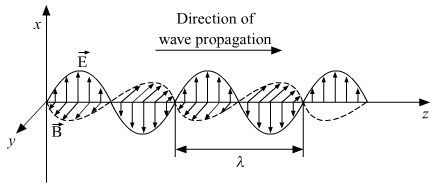
  2. A plane electromagnetic wave is travelling through a medium along the +ve z-direction. Depict the electromagnetic wave showing the directions of the oscillating electric and magnetic fields.
Answer

  1. Electromagnetic waves are formed as a result of accelerating (electric) charges under electric field. Electric charge exhibit electrostatic behaviour and once they start moving magnetic effects come into play. As a result of this a duality is established which is called electromagnetism. The electromagnetic waves are emitted by those charged particles. These waves move with the velocity of light
  2. The cross product of electric and magnetic field vectors i.e.$\vec{E}\times\vec{B}$ gives the direction in which the wave travels.
It is given that wave is propagating along the +z-axis. This means that electric field vector is oscillating in positive x- direction and magnetic field vector in positive y-direction.
The propagation of electromagnetic wave in +z direction is shown here:

Need a full question paper?

Generate a complete, print-ready paper with questions like this in minutes — across 16+ boards, with answer keys.

Start Generating Free

Similar questions

What should be the distance between the object in Exercise 9.30 and the magnifying glass if the virtual image of each square in the figure is to have an area of $6.25\ mm^2$. Would you be able to see the squares distinctly with your eyes very close to the magnifier?
The potential difference between the terminals of a battery of emf 6.0V and internal resistance $1\Omega$ drops to 5.8V when connected across an external resistor. Find the resistance of the external resistor.
Explain emf, potential difference and internal resistance of cell and derive the relation between them. (or derive the relation between emf, potential difference and internal resistance of the cell.)
Draw a circuit diagram of a transistor amplifier in CE configuration.
Define the terms: (i) Input resistance and (ii) Current amplification factor. How are these determined using typical input and output characteristics?
When we heat an object, it expands. Is work done by the object in this process ? Is heat given to the object equal to the increase in its internal energy?
  1. What are the three basic units in communication systems? Write briefly the function of each of these.
  2. Write any three applications of the internet used in communication systems.
Four point charges $q_A = 2 \mu\ C, q_B = –5 \mu\ C, q_C = 2 \mu\ C,$ and $q_D = –5 \mu\ C$ are located at the corners of a square ABCD of side 10 cm. What is the force on a charge of 1 μC placed at the centre of the square?
A rectangular wire loop of sides 8cm and 2cm with a small cut is moving out of a region of uniform magnetic field of magnitude 0.3T directed normal to the loop. What is the emf developed across the cut if the velocity of the loop is $1\ cms^{–1}$ in a direction normal to the:
  1. Longer side,
  2. shorter side of the loop?
For how long does the induced voltage last in each case?
Draw the circuit diagram showing how a p-n junction diode is
i. forward biased
ii. reverse biased
How is the width of depletion layer affected in the two cases?
Radioactive isotopes are produced in a nuclear physics experiment at a constant rate $\frac{\text{dN}}{\text{dt}}=\text{R}.$ An inductor of inductance 100mH, a resistor of resistance $100\Omega$ and a battery are connected to form a series circuit. The circuit is switched on at the instant the production of radioactive isotope starts. It is found that $\frac{\text{i}}{\text{N}}$ remains constant in time where i is the current in the circuit at time t and N is the number of active nuclei at time t. Find the half-life of the isotope.