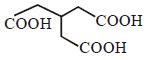
MCQ
$\begin{array}{*{20}{c}}
  {C{H_2} = CHCHC{H_2}C{H_2}OH} \\ 
  |\,\,\,\, \\ 
  {OH\,\,\,} 
\end{array}$ $\xrightarrow{{Mn{O_2}}}A.$

$A$ is

  • $\begin{array}{*{20}{c}}
      {C{H_2} = CHCC{H_2}C{H_2}OH} \\ 
      {||\,\,\,\,\,} \\ 
      O\,\,\,\, 
    \end{array}$
  • B
    $\begin{array}{*{20}{c}}
      {C{H_2} = CHCHC{H_2}CHO} \\ 
      | \,\,\,\\ 
      {OH} 
    \end{array}$
  • C
    $\begin{array}{*{20}{c}}
      {C{H_2} = CHCC{H_2}CHO} \\ 
      {||} \\ 
      O 
    \end{array}$
  • D
    $\begin{array}{*{20}{c}}
      {\,\,\,\,\,\,\,\,\,\,\,\,\,\,\,\,\,\,\,\,\,\,\,\,\,\,\,\,\,\,\,\,O} \\ 
      {\,\,\,\,\,\,\,\,\,\,\,\,\,\,\,\,\,\,\,\,\,\,\,\,\,\,\,\,\,\,\,\,||} \\ 
      {C{H_2} = CHCC{H_2}COH} \\ 
      {\,||} \\ 
      {\,O} 
    \end{array}$
Answer

Correct option: A.
$\begin{array}{*{20}{c}}
  {C{H_2} = CHCC{H_2}C{H_2}OH} \\ 
  {||\,\,\,\,\,} \\ 
  O\,\,\,\, 
\end{array}$
a

Need a full question paper?

Generate a complete, print-ready paper with questions like this in minutes — across 16+ boards, with answer keys.

Start Generating Free

Similar questions

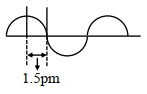
A hypothetical electromagnetic wave is show below.

(Image)

The frequency of the wave is $\mathrm{x} \times 10^{19} \mathrm{~Hz}$. $x=$ . . . .  (nearest integer)

For a chemical reaction $A+B \rightleftharpoons C+D$ $\left(\Delta_{r} H^{0}=80 \,k J\right.$ $mol\,^{-1}$ ) the entropy change $\Delta_{r} S^{0}$ depends on the temperature $T$ (in $K$ ) as $\left(\Delta_{ r } S ^{0}=2 T \left(\, J \,K ^{-1}\, mol ^{-1}\right)\right.$

Minimum temperature at which it will become spontaneous is ..... $K.$(Integer)

The correct decreasing order of priority for the functional groups of organic compounds in the $IUPAC$ system of nomenclature is
The conductivity of a solution of complex with formula $CoCl _{3}\left( NH _{3}\right)_{4}$ corresponds to $1: 1$ electrolyte, then the primary valency of central metal ion is
On bromination, propionic acid yields two isomeric $2-$bromopropionic acids. This pair is an important example of
In an aqueous solution $SCN^{-1}, B^{-1}, I^{-1}$ and $Cl^-$ are present. Which will get precipitated first, when $AgNO_3$ is mixed with each of them? Given that 
$Ksp$ of $AgCl = 1.2 \times 10^{-10}$,
$Ksp$ of $AgI = 1.7 \times 10^{-16}$
$Ksp$ of $AgSCN = 7.1 \times 10^{-7}$,
$Ksp$ of $AgBr = 3.5 \times10^{-13}$
On electrolysing a solution of dilute ${H_2}S{O_4}$ between platinum electrodes, the gas evolved at the anode is
Which of the following will increase the voltage of the cell represented by the equation

$C{u_{\left( s \right)}} + 2Ag_{\left( {aq} \right)}^ +  \to Cu_{\left( {aq} \right)}^{2 + } + 2A{g_{\left( s \right)}}$

The $IUPAC$ name of following compound is
Which of the following is the most suitable drying agent for ammonia gas