MCQ
Doppler effect is applicable for
  • A
    Moving bodies
  • B
    One is moving and other are stationary
  • For relative motion
  • D
    None of these

Answer

Correct option: C.
For relative motion
c
Relative motion apart decreases frequency. The greater the relative speed, the greater the effect. The Doppler effect occurs not only for sound, but for any wave when there is relative motion between the observer and the source

Need a full question paper?

Generate a complete, print-ready paper with questions like this in minutes — across 16+ boards, with answer keys.

Start Generating Free

Similar questions

Two masses of $10 \,kg$ and $20 \,kg$ respectivety are connected by a massless spring as shown in fig. A force of $200 \,N$ acts on the $20 \,kg$ mass At the instant shown the $10 \,kg$ mass has acceleration $12 \,m / s ^2$ towards right. The acceleration of $20 \,kg$ mass at this instant is ........ $m / s ^2$
Which of the following statements is wrong
A rod of mass $‘M’$ and length $‘2L’$ is suspended at its middle by a wire. It exhibits torsional oscillations; If two masses each of $‘m’$ are attached at distance $‘L/2’$ from its centre on both sides, it reduces the oscillation frequency by $20\%$. The value of ratio $m/M$ is close to
A coin is placed on a disc. The coefficient of friction between the coin and the disc is $\mu$. If the distance of the coin from the center of the disc is $r$, the maximum angular velocity which can be given to the disc, so that the coin does not slip away, is:
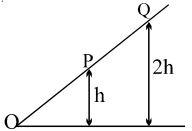
$A$ ball rolls down an inclined plane, figure. The ball is first released from rest from $P$ and then later from $Q$. Which of the following statement is/ are correct?

$(i)$ The ball takes twice as much time to roll from $Q$ to $O$ as it does to roll from $P$ to $O$.

$(ii)$ The acceleration of the ball at $Q$ is twice as large as the acceleration at $P$.

$(iii)$ The ball has twice as much $K.E$. at $O$ when rolling from $Q$ as it does when rolling from $P$.
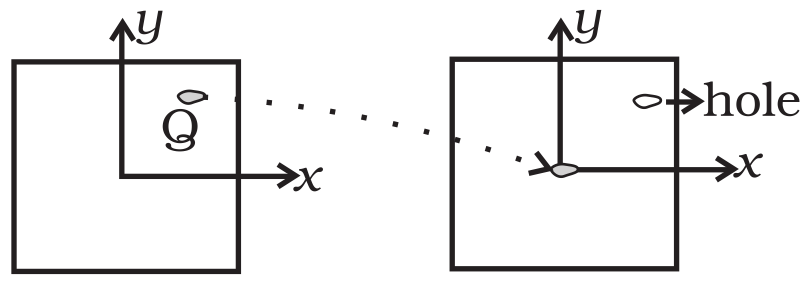
A uniform square plate has a small piece $Q$ of an irregular shape removed and glued to the centre of the plate leaving a hole behind. The moment of inertia about the $z-$axis is then:
A satellite of mass $m$ revolves around the earth of radius $R$ at a height $x$ from it's surface. If $g$ is the acceleration due to gravity on the surface of earth, the orbital speed of
A bullet of mass m fired at $30^\circ$ to the horizontal leaves the barrel of the gun with a velocity $v.$ The bullet hits a soft target at a height h above the ground while it is moving downward and emerges out with half the kinetic energy it had before hitting the target. Which of the following statements are correct in respect of bullet after it emerges out of the target?
If displacement $x$ and velocity $v$ are related as $4v^2 = 25 -x^2$ in a $SHM$. Then time Period of given $SHM$ is (Consider $SI\, units$)
The dimensional formula $[ML^0T^{-3}]$ is more closely associated with