MCQ
Doppler shift in frequency does not depend upon
  • A
    The frequency of the wave produced
  • B
    The velocity of the source
  • C
    The velocity of the observer
  • Distance from the source to the listener

Answer

Correct option: D.
Distance from the source to the listener
d
Change of frequency due to the Doppler effect is : $=n(\quad)$. This is independent of distance between source and observer.

Need a full question paper?

Generate a complete, print-ready paper with questions like this in minutes — across 16+ boards, with answer keys.
Start Generating Free

Similar questions

Two sound waves of wavelengths $5m$ and $6m$ formed $30$ beats in $3$ seconds. The velocity of sound is  .... $ms^{-1}$
A spring is compressed between two toy carts of mass $m_1$ and $m_2$. When the toy carts are released, the springs exert equal and opposite average forces for the same time on each toy cart. If $v_1$ and $v_2$ are the velocities of the toy carts and there is no friction between the toy carts and the ground, then :
A ball of mass $160\, g$ is thrown up at an angle of $60^o$ to the horizontal at a speed of $10\, m\,s^{-1}$ . The angular momentum of the ball at the highest point of the trajectcry with respect to the point from which the ball is thrown is nearly ........ $kg\, m^2/s$  $(g\, = 10\, m\,s^{-2})$
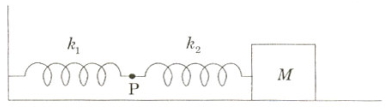
The mass $M$ shown in the figure oscillates in simple harmonic motion with amplitude $A$. The amplitude of the point $P$ is
If a load of $9$ $kg$ is suspended on a wire, the increase in length is $4.5\, mm$. The force constant of the wire is
A spring of force constant $k$ is cut in two parts at its one third length. When both the parts are stretched by same amount, the work done in the two parts, will be
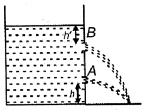
A tank is filled with water and two holes $A$ and $B$ are made in it. For getting same range, ratio of $h^{\prime} T h$ is ..........
A body rotates about a fixed axis with an angular acceleration of $3 \,rad / s ^2$. The angle rotated by it during the time when its angular velocity increases from $10 \,rad / s$ to $20 \,rad / s$ (in radian) is ..........
K.E. of molecular motion appears as:
Zero error of an instrument introduces