MCQ
Doppler's effect holds good for:
  • A
    Only sound waves.
  • B
    Only electromagnetic waves.
  • Both sound waves and electromagnetic waves.
  • D
    None of the above.

Answer

Correct option: C.
Both sound waves and electromagnetic waves.

Need a full question paper?

Generate a complete, print-ready paper with questions like this in minutes — across 16+ boards, with answer keys.
Start Generating Free

Similar questions

The distance between the carbon atom and the oxygen atom in a carbon monoxide molecule is $1.1\ Å$.  Given, mass of carbon atom is $12\ a.m.u.$ and mass of oxygen atom is $16\ a.m.u.$, calculate the position of the center of mass of the carbon monoxide molecule
A beaker is filled in with water is accelerated $a $ $m/s^2$  in $+x$ direction. The surface of water shall make on angle
Two satellite $A$ and $B$, ratio of masses $3 : 1$ are in circular orbits of radii $r$ and $4r$. Then ratio of total mechanical energy of $ A$ to $B$ is
A heave uniform rod Is hanging vertically form a foxed support. It is stretched by its won weight. The diameter of the rod is.
Two droplets merge with each other and forms a large droplet. In this process
A stationary source is emitting sound at a fixed frequency $\mathrm{f}_0$, which is reflected by two cars approaching the source. The difference between the frequencies of sound reflected from the cars is $1.2 \%$ of $f_0$. What is the difference in the speeds of the cars (in $\mathrm{km}$ per hour) to the nearest integer? The cars are moving at constant speeds much smaller than the speed of sound which is $330 \mathrm{~ms}^{-1}$.
A body of mass $5\ kg$ undergoes a change in speed from $20$ to $0.20\ m/ s.$ The momentum of the body would:
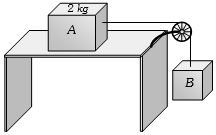
The coefficient of static friction, ${\mu _s},$ between block $A$ of mass $2\, kg$ and the table as shown in the figure is $0.2$. ........ $kg$ would be the maximum mass value of block $B$ so that the two blocks do not move. The string and the pulley are assumed to be smooth and massless. $(g = 10\,m/{s^2})$
In a simple harmonic motion:
  1. The maximum potential energy equals the maximum kinetic energy.
  2. The minimum potential energy equals the minimum kinetic energy.
  3. The minimum potential energy equals the maximum kinetic energy.
  4. The maximum potential energy equals the minimum kinetic energy.
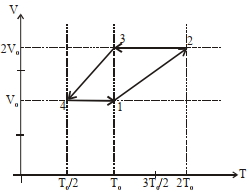
One mole of a monoatomic ideal gas goes through a thermodynamic cycle, as shown in the volume versus temperature ($V-T$) diagram. The correct statement($s$) is/are :

[ $R$ is the gas constant]

$(1)$ Work done in this thermodynamic cycle $(1 \rightarrow 2 \rightarrow 3 \rightarrow 4 \rightarrow 1)$ is $| W |=\frac{1}{2} RT _0$

$(2)$ The ratio of heat transfer during processes $1 \rightarrow 2$ and $2 \rightarrow 3$ is $\left|\frac{ Q _{1 \rightarrow 2}}{ Q _{2 \rightarrow 3}}\right|=\frac{5}{3}$

$(3)$ The above thermodynamic cycle exhibits only isochoric and adiabatic processes.

$(4)$ The ratio of heat transfer during processes $1 \rightarrow 2$ and $3 \rightarrow 4$ is $\left|\frac{Q_{U \rightarrow 2}}{Q_{3 \rightarrow 4}}\right|=\frac{1}{2}$