MCQ
Two droplets merge with each other and forms a large droplet. In this process
  • Energy is liberated
  • B
    Energy is absorbed
  • C
    Neither liberated nor absorbed
  • D
    Some mass is converted into energy

Answer

Correct option: A.
Energy is liberated
a
(a) When two droplets merge with each other, their surface energy decreases.

$W = T(\Delta A) = ({\rm{negative}})$   i.e. energy is released.

Need a full question paper?

Generate a complete, print-ready paper with questions like this in minutes — across 16+ boards, with answer keys.

Start Generating Free

Similar questions

An object moves at a constant speed along a circular path in a horizontal plane with centre at the origin. When the object is at $x =+2\,m$, its velocity is $-4 \hat{ j }\, m / s$. The object's velocity $(v)$ and acceleration $(a)$ at $x =-2\,m$ will be
A particle $P$ moving with speed $v$  undergoes a head -on elastic collision with another particle $Q$ of identical mass but at rest. After the collision
Join details of Column$-II$ with given information in Column$-I$ appropriately

Column $-I$  Column $-II$ 

$(a)$ Stress is proportional to strain.

$(i)$ Elastic limit
$(b)$ When the load of the wire is removed, the body does regain its original dimension. $(ii)$ Limit of pro-portionality
  $(iii)$ Plastic deformation
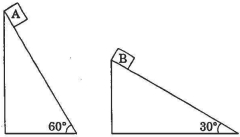
Two fixed frictionless inclined planes making an angle $30^o $ and $60^o $ with the vertical are shown in the figure. Two blocks $A$ and $B$ are placed on the two planes. What is the relative vertical acceleration of $A$ with respect to $B$?
A black body at a temperature of $127°C$ radiates heat at the rate of $1 cal/cm^2 × sec$. At a temperature of $527°C$ the rate of heat radiation from the body in ($cal/cm^2 × sec$) will be
If a liquid neither falls nor rise in a capillary tube, then the angle of contact between the liquid and the capillary material will be:
The length of a rod is $(11.05\pm0.05)\text{cm}.$ What is the total length of $2$ such rods?
In the motion of a projectile freely under gravity, its
A particle is moving with speed $6\,m/s$ along the direction of  $\vec A = 2\hat i + 2\hat j - \hat k,$ then its velocity is
On doubling the distance between two masses, the gravitational force between the masses: