Question
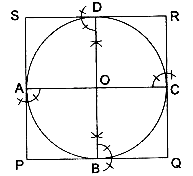
Draw a circle of radius 3 cm. Construct a square about the circle.
Answer

Steps of construction:

1) Draw a circle with centre O and radius equal to 3 cm.
2) Draw a diameter AC
3) Draw another diameter BD which bisects AC at right ∠s.
4) Join AB, BC, CD and DA.
5) Now draw tangents to the given circle at the points A, B, C, D and let them meet at P, Q, R, S. Then PQRS is the required square about the given circle.

Need a full question paper?

Generate a complete, print-ready paper with questions like this in minutes — across 16+ boards, with answer keys.

Start Generating Free

Similar questions

Draw an ogive for the following :
Age in yearsLess than 10Less than 20Less than 30Less than 40Less than 50
No. of people0174267100
A takes 10days less than B to Finish a piece of work , If both A and B work together , they can finish the work in 12 days. Find the time taken by B to finish the work.
If $\frac{a-2 b-3 c+4 d}{a+2 b-3 c-4 d}=\frac{a-2 b+3 c-4 d}{a+2 b+3 c+4 d}$ show that 2ad = 3bc
In Fig. l and m are two parallel tangents at A and B. The tangent at C makes an intercept DE between n and m. Prove that ∠ DFE = 90°
The mean of the following distribution is $21 \frac{1}{7}$. find the value of $f$
$C.I$ $0-10 $ $10-20$ $20-30$ $30-40$ $40-50$
Freq $8$ $22$ $31$ $f$ $2$
If $(x-2)$ is a factor of $2 x^3-x^2-p x-2$,
(a) find the value of $p$.
(b) with the value of $p$, factorise the above expression completely.
The points $A, B$ and $C$ are $(4, 0), (2, 2)$ and $(0, 6)$ respectively. Find the equations of $AB$ and
$BC$. If $AB$ cuts the y-axis at P and BC cuts the x-axis at $Q$, Find the co-ordinates of $P$ and $Q.$
The weights of $50$ apples were recorded as given below. Calculate the mean weight, to the nearest gram. by the Step Deviation Method.
Weights in grams No. of apples
$80 - 55$ $5$
$85 - 90$ $8$
$90 - 95$ $10$
$95 - 100$ $12$
$100 - 105$ $8$
$105 - 110$ $4$
$110 - 115$ $3$
The sum of the square of $2$ positive integers is $208$. If the square of larger number is $18$ times the smaller number, find the numbers.
If $a, b, c, d$ are in continued proportion, prove that:
$
\left(\frac{a-b}{c}+\frac{a-c}{b}\right)^2-\left(\frac{d-b}{c}+\frac{d-c}{b}\right)^2=(a-d)^2\left(\frac{1}{c^2}-\frac{1}{b^2}\right)
$