Questions

[4 marks sum]

🎯

Test yourself on this topic

19 questions · timed · auto-graded

Question 14 Marks
Draw a circle at a radius of 3 cm. Take a point at 5.5 cm from the center at the circle. From point P, draw two tangents to the circle.
Answer
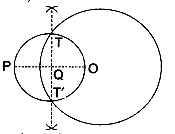
Steps of construction:
(i) Take a point O in the plane paper and draw a circle of radius 3 cm.
(ii) Mark a point P at distance 5.5 cm from the centre O and join OP.
(iii) Draw the right bisector at OP, intersecting OP at Q.
(iv) Taking Q as the centre and OQ = PQ as radius, draw a circle to intersect the given circle at T and T'.
(v) Join PT and PT' to get the required tangent.
Taype (II). Construction of a tangent to a circle from an external point when its centre is known.
Steps of construction:
Let P be the external point from where the tangent are to be drawn to the given circle.
(i) Through P draw a secant PAB to intersect the circle at A and B.
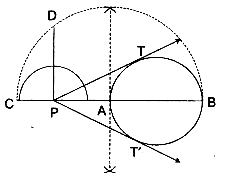
(ii) Join AP to a point C such that AP = DX is equal to the mid-point at AC.
(iii) Draw a semicircle with BC as diameter.
(iv) Draw PD ⊥ BCX intersecting the semicircle at D.
(v) With P as centre and PD as radius draw arcs to intersect the given circle at T and T'.
(vi) Join PT and PT'. Then PT and PT' are the required tangent.
View full question & answer
Question 24 Marks
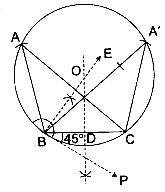
Construct a ΔABC with base BC = 3.5 cm, vertical angle ∠ BAC = 45°, and median through the vertex A is 3.5 cm. Write also the steps of construction.
Answer

Steps of construction:
1) Draw a line segment BC = 3 cm and make ∠ CBP = 45°
2) Construct EB ⊥ BP.
3) Draw the perpendicular bisector of BC its intersecting BE in O and BC in D.
4) Draw a circle taking O as a centre and OB as the radius.
5) Now with D as centre and radius = 3.5 cm. draw arcs of the circle intersecting the above-drawn circle in A and A'.
6) Join AB, AC and A'B, A'C.
Then the Δs, ΔABC and ΔA'BC are the required triangles.
View full question & answer
Question 34 Marks
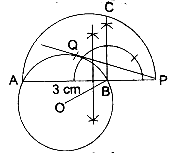
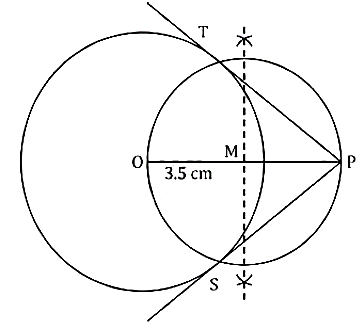
Draw a circle of radius 3 cm and construct a tangent to it from an external point without using the center.
Answer

Steps of construction:
1) With centre O and radius = 3 cm, draw a circle.
2) Take any point P outside the circle.
3) Through the external point, P draw a straight line PBA meeting the circle at A and B.
4) Draw a semicircle on AP as diameter.
5) Draw BC ⊥ AP, which intersects the semicircle at C.
6) With centre P and radius, PC draw an arc cutting the circle at Q.
7) Join PQ. Then PQ is the required tangent.
View full question & answer
Question 44 Marks
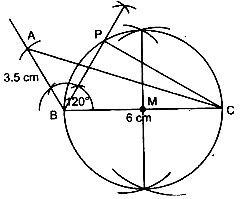
Using a ruler and compasses only:
(i) Construct a triangle ABC with the following data: AB = 3.5 cm, BC = 6 cm and ∠ ABC = 120°.
(ii) In the same diagram, draw a circle with BC as diameter. Find a point P on the circumference of the circle which is equidistant from AB and BC.
(iii) Measure ∠ BCP.
Answer

Steps of construction:
(i)

1) Draw a line segment BC = 6 cm.
2) Draw ∠ ABC = 120°.
3) With centre B and radius BA = 3.5 cm, draw an arc.
4) Join AB and AC.
(ii)
1) Draw the right bisector on line BC cut the BC line at M.
2) Draw another bisector of line AC.
3) With M as centre and radius MB draw a circle cut AC bisector at P.
(iii) ∠ BCP = 30°
View full question & answer
Question 54 Marks
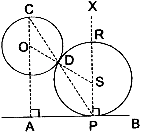
The center O of a circle of a radius 1.3 cm is at a distance of 3.8 cm from a given straight line AB. Draw a circle to touch the given straight line AB at a point P so that OP = 4.7 cm and to touch the given circle externally.
Answer

Steps of construction:
1) Take a point O at a distance of 3.8 cm from AB and with O as centre draw a circle of radius 1.3 cm.
2) With O as centre and radius equal to 4.7 cm, draw an arc cut BA at P. Draw PX perpendicular to AB.
3) Produce AO to cut the circle at C and join CP cutting the circle at D.
4) Join OD and produce it to cut PX at S. With S as centre and radius = SD, draw the circle PDR. This is the required circle.
View full question & answer
Question 64 Marks
(i) Construct a triangle ABC, in which AB = 5.0 cm, BC = 3.5 cm and ∠ ABC = $67 \frac{1}{2}^{\circ}$
( Use a pair of compasses and ruler only.)
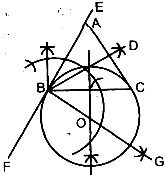
(ii) Construct a circle to touch AB at B and it pass though C.
Answer

Steps of construction:
1) Draw BC = 3.5 cm.
2) At B draw BE such that ∠ EBC = $67 \frac{1}{2}^{\circ}$. From BE cut off BA = 5 cm
3) Join AC. Then ΔABC is the required triangle.
4) Produce EB to F.
5) At B draw BG such that ∠ EBG = 90°.
6) Draw perpendicular bisector of BC to cut BG at O.
7) With O as centre and OB as radius draw a circle. This is the required circle to touch AB at B and pass-through C.
View full question & answer
Question 74 Marks
Ruler and compasses only may be used in this question. All constructions lines and arcs must be clearly shown, and the be sufficient length and clarity to permit assessment:
(i) Construct a triangle ABC, in which AB = 9 cm, BC = 10 cm and angle ABC = 45°.
(ii) Draw a circle, with center A and radius 2.5 cm. Let it meet AB at D.
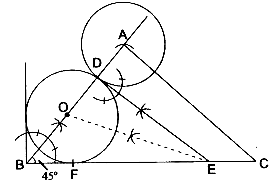
(iii) Construct a circle to touch the circle with center A externally at D and also to touch the line BC.
Answer

Steps of construction:
1) Take BC = 10 cm
2) Make ∠ ABC = 45° and with centre B, cut the arc = 9 cm.
3) Join AC, So Δ ABC is the required triangle.
4) With A as centre and radius = 2.5 cm, draw a circle. It will pass through D.
5) Draw DE ⊥ AB, which cuts BC at E.
6) Draw the angle bisector of ∠ BED which cut BD at O.
7) Taking Radius = OD to draw a circle which touches the first circle at D and also touches the line BC at F.
8) This is the required circle. The radius OD = 2.7 cm.
View full question & answer
Question 84 Marks
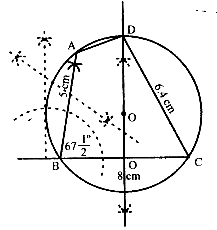
Use a ruler and compass only for this question to construct the cyclic quadrilateral ABCD in which AB = 5 cm, BC = 8 cm, ∠ ABC = $67 \frac{1}{2}^{\circ}$, and D is equidistant from B and C.
Answer

Steps of construction:
1) Draw BC = 8 cm, Construct ∠ B = $67 \frac{1}{2}^{\circ}$and Cutoff AB = 5 cm.
2) Draw bisector of BC and AB and produce these to meet at O.
3) With O as the centre, radius OA or Ob or OC draw a circle to pass-through ∠ABC.
4) Produce the bisector of BC to interest the circumference of the circle. This intersection point is D.
5) Join CD and AD.
6) ABCD is the required cyclic quadrilateral. Length of CD = 6.4 cm. ....(By measurement).
View full question & answer
Question 94 Marks
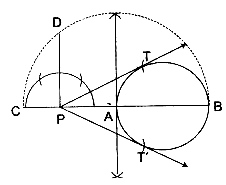
Draw a circle of radius 4 cm. Take a point P outside the circle without using the center at the circle. Draw two tangents to the circle from point P.
Answer

Steps of construction:

(i) Draw a circle of radius 4 cm.
(ii) Take a point P outside the circle and draw a secant PAB, intersecting the circle at A and B.
(iii) Produce AP to C such that AP = CP.
(iv) Draw a semicircle with CB as diameter.
(v) Draw PD and CB intersecting the semi-circle at D.
(vi) With P as centre and PD as a radius draw arcs to intersect the given circle at T and T'.
(vii) Join PT and PT'. Then PT and PT' are the required tangents.
View full question & answer
Question 104 Marks
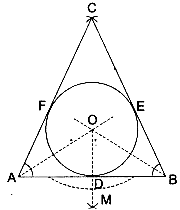
Draw an isosceles triangle with sides 6 cm, 4 cm, and 6 cm. Construct the incircle of the triangle. Also, write the steps of construction.
Answer

Steps of construction:
1) Construction a Δ ABC such that AB = 4 cm, AC = 6 cm, BC = 6 cm
2) Draw the bisectors of ∠ A and ∠ B and let them meet at O.
3) With O as centre draw OM the right bisector of AB meeting AB at D.
4) With O as centre and OD as radius draw a circle. The circle touches the sides of the Δ ABC at D, E, and F. Then this is the required incircle of Δ ABC.
View full question & answer
Question 114 Marks
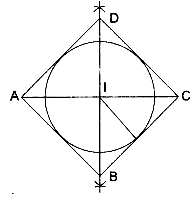
Construct the rhombus ABCD whose diagonals AC and BD are of lengths 8 cm and 6 cm respectively. Construct the inscribed circle of the rhombus. Measure its radius.
Answer

Steps of construction:
1) Draw AC = 8 cm
2) Draw perpendicular bisector of AC = cut it at I.
3) Cut IB $=\frac{6}{2}$ = 3cm and ID = 3 cm and join ABCD. Then ABCD is the required rhombus.
4) Now form I draw a perpendicular to BC to meet it at L.
5) With I as centre and IL as radius draw a circle which is the required circle. Its radius = IL = 2.4 cm.
View full question & answer
Question 124 Marks
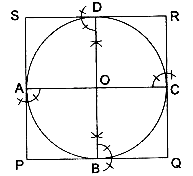
Draw a circle of radius 3 cm. Construct a square about the circle.
Answer
Steps of construction:

1) Draw a circle with centre O and radius equal to 3 cm.
2) Draw a diameter AC
3) Draw another diameter BD which bisects AC at right ∠s.
4) Join AB, BC, CD and DA.
5) Now draw tangents to the given circle at the points A, B, C, D and let them meet at P, Q, R, S. Then PQRS is the required square about the given circle.
View full question & answer
Question 134 Marks
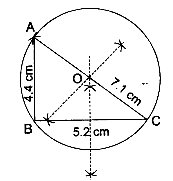
Construct a triangle whose sides are 4.4 cm, 5.2 cm, and 7.1 cm. Construct its circumcircle. Write also the steps of construction.
Answer
Steps of construction:

1) Draw an line segment BC = 5.2
2) With centre B and radius BA = 4.4 cm, draw an arc.
3) With C centre and radius CA = 7.1 cm, draw an arc intersecting the previous arc at A. Then ABC is the given triangle.
4) Draw the perpendicular bisectors of any two sides, say BC and AC, intersecting at O. Then O is the circumference of ΔABC.
View full question & answer
Question 144 Marks
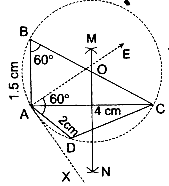
Using ruler and compass construct a cyclic quadrilateral ABCD in which AC = 4 cm, ∠ ABC = 60°, AB 1.5 cm and AD = 2 cm. Also, write the steps of construction.
Answer


Steps of construction:
1) Draw a line segment AC = 4 cm.
2) Draw ∠ CAX = 60°.
3) Draw the perpendicular bisector MN of AC.
4) Draw EA ⊥ AX at point A which intersects MN at O.
5) With Centre O and radius OA draw a circle.
6) Mark a point B on the circumference of the circle such that AB = 1.5 cm and mark a point D on the circumference so that AD = 2.0 cm.
7) Join BC and measure ∠ ABC = 60°. Then ABCD is the required cyclic quadrilateral.
View full question & answer
Question 154 Marks
(a) Only the ruler and compass may be used in this question. All contraction lines and arcs must be clearly shown and be of sufficient length and clarity to permit assessment.
(i) Construct a ABC, such that AB = AC = 7 cm and BC = 5 cm.
(ii) Construct AD, the perpendicular bisector of BC.
(iii) Draw a circle with center A and radius 3 cm. Let this circle cut AD at P.
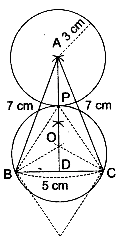
(iv) Construct another circle, to touch the circle with center A, externally at P, and pass through B and C.
Answer

Steps of construction:
(i) 1) Draw BC = 5 cm.
2) With B and C as centres draw two arcs to length 7 cm cutting each at A.
3) Join AB and AC
4) Then ABC is required triangle.
(ii) Draw AD, the right bisector of BC.
(iii) With A as centre and radius 3 cm draw a circle meeting AD in P.
(iv) 1) Join BP and CP.
2) Draw the right bisector of CP meeting AD in O.
3) With O as centre and radius equal to Op draw the required circle, passing through B and C.
View full question & answer
Question 164 Marks
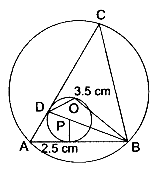
Using ruler and compass only, construct a triangle ABC such that AB = 5 cm, ABC = 75°, and the radius of the circumcircle of triangle ABC is 3.5 cm. On the same diagram, construct a circle, touching AB at its middle point and also touching the side AC.
Answer
Steps:
Draw a line segment AB = 5 cm long. Make an angle of 75° at 'B' draw perpendicular bisector of AB and the angular bisector of B.
Make 3.5 cm on the perpendicular bisector with O as centre and radius equal to OA or OB draw circumcircle. Mark 2.5 cm on AC from A. Join BD, it will intersect at P, with P as centre and PD as radius draw another circle.
View full question & answer
Question 174 Marks
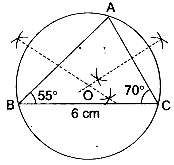
Construct the circumcircle of the ABC when BC = 6 cm, B = 55° and C = 70°.
Answer

Steps of construction:
(i) Draw a line segment BC = 6 cm.
(ii) At point B, make ∠ CBA = 55°, and at point C, make an angle ∠ BCA = 70° with the help of a protractor. Join AB and AC.
(iii) Draw the perpendicular bisectors of sides AB and AC. Let them intersects at O.
(iv) With O as centre and radius OA, draw a circle which passes through the point A, B and C. This is the required circumcircle of ΔABC.
View full question & answer
Question 184 Marks
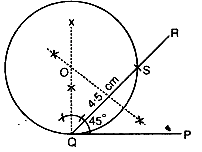
Construct an angle PQR = 45°. Mark a point S on QR such that QS = 4.5 cm. Construct a circle to touch PQ at Q and also to pass through S.
Answer


Steps of constructions:
(i) Draw ∠ PQX = 90°
(ii) Bisects ∠ PQX and draw ∠ PQR = 45°
(iii) Cut off QS = 4.5 cm from QR.
(iv) r bisector of QS and it intersects of QX at O.
(v) With O as centre and radius = OQ ( or OS draw the required circle).
View full question & answer
Question 194 Marks
Draw a circle of radius 3.5 cm. mark a point P outside the circle at a distance of 6 cm from the centre. Construct two tangents from P to the given circle. Measure and write down the length of one tangent.
Answer

Steps of Construction:
i) Draw a line segment OP = 6 cm
ii) With centre O and radius 3.5 cm, draw a circle
iii) Draw the midpoint of OP
iv) With centre M and diameter OP, draw a circle which intersect the circle at T and S
v) Join PT and PS.
PT and PS are the required tangents. On measuring the length of PT = PS = 4.8 cm
View full question & answer
[4 marks sum] - Mathematics STD 10 Questions - Vidyadip