Question
Draw a circle with centre O and radius 3 cm. Take a point P outside the circle. Draw tangents to the circle from P without using the centre and using only ruler and compasses.
Answer


Steps of construction:
(i) Draw a cirde of radius 3 cm with centre O.
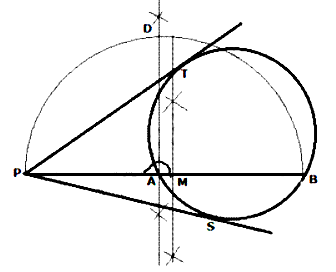
(ii) If P is the given point, then draw PAB a secant to the given circle.
(iii) Draw a perpendicular bisector of PB and let M be the mid-point of PB.
(iv) With Mas centre and MP as radius, draw a semi-circle on PB.
(v) At A, draw a perpendicular to PB. Let this perpendicular meet the semi-circle at D.
(vi) With P as centre and PD as radius, cut off two arcs on the given circle at T and S.
(vii) Join PT and PS.
(viii) PT and PS are the required tangents.

Need a full question paper?

Generate a complete, print-ready paper with questions like this in minutes — across 16+ boards, with answer keys.

Start Generating Free

Similar questions

Draw a circle of radius 4.5 cm. Take a point Pon its circumference. Construct a tangent to the circle at P without using the centre.
If $(x + 1)$ and $(x – 2)$ are factors of $x^3 + (a + 1)x^2 – (b – 2)x – 6$, find the values of a and b. And then, factorise the given expression completely.
40 students enter for a game of shot-put competition. The distance thrown (in metres) is recorded below:
Distance (in m)12 - 1313 - 1414 - 1515 - 1616 - 1717 - 1818 - 19
Number of Students39129421
Use a graph paper to draw an ogive for the above distribution.
Use a scale of 2cm = 1 m on one axis and 2cm = 5 students on the other axis.
Hence using your graph find:
(a) the median
(b) upper quartile
(c) the number of students who cover a distance which is above $16 \frac{1}{2} \mathrm{~m}$.
If $A =\left|\begin{array}{cc}3 & -2 \\ -1 & 4\end{array}\right|, B =\left|\begin{array}{c}2 a \\ 1\end{array}\right|, C =\left|\begin{array}{c}-4 \\ 5\end{array}\right|, D =\left|\begin{array}{l}2 \\ b \end{array}\right|$ and $AB +2 C =4 D$ then find the values of $a$ and $b$.
An observer point for ships moving in the sea 500m above the sea level. The person manning this point observes the angle of depression of twc boats as 45° and 30°. Find the distance between the boats when they are on the same side of the observation point and when they are on opposite sides of the observation point.
The daily wages of 80 workers in a project are given below.

 
Wages
(in Rs.)
400-450 450-500 500-550 550-600 600-650 650-700 700-750
No. of
Workers
2 6 12 18 24 13 5

Use a graph paper to draw an ogive for the above distribution. (Use a scale of 2 cm = Rs.
50 on x-axis and 2 cm = 10 workers on y-axis). Use your ogive to estimate:
1)the median wage of the workers
2)the lower quartile wage of workers
3)the numbers of workers who earn more than Rs. 625 daily

A vertical pole and a vertical tower are on the same level ground in such a way that from the top of the pole, the angle of elevation of the top of the tower is $60^\circ$ and the angle of depression of the bottom of the tower is $30^\circ.$ Find: the height of the tower, if the height of the pole is $20\ m.$
Construct histograms for following frequency distribution:
Class Mark 6 12 18 24 30 36
Frequency 8 12 15 18 25 7
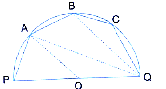
The given figure shows a semi-circle with centre O and diameter PQ. If PA = AB and ∠BCQ =140°; Find measures of angles PAB and AQB. Also, show that AO is parallel to BQ.
A man buys 400, twenty-rupee shares at a discount of 20% and receives a return of 12% on his money. Calculate:
(1) the amount invested by him.
(2) the rate of dividend paid by the company.