Questions

[5 Mark Question Answer]

🎯

Test yourself on this topic

22 questions · timed · auto-graded

Question 15 Marks
State one advantage of using a.c. over d.c.
Answer
The voltage of a.c. can be stepped up by the use of step-up transformer at the power generating station before transmitting it over long distances. It reduces the loss of electrical energy as heat in the transmission line wires. On the other hand, if d.c. is generated at the power generating station, its voltage cannot be increased for transmission, and so due to passage of high current in the transmission line wires, there will be a huge loss of electrical energy as heat in the line wires.
View full question & answer
Question 25 Marks
Name the markings of a three-pin plug. Give the colour codes of the connecting leads.
Answer
The three pins of a three-pin plug are:
(i) Live pin
(ii) Neutral pin
(iii) Earth pin.
The colour of the corresponding connecting leads are
(i) Live pin—Brown (or Red),
(ii) Neutral pin—Blue (or Black),
(iii) Earth pin—yellow (or Green).
View full question & answer
Question 35 Marks
Two sets A and B of four bulbs each are glowing in two separate rooms. When one of the bulbs in set A is fused, the other three bulbs also cease to glow. But in set B, when one bulb fuses the other bulbs continue to glow. Explain the difference.
Answer
In set A, the bulbs are connected in series. Thus, when the fuse of one bulb blows off, the circuit gets broken and current does not flow through the other bulbs also.
In set B, the bulbs are connected in parallel. Thus, each bulb gets connected to its voltage rating (= 220 V) and even when the fuse of one bulb blows off, others remain unaffected and continue to glow.
View full question & answer
Question 45 Marks
Two bulbs are rated: bulb A 100W, 120 V bulb B 10 W, 120 V. If both are connected across a 120V supply, which bulb will consume more energy, When in parallel? Also calculate the current through each bulb in the above cases.
Answer
In the case of bulb A, Power: $P =\frac{ V ^2}{ R _{ A }}$
$
R _{ A }=\frac{ V ^2}{ P }=\frac{120 \times 120}{100}=144 \Omega
$
i.e., Resistance $\left(R_A\right)$ of bulb, $A=144 \Omega$
Similarly resistance $R_B$ of bulb, $B=\frac{V^2}{P}$
$
=\frac{120 \times 120}{10}=1440 \Omega
$
When the bulb are connected in Parallel:
Voltage is the same (120 V) across each bulb.
$\therefore$ The current in bulb $A$ or $I _{ A }=\frac{ V }{ R _{ A }}=\frac{120}{144}=0.83 A$
$\therefore$ The current in bulb $B$ or $I _{ B }=\frac{120}{1440}=0.083 A$
A
Hence, power consumed in bulb $A = P _{ A }=$
$
\begin{aligned}
& \frac{ V ^2}{ R _{ A }}=\frac{120 \times 120}{144} \\
& =100 W
\end{aligned}
$
and power consumed in bulb $B=P_B=\frac{V^2}{R_B}$
$
=\frac{120 \times 120}{1440}=10 W
$
Hence, bulb A (100W, 120 V) consumes more energy then bulb B, when both are connected in parallel.
View full question & answer
Question 55 Marks
Two bulbs are rated: bulb A 100W, 120 V bulb B 10 W, 120 V. If both are connected across a 120V supply, which bulb will consume more energy, When in series? Also calculate the current through each bulb in above cases.
Answer
(i) Maximum power of the circuit = (40 × 15) + (100 × 5) + (80 × 5) + (1000 × 1)
= 600 + 500 + 400 + 1000
= 2500 W = 2.5 kW.
(ii) Maximum current capacity =
$\frac{\text { Total wattage }}{\text { Voltage of mains }}=\frac{2500}{220}=11.36$
(or 11.4) A.
(iii) Electrical energy consumed in a week
In 40 W bulbs =
$\frac{(40 \times 15) \times(4 \times 7)}{1000}=16.8 kWh$
$\begin{aligned} & \text { In } 100 W \text { bulbs }=\frac{(100 \times 5) \times(4 \times 7)}{1000}=14 \\ & kWh \end{aligned}$
In 1 kW heater =
$\frac{(1000 \times 1) \times(2 \times 7)}{1000}=14 kWh$
∴ Total electrical energy consumed = 16.8 + 14 + 28 + 14 = 72.8 kWh
(iv) Cost of electricity = 72.8 × 1.25 = Rs. 91
View full question & answer
Question 65 Marks
A house is provided with 15 bulbs of 40W, 5 bulbs of 100W, 5 fans of 80 W, and one heater of 1.0 kW. Each day bulbs are used for 4h, fans for lOh, and heater for 2h. The voltage of mains is 220 V. Calculate:
(i) Maximum power of the circuit in the house,
(ii) maximum current capacity of the main fuse in the house,
(iii) the electrical energy consumed in a week,
(iv) cost of electricity consumed at 1.25 Rs. per kWh.
Answer
(i) Maximum power of the circuit = (40 × 15) + (100 × 5) + (80 × 5) + (1000 × 1)
= 600 + 500 + 400 + 1000
= 2500 W = 2.5 kW.
(ii) Maximum current capacity =
$\frac{\text { Total wattage }}{\text { Voltage of mains }}=\frac{2500}{220}=11.36$
(or 11.4) A.
(iii) Electrical energy consumed in a week
In 40 W bulbs =
$\frac{(40 \times 15) \times(4 \times 7)}{1000}=16.8 kWh$
$\begin{aligned} & \text { In } 100 W \text { bulbs }=\frac{(100 \times 5) \times(4 \times 7)}{1000}=14 \\ & kWh \end{aligned}$
In 1 kW heater =
$\frac{(1000 \times 1) \times(2 \times 7)}{1000}=14 kWh$
∴ Total electrical energy consumed = 16.8 + 14 + 28 + 14 = 72.8 kWh
(iv) Cost of electricity = 72.8 × 1.25 = Rs. 91
View full question & answer
Question 75 Marks
An immersion rod having resistance of $50 Ω$ is connected to 220V main supply. Assuming that all the energy generated goes to heat the water, calculate the time taken to heat $5$ kg water from $30^\circ C$ to $100^\circ C.$
Answer
We know that $P = VI$
$\therefore I =\frac{ P }{ V }=\frac{220}{50}=4.4$
Heat produced in an immersion heater
$H = I^2Rt$
$H = (4.4)^2 \times 50 \times t$
$H = 968 t$ Joules
and Heat needed = mcθ
where C is the sp. heat capacity of water
$= 4.2 \times 10^3 J/kgC = 5 \times 4.2 \times 10^3 \times (100 - 30)$
$= 5 \times 4.2 \times 10^3 \times 70 = 1470000 J.$
But Heat lost = Heat gained
$968 t = 1470000$
$t =\frac{1470000}{968}$
$t = 1518.59$ secs
$t = 1518.6$ secs
$t = 25.326$ min.
$t = 25.33$ mins.
 
View full question & answer
Question 85 Marks
A bulb is marked $100W, 220V$ and an electric heater is marked $2000 W, 220 V.$
(i) What is the ratio between the resistances of these two devices?
(ii) How does the power-voltage rating of a device help us to decide about the type of leads (connecting wires) to be used for it?
(iii) In which of the above two devices, a thicker connecting wire of lead is required?
Answer
(i) For bulb, let $R_1$​​​​​​​ be the resistance of its filament wire
$P = V \times I or W = V \times I$
$100=200 \times I=\frac{220 \times V}{R_1}=\frac{220 \times 220}{R_1}$
$\therefore R _1=\frac{220 \times 220}{100} \Omega=484 \Omega$
For heater, let its resistance be $R_2$
$2000=220 \times I =\frac{220 \times 220}{ R _2}$
$\therefore R _2=\frac{220 \times 220}{2000} \Omega=24.2 \Omega$
i.e., $R1 : R2 = 20 : 1$
(ii) In the case of bulb current $I1 =$
$\frac{W}{V}=\frac{100}{200}=\frac{5}{11} A=0.45 A$
We have (i) and (ii)
In the case of heater current $=\frac{W}{V}=\frac{2000}{220}$ = 9.09 A.
Hence power-voltage rating help us in this case. The current through the bulb is only 0.45 A while through the heater it is $9.09 A$. Hence a heavy lead (to avoid power loss due to heating effect) is needed for the heater which for a bulb an ordinary thin connecting wire is required.
(iii) Electric heater requires a thicker wire of lead.
View full question & answer
Question 95 Marks
A battery of e.m.f. $12 V$ and internal resistance $1.6 \Omega$ is connected to two resistors of $4 \Omega$ and $6 \Omega$ connected in parallel. Calculate:
(i) the current drawn from the battery,
(ii) the power dissipated in each resistor,
(ii)the total power supplied by the battery.
Answer
Given: $E=12 V, r =1.6 \Omega, R _1=4 \Omega, R _2=6 \Omega$
Equivalent resistance in parallel $R=$
$\frac{R_1 R_2}{R_1+R_2}=\frac{4 \times 6}{4+6}=2.4 \Omega$
Total resistance of circuit $=R=r=2.4+1.6=4.0 \Omega$
(i) The current drawn from the battery
$I=\frac{E}{R+r}=\frac{12}{4.0}=3.0 A$
(ii) The voltage drop in internal resistance $v = Ir =3.0 \times 1.6=4.8 V$
Voltage across each resistor (connected in parallel) $V = E - V =12-4.8=7.2 V$
Power dissipated in $R _1=4 \Omega, P _1=$
$\frac{V^2}{R_1}=\frac{(7.2)^2}{4}=12.96 W$
Power dissipated in $R _2=6 \Omega, P _2=$
$\frac{V^2}{R_2}=\frac{(7.2)^2}{6}=8.64 W$
(iii) Total power supplied by the battery $P = EI =12 \times 3=36 W$.
View full question & answer
Question 105 Marks
A consumer uses 4 lamps of 60 watt, 2 lamps of 40 watt, and 2 lamps of 100 watt. All these are used for 6 hour daily. Find the total bill for 30 days when the rate of energy is 75 paise per unit and the meter rent is Rs. 1.
Answer
Total power consumption of 4 lamps of 60 watt each $=$ $60 \times 4=240 W$
Total power consumption of 2 lamps of 40 watt each $=$ $40 \times 2=80 W$
Total power consumption of 2 lamps of 100 watt each $=$ $100 \times 2=200 W$.
$\therefore$ Total power consumption $=(240+80+200)=520 W$
$\therefore$ Total watt-hour for 6 hours a day for 30 days $=520 \times$ $6 \times 30=93600$ watt-hour
Hence, kilowatt-hour $=\frac{93600}{1000}=93.6 kWh$
Cost of electric energy at 75 p.per $kWh =$
$
\frac{93.6 \times 75}{100}=70.20
$
$\therefore$ Total cost $=$ Rs. $70.20+$ Rs. 1.0 (Meter rent) $=$ Rs. 71.20
View full question & answer
Question 115 Marks
The following table gives the electrical appliances used, their power and the average time for which they are used each day in a home. Estimate the monthly electricity bill if the rate is 60 paise per unit.
Sr.no. Name Nos. Power rating Time/day
1 Bulb 4 100 W 7.5 hr
2 Fans 2 50 W 10 hr
3 T.V. 1 100 W 2 hr
4 Iron 1 500 W 1 hr
5 Electric stove 1 750 W 2 hr
Answer
We first calculate the total kWh consumption of each appliance per day. This is done is below:
(1) Bulbs: $k W h$ consumption =
$
\frac{4 \times 100}{1000} k W \times 7.5 h=3 k W h
$
(2) Fans: $k W h$ consumption =
$
2 \times \frac{50}{1000} k W \times 10 h=1 k W h
$
(3) T.V. $k W h$ consumption $=$
$
1 \times \frac{100}{1000} k W \times 2 h=0.2 k W h
$
(4) Iron: $k W h$ consumption =
$
1 \times \frac{500}{1000} k W \times 1 h=0.5 k W h
$
(5) Electric stove: $k W h$ consumption =
$
1 \times \frac{750}{1000} k W \times 2 h=1.5 k W h
$
$\therefore$ Total $k W h$ consumption per day
$
\begin{aligned}
& =(3+1+0.2+0.5+1.5) kWh \\
& =6.2 kWh =6.2 \text { unit }
\end{aligned}
$
$\therefore$ No. of.units consumed in one month $=6.2 \times 30$ unit $=186$ units
$\therefore$ Monthly electricity bill $=186 \times 60$ paise $=$ Rs.
111.60. We first calculate the total $k W h$ consumption of each appliance per day. This is done is below:
(1) Bulbs: kWh consumption =
$
\frac{4 \times 100}{1000} k W \times 7.5 h=3 k W h
$
(2) Fans: $kWh$ consumption =
$
2 \times \frac{50}{1000} k W \times 10 h=1 k W h
$
(3) T.V. kWh consumption = '1 xx 100/1000 "kW" xx 2 "h" $=0.2$ "kWh"'
(4) Iron: kWh consumption =
$
1 \times \frac{500}{1000} kW \times 1 h =0.5 kWh
$
(5) Electric stove: $kWh$ consumption $=$
$
1 \times \frac{750}{1000} kW \times 2 h =1.5 kWh
$
$\therefore$ Total $kWh$ consumption per day $=(3+1+0.2+0.5+$ 1.5) kWh
$
=6.2 kWh =6.2 \text { unit }
$
$\therefore$ No. of.units consumed in one month $=6.2 \times 30$ unit $=$ 186 units
$\therefore$ Monthly electricity bill $=186 \times 60$ paise $=$ Rs. 111.60.
View full question & answer
Question 125 Marks
How does earthing prevent electrical shock?
Answer
Local earthing provides us safety from electric shocking in the case of short circuiting. When excessive current flows through the live wire, it will pass to the earth through the earth wire. In the absence of local earthing, it may causes fire due to over heating of the live wire.
In the case of an electronic appliance, if its outer metallic body is earthed and by chance, if it happens to touch live wire, then metallic casing acquires the potential of the live wire and so any person touching it is likely to get a total shock. But if earthed, a heavy current flows and the fuse connected to the appliances blows off. Thus the person touching it does not get any shock.
View full question & answer
Question 135 Marks
State the reason why, in a three pin plug, the earth pin is longer and thicker than the other two.
Answer
The live terminal of the three pin plug helps us to connect our appliance to the live (or high voltage wire) or the ‘mains’. The neutral terminal connects the other end of the appliance to the ‘ground potential’ wire of the ‘mains’. The ‘earth’ terminal helps us to connect the body of the appliance to a wire whose other end is burned deep in moist earth. This ‘earthing’ of the body of the appliance acts as a safety measure and saves the user from any unwarranted dangerous shocks.
View full question & answer
Question 145 Marks
(i) Two sets A and B, of three bulbs each, are glowing in two separate rooms. When one of the bulbs in set A is fused, the other two bulbs also cease to glow. But in set B, when one bulb fuses, the other two bulbs continue to glow. Explain why this phenomenon occurs.(ii) Why do we prefer arrangements of Set B for house circuiting?
Answer
In set A, all the three bulbs are connected in series. The voltage of source gets divided in all the three bulbs connected in series, and they operate simultaneously. None of the bulb can be operated independently, and hence when one bulb fuses the other two bulbs also cease to glow.
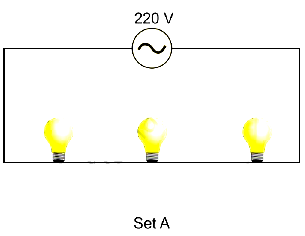
In set B, the three bulbs are connected in parallel. So, even when one of the bulbs ceases to glow, the others continue to glow. Each bulb operates independently.
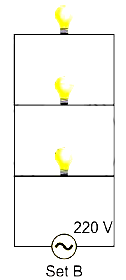
For house circuiting we use the set B arrangement i.e., all the appliances are connected in parallel. The advantage of connecting the appliances in parallel are:
1. Each appliance gets connected to 220 V supply for its normal working.
2. Each appliance works independently without being affected whether the other appliance is switched on or off.
Whereas when connected in series
  1. All appliances that are connected operate simultaneously and none can be operated independently.
  2. Voltage of the source gets divided and on connecting one more appliance in the same circuit, the resistance of the circuit will increase. Hence, it will reduce the current in the circuit, so each appliance will get less power.
Hence we prefer arrangements of set B for house circuiting.
View full question & answer
Question 155 Marks
State relative advantages and disadvantages of ring system of wiring over the tree system.
Answer
Advantages:
(i) The tree system of wiring requires the plugs and sockets of different sizes for different current capacities while they are all of the same sizes in the ring system of wiring.
(ii) The tree system of wiring has one fuse in one distribution line. If the fuse in one distribution line blows, it disconnects all the appliances in that distribution line. But in the ring system, a separate fuse is connected with each appliance. So if one fuse blows, it does not affect the other appliances.
(iii) The tree system of wiring is expensive while the ring system of wiring is cheaper.
(iv) It is expensive and inconvenient to install a new appliance in the tree system of wiring since it requires to put the new leads up to the distribution box, while it is easy to install a new appliance in the ring system since the appliance can be directly connected to ring mains in the room.

Disadvantages:
The only disadvantage of the ring system of wiring over the tree system is that while installing a new appliance, care has to be taken that the total load on the ring circuit does not exceed the main fuse rating (i.e., generally 30 amp.).

View full question & answer
Question 165 Marks
How is the amount of heat produced calculated due to the passage of current in a metallic conductor? Derive an expression for it.
Answer
It is calculated by finding the amount of work done in sending the current through the conductor.
Let a current of i ampere flow in conductor having a potential difference of V volt across its ends for t second.
If Q be the amount of charge that flows in the conductor in t second.
Then Q = i × t coulomb
Since the amount of work done in: moving a charge Q across the ends of a conductor is W.
then W = Q × V joule
i.e., = i × t × V = Vit joule
or, the amount of heat produced Q = V it joule.
View full question & answer
Question 175 Marks
At what voltage is the electric power generated at the generating station? Explain the transmission of this power to your house.
Answer
At the generating station the electric power is generated at 11,000 volt. This voltage is alternating of frequency 50 Hz. To transmit this power to our house the alternating voltage generated at the generating station is first stepped up from 11,000 V to 1,32,000 V. It is then transmitted to the main sub-station through the high-tension line wires, where it is stepped down to 3,300 V and then transmitted to the city sub-station. At the city sub-station, the voltage is further stepped down to 220 V for supply to the houses through the overhead line wires.
View full question & answer
Question 185 Marks
What is an ‘electric fuse’? State its two characteristics of electric fuse.
Answer
The electric fuse is a safety device in electric circuits, used to limit the current and thus it acts as a safeguard for the household circuit and any electric appliance connected in the circuit from being damaged. Its characteristics are:
(i) It has a low melting point (m.p.) of about 200°C and is usually made from an alloy of 50% tin and 50% lead.
(ii) It has a high resistance so that its temperature rises rapidly and soon exceeds its m.p. and thus breaks it, when current passing through it exceeds the permissible limits. In such a case it acts as a switch.
View full question & answer
Question 195 Marks
What do you understand by ‘earthing’? What are the advantages of earthing in a household electric circuit? Explain, how it is done?
Answer
By earthing we mean that the metallic body of an electric appliance is connected to thick copper wire, which is buried deep in the earth and at its end is a copper plate surrounded by a mixture of charcoal and common salt.

Advantages: It is a kind of safety device which saves us from an electric shock, in a case when the
the metal casing of the appliance happens to touch the live wire or due to short-circuiting or leakage of electric current.
Whenever an appliance which is earthed, get short-circuited, the current from the metal casing of the appliance flows into the earth which acts as an ‘electric sink’, i.e., its potential always remains zero. Due to the flow of heavy current, the fuse in that circuit melts and disconnects the appliance from the circuit.
So the user who happens to touch the appliance is protected from receiving any electric shock. Another advantage is that overheating the house wiring system is saved from being damaged and the same time from being burnt out.

Procedure: A three core, cord having three wires coated with insulation of red, brown, and green colour, is used for connecting die appliance to the mains for drawing current from the mains. At one end of the cord, red is connected to the pin marked L (live), the brown to the pin marked N (neutral) and green to a thick pin of the plug. The three wires at the other end of the cord are connected to the appliance such that live and neutral wires are connected to the element and the earth wire is connected to the metal body of the appliance so as to earth it.
Once the plug is put in the socket, the current through the appliance becomes as soon as the switch is pressed. The live wire gets connected to the live wire of the mains. Neutral wire is connected to the neutral of the mains and the earth wire gets connected to the earth in the mains.

View full question & answer
Question 205 Marks
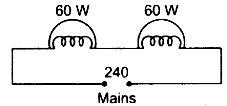
An electric bulb is rated $240V-60W$ and is working at $100\%$ efficiency.
(i) Calculate the resistance of bulb.
(ii) (a) Draw the circuit diagram.
(b) What is the rate of conversion of energy in each bulb?
(c) Total power used by the bulbs.
Answer
(i) From $P =\frac{ V ^2}{ R }$
Resistance of bulb (R) =
$\frac{ V ^2}{ P }=\frac{240 \times 240}{60}=960 \Omega$
(ii) (a)

(b) Resistance of bulbs in series $= (960 + 960) \Omega = 1920 \Omega$
$\therefore$ Current in series circuit $I =$
$\frac{ V }{ R }=\frac{240}{1920}=0.125 A$
$\therefore$ Rate of conversion of energy in any one bulb in 1 second $= I^2Rt$
$= (0.125)^2 \times 960 \times 1 = 15.5$
(c) Power of $1$ bulb in series circuit $= 15 W$
So poewr of $2$ bulb in series circuit $= 2 \times 15 W = 30 W.$
View full question & answer
Question 215 Marks
Draw a circuit diagram using the dual control switches to light a staircase electric light and explain its working.
Answer
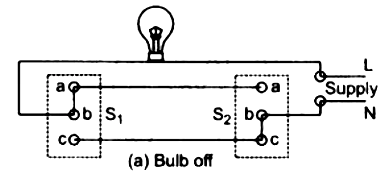
Dual control switches are the double pole type switches which are generally used at the top and bottom of a staircase, or at the opposite ends of a long corridor, etc. With such switches, the appliance (say, a bulb) can be switched on or off from, two different places.

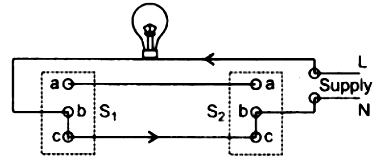
b) Bulb on through switch $S_1$​​​​​​​

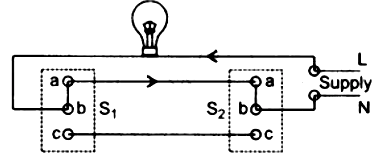
(c) Bulb on through switch $S_2$

The working and circuits of a dual control switch are illustrated in Fig. a,b,c. Let a switch $S _1$ be fitted at the top of the staircase. Fig. (a) shows the off position of the bulb.
The bulb can now be switched on independently by either the switch $S _1$ or the switch $S _2$ If the switch $S _1$ is operated, the connection 'ab' is changed to 'bc', which completes the circuit and the bulb lights up [Fig. (b)]. Similarly, on operating the switch $S _2$, the connection 'bc' changes to 'ba', which again completes the circuit [Fig. (c)].
Similarly, if the bulb is in on position as shown in Fig. (b), one can switch off the bulb by changing the connections 'ab' to 'bc' either by the switch $S _1$ or the switch $S _2$.
In a staircase, while going up a person puts on the light by operating the switch $S_1$ so that the connection 'ab' changes to 'bc' and makes the current flow in the circuit. On reaching at the top of operates the switch $S _2$ to put off the light so that the connection 'cb' changes to 'ba' and the flow of current stops.
The same system is operative when a person puts on light by operating the switch $S _2$ to change the connection 'cb' to 'ba' and switch off the light by operating the switch $S _1$ to change the connection 'ab' to 'bc'.
View full question & answer
Question 225 Marks
Explain the significance of kWh meter, main switch and main fuse in house-circuiting.
Answer
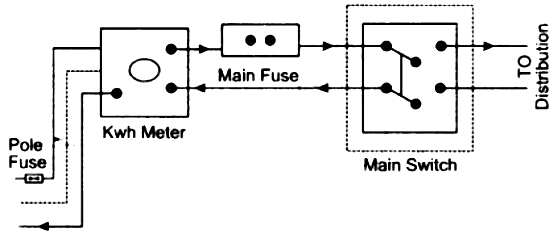
The electric cable coming to a house consists of three separate insulated wires, namely, live (phase) wire, a neutral wire, and earth wire. The neutral and earth wire on the supply end are connected together so that both of them are at zero potential.
Inside the house, the live and neutral wires are connected to the input terminals of kWh meter, while the earth wire is connected to the body of the kWh meter. The kWh meter-reads the units of electric energy (in kWh), consumed in a house. Without the kWh meter, it is not possible to correctly note the electric energy consumed in a house or by an electric appliance.

The live wire coming out from the output terminal of kWh meter has another fuse in it which is called the main fuse. If the main fuse blows off the entire circuit of the house wiring system is disconnected from the mains supply.
Beyond the main fuse, the live and neutral wires are connected to the main switch which consists of a double pole iron-clad switch. This switch can cut off the live and neutral wires from the household circuit by operating a single lever. The iron casing of the main switch is locally earthed. Then the power flowing out of the main switch is distributed in house by the common ring or three-wire system. The diagram illustrates the working of the kWh meter, the main fuse, and the main switch.
View full question & answer
[5 Mark Question Answer] - Physics STD 10 Questions - Vidyadip