Question
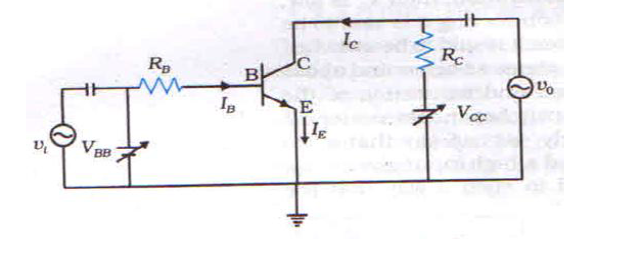
Draw a circuit diagram of a common emitter amplifier using n-p-n transistor. Derive an expression for the current gain $\beta_{ac}.$
Answer

  1.  

  1. $\text{A}_{v} = \beta_{ac}.\frac{\text{R}_{L}}{\text{r}}$

$\therefore\beta_{ac} = \text{A}_{c}\frac{\text{r}}{\text{R}_{L}}$

Alternate Answer

$\beta_{ac} = \frac{\delta\text{l}_{c}}{\Delta\text{I}_{B}}$

Need a full question paper?

Generate a complete, print-ready paper with questions like this in minutes — across 16+ boards, with answer keys.
Start Generating Free

Similar questions

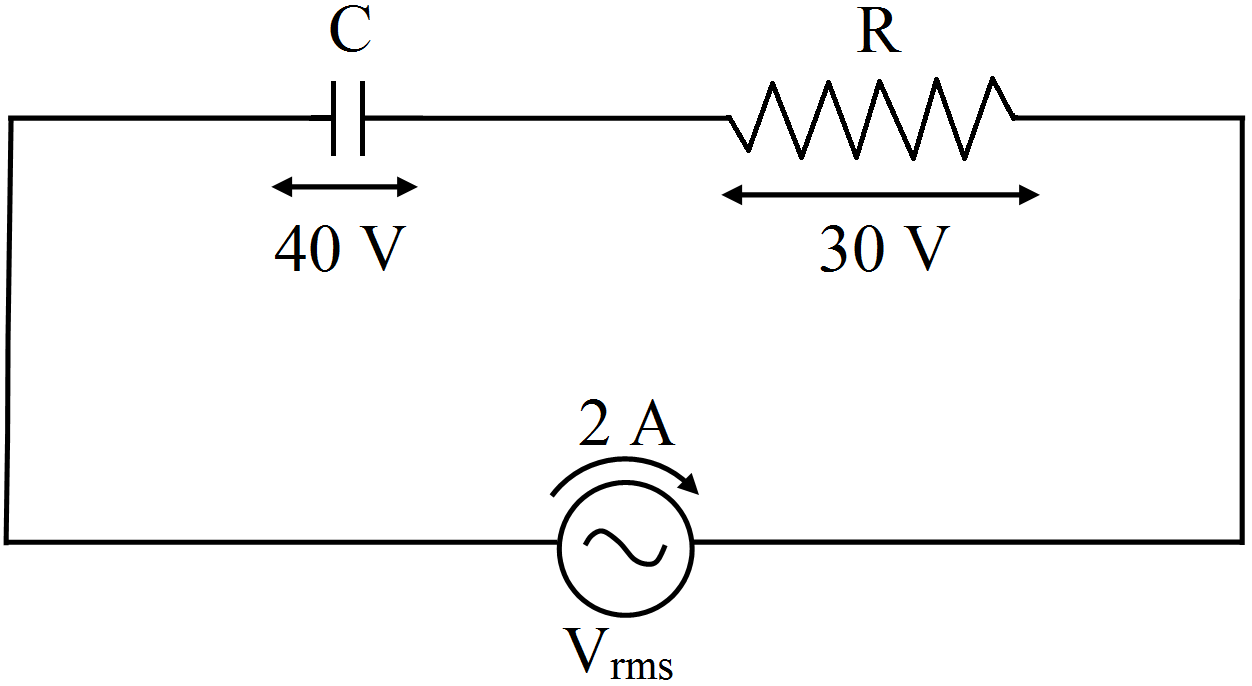
Calculate the following:

  1. Impedance of the given ac circuit.
  2. Wattless current of the given ac circuit.
Describe the motion of a charged particle in a cyclotron if the frequency of the radio frequency (rf) field were doubled.
How does the resolving power of a compound microscope get affected on:
  1. Decreasing the diameter of its objective?
  2. Increasing the focal length of its objective?
An ac genrator is made from area of cross section $3 m^2$ and a coil of 100 turns which is rotated by a constant angular velocity of $60 rad / s$ in a magnetic field of 0.04 T . Resistance of the coil is $500 \Omega$ Calculate: (i) maxumum current obtained from the generator and (ii) maximum power dissipated in the coil.
Prove that the current density of a metallic conductor is directly proportional to the drift speed of electrons.
Consider a sample of oxygen at 300K. Find the average time taken by a molecule to travel a distance equal to the diameter of the earth.
A transformer has 50 turns in the primary and 100 in the secondary. If the primary is connected to a 220V DC supply, what will be the voltage across the secondary?
Sketch a graph showing the variation of fringe width versus the distance of the screen from the plane of the slits (keeping other parameters same) in Young’s double slit experiment. What information can one obtain from the slope of this graph?
A particle is subjected to two simple harmonic motions, one along the X-axis and the other on a line making an angle of 45° with the X-axis, The two motions are given by,

$\text{x}=\text{x}_0\sin\omega\text{t}$ and $\text{s}=\text{s}_0\sin\omega\text{t}$

Find the amplitude of the resultant motion.
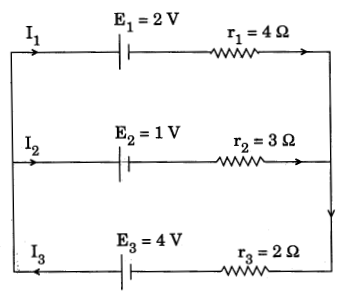
State Kirchhoff’s rules. Use these rules to write the expressions for the currents I1, I2 and I3 in the circuit diagram shown.