Question
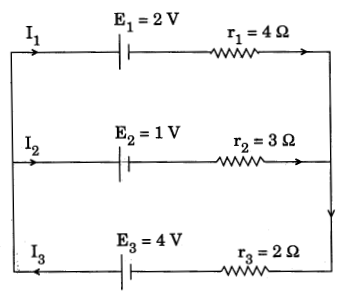
State Kirchhoff’s rules. Use these rules to write the expressions for the currents I1, I2 and I3 in the circuit diagram shown.
Answer

  1. Junction rule: At any junction, the sum of the currents entering the junction is equal to the sum of currents leaving the junction.
  2. Loop rule: The algebraic sum of changes in potential, around any closed loop, involving resistors and cells in the loop, is zero.

Expressions for the currents I1, I2 and I3 using given loop.

  1. I3 = I2 + I1
  2. 4I1 – 3I2 + 1 = 0
  3. 3I2 + 2I3 – 3 = 0.

Need a full question paper?

Generate a complete, print-ready paper with questions like this in minutes — across 16+ boards, with answer keys.
Start Generating Free

Similar questions

The luminous flux of a 1W sodium vapour lamp is more than that of a 10kW source of ultraviolet radiation. Comment.
  1. Define current sensitivity of a galvanometer. Write its expression.
  2. A galvanometer has resistance G and shows full scale deflection for current Ig.
  1. How can it be converted into an ammeter to measure current up to I0(I0 > Ig)?
  2. What is the effective resistance of this ammeter?
A hollow charged conductor has a tiny hole cut into its surface. Show that the electric field in the hole is (σ/2ε0) $\hat{\text{n}}$ , where $\hat{\text{n}}$ is the unit vector in the outward normal direction, and σ is the surface charge density near the hole.
Answer the following question:
Two students are separated by a 7 m partition wall in a room 10 m high. If both light and sound waves can bend around obstacles, how is it that the students are unable to see each other even though they can converse easily.
Find the temperature at which the average thermal kinetic energy is equal to the energy needed to take a hydrogen atom from its ground state to n = 3 state. Hydrogen can now emit red light of wavelength 653.1nm. Because of Maxwellian distribution of speeds, a hydrogen sample emits red light at temperatures much lower than that obtained from this problem. Assume that hydrogen molecules dissociate into atoms.
  1. Mention two properties of soft iron due to which it is preferred for making an electromagnet.
  2. State Gauss's law in magnetism. How is it different from Gauss's law in electrostatics and why?
Draw a plot showing the variation of photoelectric current with collector plate potential for two different frequencies, ν1 > ν2, of incident radiation having the same intensity. In which case will the stopping potential be higher? Justify your answer.
Monochromatic light of frequency $5.0 \times 10^{14} Hz$ is produced by a laser. The power emitted is 66 W . (a) What is the energy of a photon in the light beam ? (b) Hon many photons per second, on an average, are emitted by the source?
Find the total energy stored in the capacitors in the given network.

Solve the previous problem if the paperweight is inverted at its place so that the spherical surface touches the paper.