Question
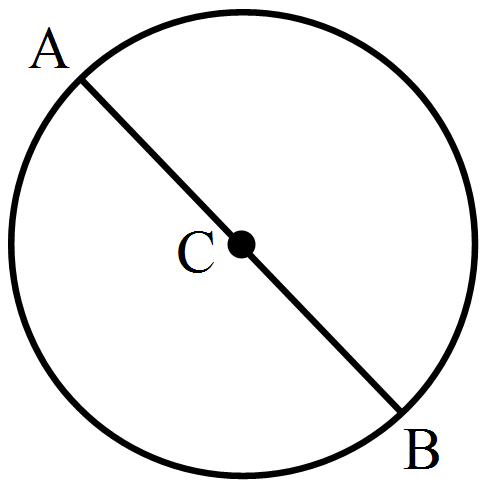
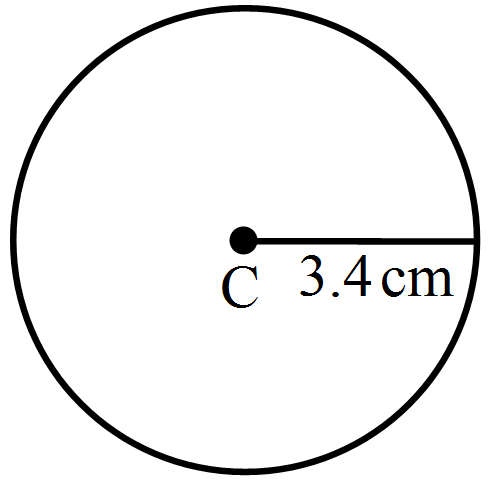
Draw a circle with centre $C$ and radius $3.4\ cm.$ Draw any chord $\overline{\text{AB}}$. Construct the perpendicular bisector of $\overline{\text{AB}}$ and examine if it passes through $C. $ if $\overline{\text{AB}}$ happens to be a diameter.

Answer

$1.$Mark any point $C$ on the sheet.
$2.$By adjusting the compasses up to $3.4\ cm$ and by putting the pointer of the compasses at point $C,$ turn the compasses slowly to draw the circle. It is the required circle of $3.4\ cm$ radius.

$3.$Now, mark any chord $\overline{\text{AB}}$ in the circle.

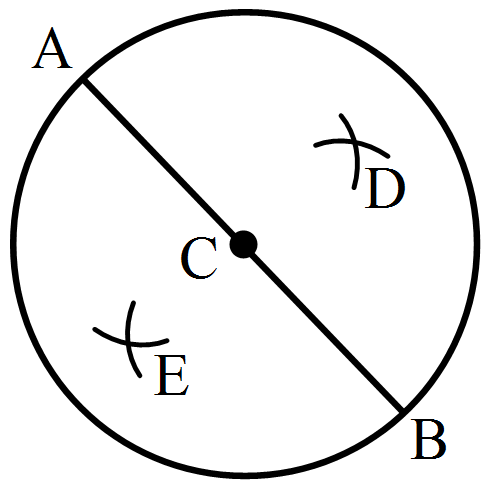
$4.$Taking $A$ and $B$ as centres, draw arcs on both sides of$\overline{\text{AB}}$. Let these intersect each other at $D$ and $E.$

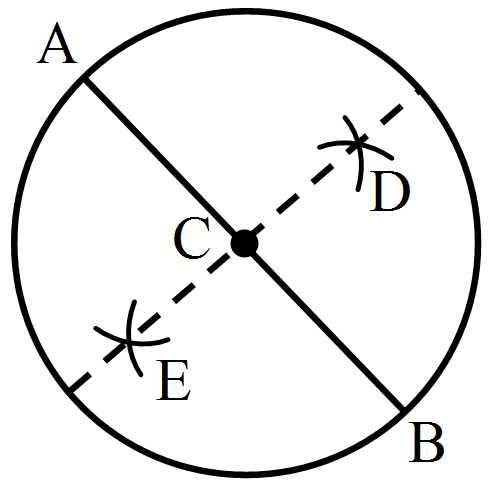
$5.$Join $DE,$ which is the perpendicular bisector of $AB$.

It can be observed that $\overline{\text{DE}}$ is passing through point $C$ of the circle.
 

Need a full question paper?

Generate a complete, print-ready paper with questions like this in minutes — across 16+ boards, with answer keys.

Start Generating Free

Similar questions

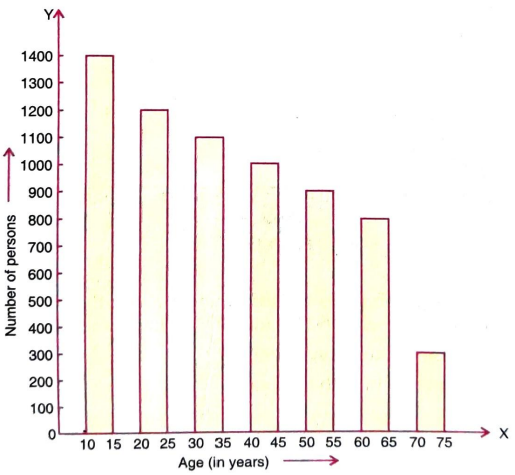
Study the bar graph representing the number of persons in various age groups in a town shown in Fig. Observe the bar graph and answer the following questions:
Image
(i) What is the percentage of the youngest age-group persons over those in the oldest ag group?
(ii) What is the total population of the town?
(iii) What is the number of persons in the age-group 60-65?
(iv) How many persons are more in the age-group 10-15 than in the age group 30-35?
(v) What is the age-group of exactly 1200 persons living in the town?
(vi) What is the total number of persons living in the town in the age-group 50-55?
(vii) What is the total number of persons living in the town in the age-groups 10-15 and 60-65?
(viii) Whether the population in general increases, decreases or remains constant with the increase in the age-group.
Use number line and add the integers: $5 + (-11)$
Draw any three triangles and write the measures of their angles adjacent to the corresponding vertices. For each triangle add up the three measures. What do you get?
Write the letters of the word $\text{‘MATHEMATICS’}$ which have no line of symmetry.
Find the largest number which divides $630$ and $940$ leaving remainders $6$ and $4$ respectively.
Show that the following pairs are co-primes: $512, 945$
Given $\overline {AB}$ of length $3.9 \ cm,$ construct $\overline {PQ}$ such that the length of $\overline {PQ}$ is twice that of $\overline {AB}$. Verify by measurement. $($Hint : Construct $PX$ such that length of $PX =$ length of $AB ;$ then cut off $\overline {XQ}$ such that $\overline {XQ}$ also has the length of $\overline {AB}.)$
Use a pair of compasses and construct the following angles: $45^\circ $
Can we have two acute angles whose sum is:
$a.\ $An acute angle? Why or why not?
$b.\ $A right angle? Why or why not?
$c.\ $An obtuse angle? Why or why not?
$d.\ $A straight angle? Why or why not?
$e.\ $A reflex angle? Why or why not?
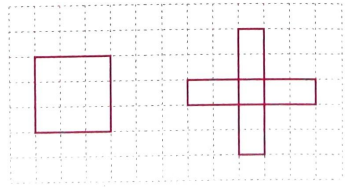
Avneet buys 9 square paving slabs, each with a side of $\frac{1}{2} m$. He lays them in the form of a square.
Image
(i) What is the perimeter of his arrangement?
(ii) Shari does not like his arrangement. She gets him to lay them out like a cross. What is the perimeter of her arrangement?
(iii) Which has greater perimeter?
(iv) Avneet wonders, if there is a way of getting an even greater perimeter. Can you find a wal of doing this? (The paving slabs must meet along complete edges they cannot be broken!