Question
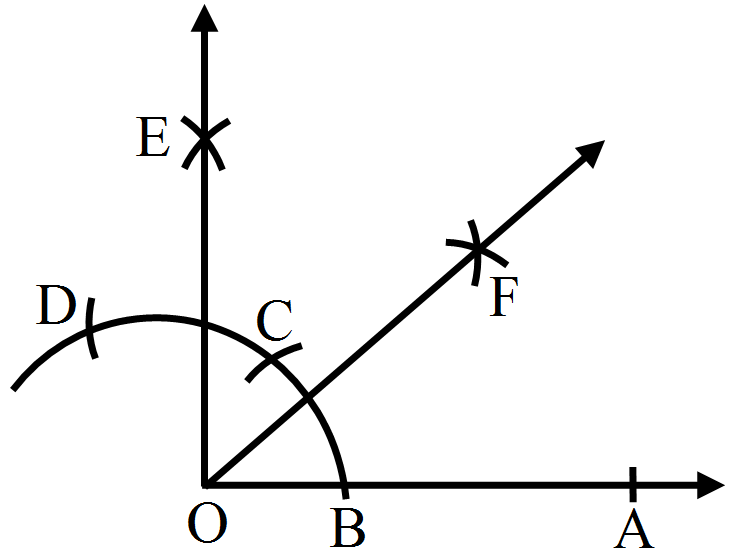
Use a pair of compasses and construct the following angles: $45^\circ $
Answer


Steps of Construction:
1. Draw a ray $OA.$
2. With $O$ as centre and any su itable radius draw an arc above $O A$ to cut it at $B$.
3. With $B$ as centre and same radius cut the previous arc at $C$ and then with $C$ as centre and same radius cut the arc at $D$.
4. With $C$ as centre and radius more than half $C D$, draw an arc.
5. With $D$ as centre and same radius draw another arc to cut the previous arc at $E$.
6. Join $O E$. Then $\angle A O E=90^{\circ}$.
7. Draw the bisector OF of angle $\angle AOE$.
Then, $\angle\text{AOF}=45^\circ$ is the required angle.

Need a full question paper?

Generate a complete, print-ready paper with questions like this in minutes — across 16+ boards, with answer keys.
Start Generating Free

Similar questions

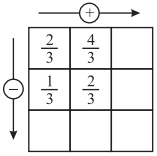
Complete the addition-subtraction box.
How quickly can you do this? Fill the appropriate sign. $('<', '=', '>')$
$\frac{3}{5} \square \frac{2}{3}$
Using a protractor, draw an angle of measure $72^\circ .$ With this angle as given, draw angles of measure $36^\circ $ and $54^\circ .$
The following table shows the number of maruti cars sold by five dealers in a particular month:
Dealer
Saya
Bagga Links
$D.D$ Motors
Bhasin Motor
Competent Motors
Cars Sold
$60$
$40$
$20$
$15$
$10$
Represent the above information by a pictograph.
Draw an angle of measure $153^\circ $ and divide it into four equal parts.
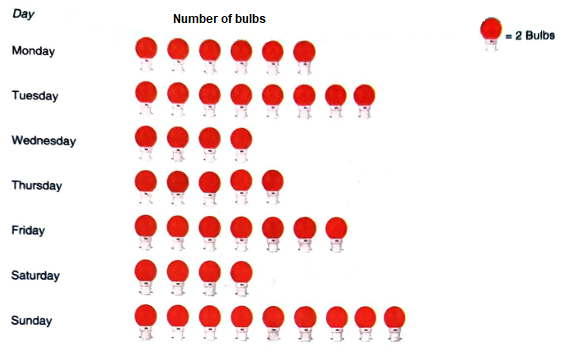
The sale of electric bulbs on different days of a week is shown below:
Days Number of electric bulbs $- 2$ Bulbs
Monday
Tuesday
Wednesday
Thursday
Friday
Saturday
Sunday
If one big carton can hold 9 bulbs. How many cartons were needed in the given week?
The following table shows the interest paid by a company (in lakhs):
Year
$1995-96$
$1996-97$
$1997-98$
$1998-99$
$1999-2000$
Interest (in lakhs of rupees)
$20$
$25$
$15$
$18$
$30$
Draw the bar graph to represent the above information.
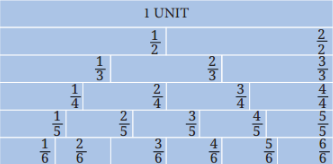
Answer the following questions after looking at the fraction wall:
Image
Q.1. Are the lengths $\frac{1}{2}$ and $\frac{3}{6}$ equal?
Q.2. Are $\frac{2}{3}$ and $\frac{4}{6}$ equivalent fractions? Why?
Q.3. How many pieces of length $\frac{1}{6}$ will make a length of $\frac{1}{2} ?$
Q.4. How many pieces of length $\frac{1}{6}$ will make a length of $\frac{1}{3}$ ?