Question
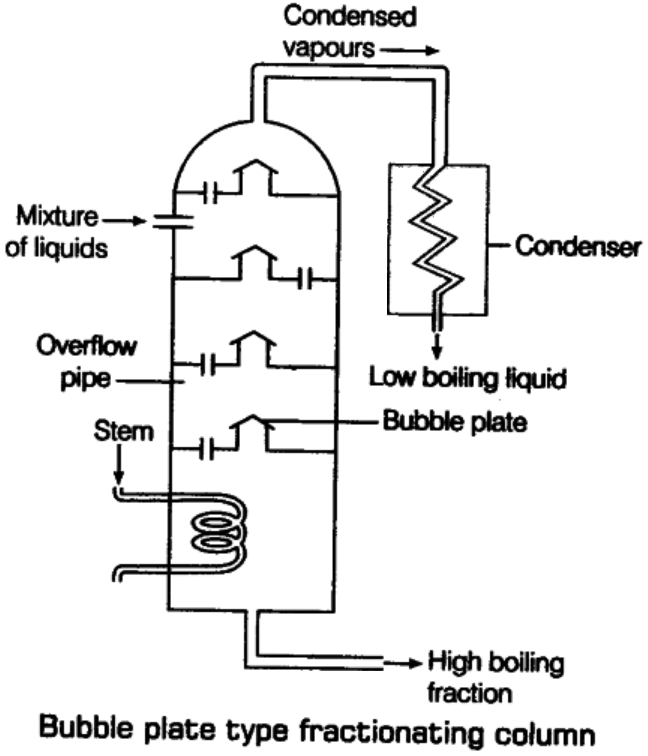
Draw a diagram of bubble plate type fractionating column. When do we require such type of a column for separating two liquids. Explain the principle involved in the separation of components of a mixture of liquids by using fractionating column. What industrial applications does this process have?
Answer

The bubble plate type fractionating column is shown in the figure. The tower is divided into number of compartments by mean as of shelves having openings. The openings are covered with caps called bubble caps. Each shelf is provided with an overflow pipe which keeps the liquid to a certain level and then allows the rest to trickle down to the lower shelf. Such type of column is used for continuous separation of bulk quantities of liquids, e.g., distillation of fermented liquid for manufacture of rectified spirit.

Industrial application.

  1. Separation of crude oil in petroleum industry into various useful fractions such as gasoline, kerosene oil, diesel oil, lubricating oil, etc.
  2. Separation of acetone and methanol from pyroligneous acid obtained by destructive distillation of wood.

Need a full question paper?

Generate a complete, print-ready paper with questions like this in minutes — across 16+ boards, with answer keys.

Start Generating Free

Similar questions

Calculate the pH of 1 × 10⁻⁸M solution of HCl.
  1. Write the conjugate acid for Bronsted base of HCOO-.
  2. Calculate the pH of a 1.0 × 10⁻⁸ M solution of HCl.
  3. Calculate the solubility of A2X3 in pure water, assuming that neither kind of ion reacts with water. [The solubility product of A2X3, Ksp = 1.1 × 10⁻²³]
1. Write all structural isomers of molecular formula $C _3 H _6 O$
2. Write resonance structures of $CH _3 COO ^{-}$and show the movement of electrons by curved arrows.
Predict the products of electrolysis in the following:

A dilute solution of H2SO4 with platinum electrodes.

Calculate the wavelength for the emission transition if it starts from the orbit having radius 1.3225nm and ends at 211.6pm. Name the series to which this transition belongs and the region of the spectrum.
Explain briefly about the electrochemical series and give its main uses.
  1. Consider the following redox reaction that produce electricity in a galvanic cell:
    1. $2\text{Fe}^{3+}+2\text{Cl}^-\xrightarrow{ \ \ \ \ \ \ \ \ \\ }2\text{Fe}^2+\text{Cl}_2\text{(g)}$

    2. $\text{Cd}\text{(s)}+\text{I}_2\xrightarrow{ \ \ \ \ \ \ \ }\text{Cd}^{2+}+2\text{I}^-$

    3. $2\text{Cr}\text{s}+3\text{Cu}^{2+}\xrightarrow{ \ \ \ \ \ \ \\ \ \ }+3\text{Cu}\text{(s)}+2\text{Cr}^{3+}$

Write the anode and cathode reaction for galvanic cell.

  1. Split the following redox reaction into the oxidation and reduction hay reactions:
    1. $\text{Zn}+\text{Cu}^{2+}\xrightarrow{ \ \ \ \ \ \ \ \\}2\text{n}^{2+}+\text{Cu} $

    2. $\text{Sn}^2+2\text{Hg}^+\xrightarrow{ \ \ \ \\ \ \ \ }\text{Sn}^{4+}+\text{Hg}_2^{2+}$

Which of the following are isoelectronic species i.e., those having the same number of electrons?
$\text{Na}^+,\text{K}^+,\text{Mg}^{2+},\text{Ca}^{2+},\text{S}^{2-},\text{Ar}.$
Which important property did Mendeleev use to classify the elements in his periodictable and did he stick to that?
In Ostwald’s process for the manufacture of nitric acid, the first step involves the oxidation of ammonia gas by oxygen gas to give nitric oxide gas and steam. What is the maximum weight of nitric oxide that can be obtained starting only with 10.00g of ammonia and 20.00g of oxygen?