Question
Which important property did Mendeleev use to classify the elements in his periodictable and did he stick to that?

Answer

Mendeleev organized the components in his periodic table, according to the order of their atomic weight. Mendeleev organized the components in groups and periods according to the increasing atomic weight. Mendeleev set the elements which are having comparative properties in the similar groups.
Nonetheless, he didn’t adhere to arrangement that he gave for long. He discovered that if the elements were organized according to their increasing atomic weights, then a few elements did not match within this plan of characterization.
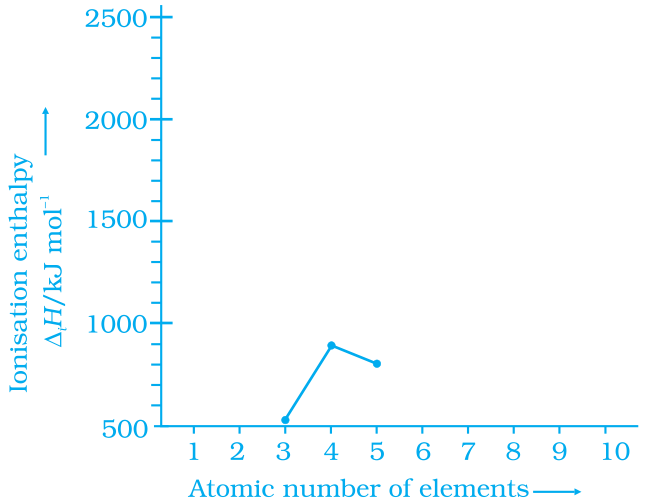
In this manner, he overlooked the order of atomic weights now and again. For instance, the atomic mass of iodine is lower than atomic mass of tellurium.
Still Mendeleev set tellurium (in Group 6) ahead of iodine (in Group 7) essentially in light of the fact that iodine’s properties are so comparable to fluorine, chlorine, and bromine.

Need a full question paper?

Generate a complete, print-ready paper with questions like this in minutes — across 16+ boards, with answer keys.

Start Generating Free

Similar questions

  1. Out of different gases formed in Duma's method, which gas is not absorbed over an aqueous solution?
  2. What is function of K2SO4 and a little of CuSO4 added in Kjeldahl's flask?
  3. 0.4g of compound was Kjeldahl's and ammonia evolved was absorbed into 50mL of $\frac{\text{M}}{4}\text{ H}_2\text{SO}_4$ The residual acid was diluted with distilled water and made up to 150mL. 20mL of this diluted acid required 31mL of $\frac{\text{M}}{4}\text{ NaOH}$ solution for complete neutralisation. Calculate % of N in compound.
Express the following in the scientific notation:
  1. 0.0048
  2. 234, 000
  3. 8008
  4. 500.0
  5. 6.0012
The pH of milk, black coffee, tomato juice, lemon juice and egg white are 6.8, 5.0, 4.2, 2.2 and 7.8 respectively. Calculate corresponding hydrogen ion concentration in each.
  1. For the reaction:

$\text{N}_2(\text{g})+3\text{H}_2(\text{g})\rightleftharpoons2\text{NH}_3(\text{g}),$

The value of Kp is 3.6 × 10-2 at 500K.

Colculate the value of Kc for the reaction at the same temperature R = 0.083L bar K-1mol-1.

  1. What is the effect of increasing pressure in the reactions? Give reason.

$\text{PCl}_5(\text{g})\rightleftharpoons\text{PCl}_3(\text{g})+\text{Cl}_2\text{(g)}$

$\text{N}_2(\text{g})+\text{O}_2(\text{g})\rightleftharpoons2\text{NO(g)}$

What is hybridization? Describe sp³, sp² and sp hybridization with examples.
  1. Which of the following are Lewis acids?

$\text{H}_2\text{O},\text{BF}_3,\text{H}^+$ and $\text{NH}^+_4$
  1. The pH of a sample of vinegar is 3.76. Calculate the concentration of hydrogen ion in it.
  2. What is common ion effect? Explain its application in qualitative analysis of II group radicals.
Write comments on the following:
(a) Pauli's exclusion law
(b) n +$l$ rule
1. Suggest a method to purify
i. a liquid which decomposes at its boiling point.
ii. kerosene oil containing water.
iii. camphor containing traces of common salt.
2. Differentiate between the principle of estimation of nitrogen in an organic compound
i. Dumas method
ii. Kjeldahl's method.
  1. The reaction quotient of a reversible reaction is QC and the equilibrium constant is Kc. What do you conclude for the reaction if Qc < Kc?
  2. State Le Chatelier's principle.
  3. In qualitative analysis, NH4Cl is added before adding NH4OH solution for testing of III group radicals [Fe3+, Cr3+ and Al3+]. Explain by using concept of common ion effect.