- Draw a diagram of excretory system in human beings and label on it: Aorta, Vena cava, Urinary bladder, Urethra.
- List two vital functions of the kidney.
CBSE DELHI - SET 1 2009
Download our app for free and get started
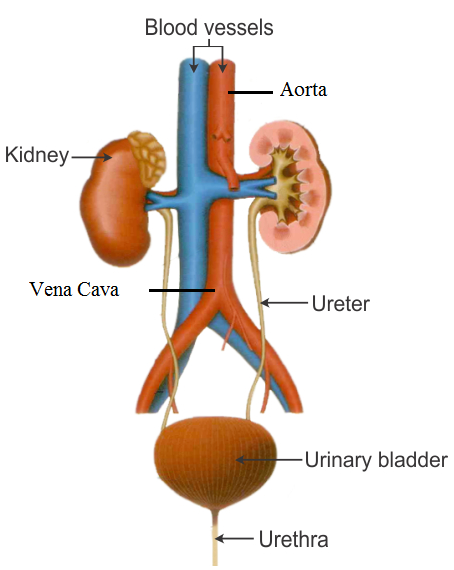
- Functions of the kidney:
-
Maintaining overall fluid balance.
-
Regulating and filtering minerals from blood.
-
Filtering waste materials from food, medications, and toxic substances.
-
Creating hormones that help produce red blood cells, promote bone health, and regulate blood pressure.

Download our appand get started for free
Experience the future of education. Simply download our apps or reach out to us for more information. Let's shape the future of learning together!No signup needed.*
Similar Questions
- 1View SolutionState the location of salivary glands.
- 2View SolutionExplain how deoxygenated blood travel from body to lung for purification. Draw well-labeled diagram in support of your answer.
- 3View SolutionDescribe the mechanism of urine formation in human excretory system. Draw a labelled diagram to illustrate your answer.
- 4View SolutionWhat are the various components of blood? State their functions.
- 5View SolutionWrite the events that occur during the process of breathing in humans.
- 6What happens with $CO _2$ and $O _2$ in plants during daytime?View Solution
- 7View SolutionThere is a pair of bean-shaped organs P in the human body towards the back, just above the waist. A waste product Q formed by the decomposition of unused proteins in the liver is brought into organ P through blood by an artery R. The numerous tiny filters S present in organ P clean the dirty blood by removing the waste product Q. The clean blood goes into circulation through a vein T. The waste substance Q, other waste salts, and excess water form a yellowish liquid U which goes from organ P into a bag-like structure V through two tubes W. This liquid is then thrown out of the body through a tube X.
- What is (i) organ P and (ii) waste substance Q?
- Name (i) artery R, and (ii) vein T.
- What are tiny filters S known as?
- Name (i) liquid U, (ii) structure V, (iii) tubes W and (iv) tube X.
- 8View SolutionThe liquid connective tissue A circulates in our body continuously without stopping. This tissue contains a pigment B which imparts it a colour C. The tissue A consists of four components D, E, F and G. The component D fights infection and protects us from diseases. The component E helps in the clotting of tissue A if a person gets a cut. The component F is a liquid which consists mainly of water with many substances dissolved in it and component G carries oxygen from the lungs to all the parts of the body.
- What is (i) tissue A, (ii) pigment B and (iii) colour C?
- Name (i) D, (ii) E, (iii) F and (iv) G.
- Name one substance (other than oxygen) which is transported by tissue A in the human body.
- Which two components of tissue A are the cells without nucleus?
- Name any two organisms (animals) which do not have liquid like A in their body.
- 9View SolutionWrite the difference between nutrition in plants and animals.
- 10View SolutionWhat substances are contained in pancreatic juice? What are their functions?