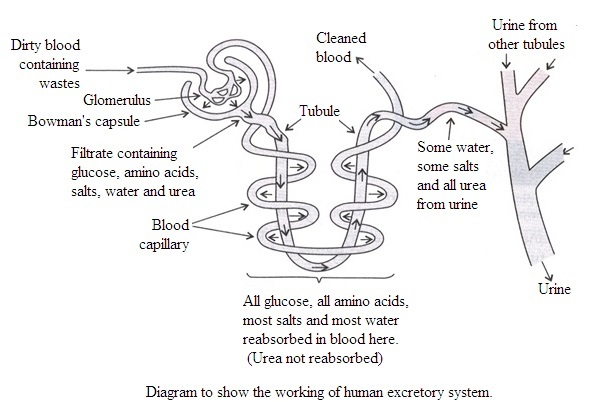
Describe the mechanism of urine formation in human excretory system. Draw a labelled diagram to illustrate your answer.
Download our app for free and get started
Urine formation: The dirty blood containing waste like urea enters the glomerulus which filters the blood. During filtration, the substance like glucose, amino acids, salts, water, urea etc present in the blood pass into Bowman’s capsule and then enter the tubule of nephron. When the filtrate containing useful substances as well as the waste substances passes through the tubule, the useful substances like glucose, amino acids, most salts and water are reabsorbed into the blood through blood capillaries surrounding the tubule. Only the waste substances like urea, some unwanted salts and excess water remains behind in the tubule. This yellowish liquid is called urine.

Download our appand get started for free
Experience the future of education. Simply download our apps or reach out to us for more information. Let's shape the future of learning together!No signup needed.*
Similar Questions
- 1View SolutionDistinguish between aquatic and terrestrial respiration.
- 2View SolutionExplain with a schematic representation the exchange of gases in tissues.
- 3View SolutionExplain the process of digestion of food in mouth, stomach and small intestine in human body.
- 4View SolutionWhat are the different modes of nutrition? Explain with one example of each mode of nutrition.
- 5View SolutionDraw a schematic representation of transport and exchange of oxygen and carbon dioxide during transportation of blood in human beings and label on it, Lung capillaries, Pulmonary artery to lungs Aorta to body, Pulmonary veins from lungs.
- 6View SolutionExplain the various functions of blood.
- 7View SolutionWhere does anaerobic respiration occur in human body?
- 8View SolutionClassify the following into herbivores, carnivores and omnivores:
Lion, Man, Dog, Goat, Crow, Elephant, Snake, Hawk, Rabbit, Deer. - 9View SolutionConsider the following chemical reactions which take place in different organisms/ tissues under various conditions:
- Glucose → Respiration → Respiration Ethanol + Carbon-dioxide + Energy.
- Glucose → Respiration → Respiration Carbon-dioxide + Water + Energy.
- Glucose → Respiration → Respiration Lactic acid + Energy.
- Name one organism which respires according to equation (i) above.
- Name one organism which respires according to equation (ii) above.
- When and where does respiration represented by equation (iii) above take place?
- Which equation/ equations represent aerobic respiration?
- Which equation/ equations represent anaerobic respiration?
- Which of the above reactions produces the maximum amount of energy?
- 10View SolutionDescribe the parts of our tooth with the help of a labelled diagram.