(1) Centre of curvature (C): The centres of the spheres whose parts form the surfaces of a lens are called the centres of curvature of the lens. A lens has two centres of curvature $C_1$, and $C _2$ for its two spherical surfaces.
(2) Radii of curvature $\left(R_1, R_2\right)$ : The radii of the spheres whose parts form surfaces of a lens are called the radii of curvature of the lens.
(3) Principal axis: The imaginary straight line passing through the two centres of curvature of a lens is called the principal axis of the lens.
(4) Optical centre $(O)$ : The point inside a lens on the principal axis, through which light rays pass without changing their path is called the optical centre $(O)$ of the lens.
(5) Principal focus (F): When light rays parallel to the principal- axis are incident on aconvex lens, they converge at a point on the principal axis. This point is called the principal focus (F) of the convex lens. Light rays travelling parallel to the principal axis of a concave lens diverge after refraction in such a way that they appear to be coming out of a point on the principal axis. This point is called the principal focus of the concave lens. A lens has two principal foci $F_1$ and $F_2$.
[Note: In this chapter, the terms focus and the principal focus are used in the same sense.]
(6) Focal length (f): The distance between the optical centre and the principal focus of a lens is called the focal length (f) of the lens.
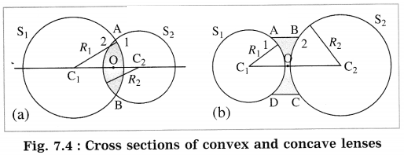
$C_1, C_2:$ Centres of curvature, $R_1, R_2:$ Radii of curvature, $O$ : Optical centre.
The cross sections of convex and concave lenses are shown in parts (a) and (b) of Fig. 7.4. The surface marked as 1 is part of sphere $S_1$ while the surface marked as 2 is part of sphere $S_2$.
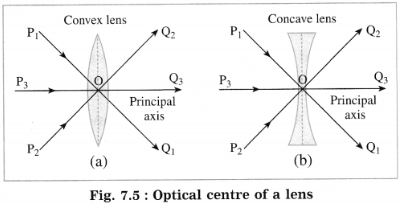
$P_1, P_2, P_3$ : Incident rays of light,
$Q _1, Q _2, Q _3:$ Refracted rays of light, $O$ : Optical centre
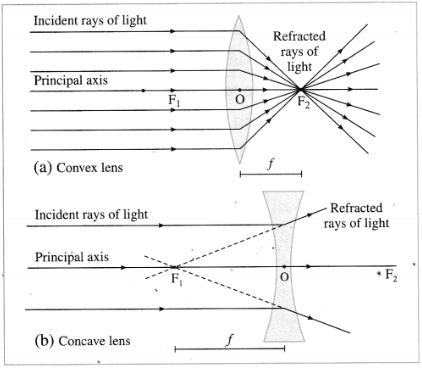
$F_1, F_2$ : Principal foci of the lens, f: Focal length of the lens