Question
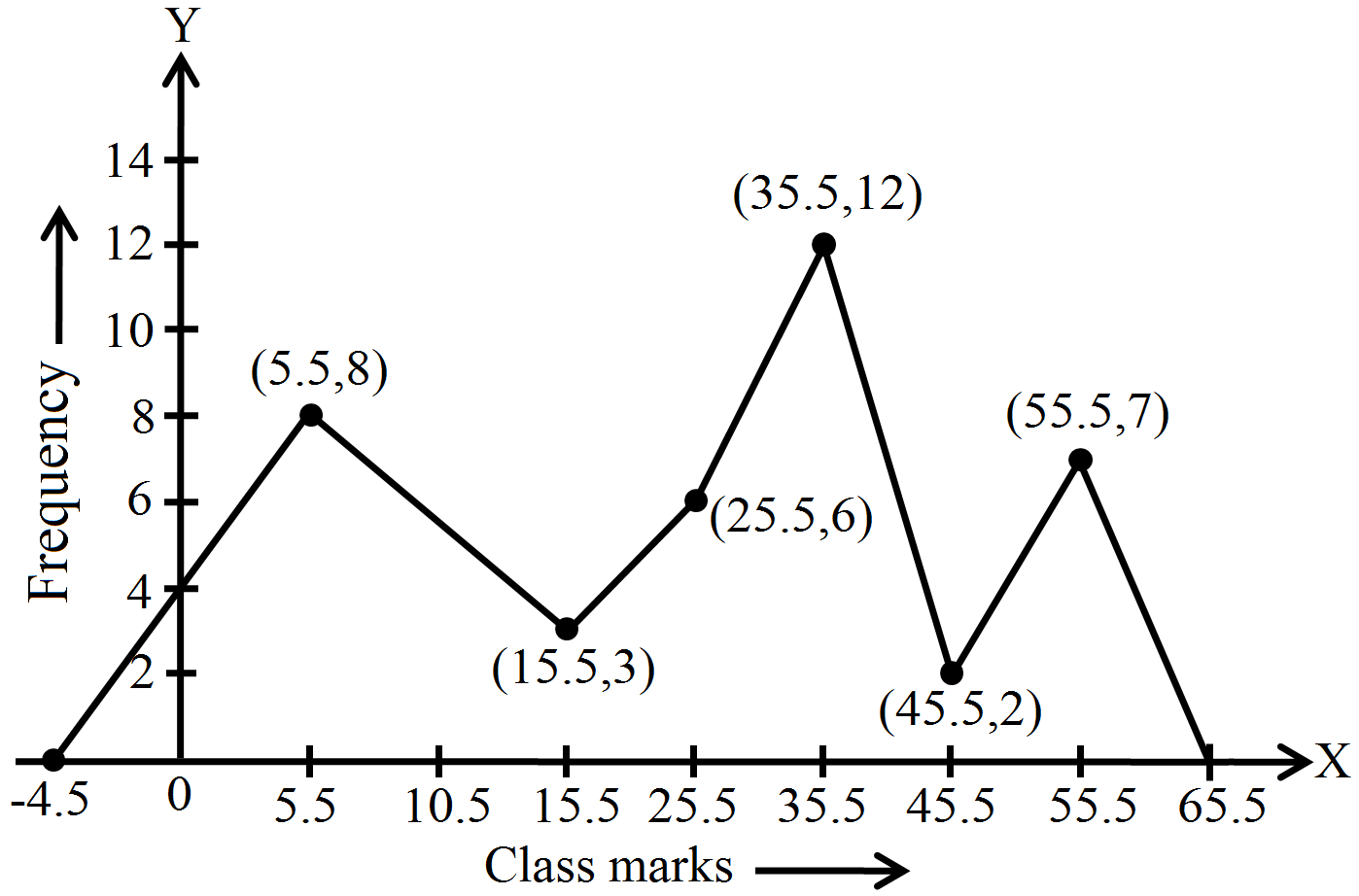
Draw a frequency polygon for the following frequency distribution:
Class interval
$1-10$
$11-20$
$21-30$
$31-40$
$41-50$
$51-60$
Frequency
$8$
$3$
$6$
$12$
$2$
$7$

Answer

The given frequency distribution table is as below:
Class intervals
$1-10$
$11-20$
$21-30$
$31-40$
$41-50$
$51-60$
Frequency
$8$
$3$
$6$
$12$
$2$
$7$
This table has inclusive class intervals and so these are to be converted into exclusive class intervals (i.e true class limits).
These are$ (0.5-10.5), (10.5-20.5), (20.5-30.5), (30.5-40.5), (40.5-50.5)$ and $(50.5-60.5)$ In order to draw a frequency polygon, we need to determine to determine the class marks.
Class marks of a class interval $=\frac{\text{Lower limit}+\text{upper limit}}{2}$ Take imaginary class interval $(-9.5-0.5)$ at the beginning and $(60.5-70.5)$ at the end, each with frequency zero. So, we have the following table
Class intervals
True class intervals
class marks
Frequency
$(-9)-0$
$(-9.5)-0.5$
$-4.5$
$0$
$1-10$
$0.5-10.5$
$5.5$
$8$
$11-20$
$10.5-20.5$
$15.5$
$3$
$21-30$
$20.5-30.5$
$25.5$
$6$
$31-40$
$30.5-40.5$
$35.5$
$12$
$41-50$
$40.5-50.5$
$45.5$
$2$
$51-60$
$50.5-60.5$
$55.5$
$7$
$61-70$
$60.5-70.5$
$65.5$
$0$
Now, take class marks along $x$-axis and their corresponding frequency along $y$-axis. Mark the points ans join them. Thus, we obtain a complete frequency polygon as shown below:

Need a full question paper?

Generate a complete, print-ready paper with questions like this in minutes — across 16+ boards, with answer keys.

Start Generating Free

Similar questions

The diameter of a cylinder is $28\ cm$ and its height is $40\ cm$. Find the curved surface, total surface area and the volume of the cylinder.
Given below are the seats won by different political parties in the polling outcome of a state assembly elections:
Political party $A$ $B$ $C$ $D$ $E$ $F$
Seats won $75$ $55$ $37$ $29$ $10$ $37$
$i.$ Draw a bar graph to represent the polling results.
$ii.$ Which political party won the maximum number of seats$?$
A juiceseller has a large cylindrical vessel of base radius $15\ cm$ filled up to a height of $32\ cm$ with orange juice. The juice is filled in small cylindrical glasses of radius $3\ cm$ up to a height of $8\ cm$, and sold for $₹ 15$ each. How much money does he received by selling the juice completely?
Following are the ages $($in years$)$ of $360$ patients, getting medical treatment in a hospital:
Age $($in years$)$
$10 - 20$
$20 - 30$
$30 - 40$
$40 - 50$
$50 - 60$
$60 - 70$
Number of patients
$90$
$50$
$60$
$80$
$50$
$30$
One of the patients is selected at random. What is the probability that his age is:
$i. 30$ years or more but less than $40$ years$?$
$ii. 50$ years or more but less than $70$ years$?$
$iii.10$ years or more but less than $40$ years$?$
$iv. 10$ years or more$?$
$v.$ Less than $10$ years$?$
A diagonal of a parallelogram divides it into two congruent triangles.
Find the values of $a$ and $b$ so that the polynomial $\left(x^4+a x^3-7 x^2-8 x+b\right)$ is exactly divisible by $(x+2)$ as well as $(x+3)$.
If $O$ is a point within $\triangle\text{ABC,}$ show that:
$i. AB + AC > OB + OC$
$ii. AB + BC + CA > OA + OB + OC$
$iii. OA + OB + OC >\frac{1}{2}(AB + BC + CA)$.
An equilateral triangle of side $9\ cm$ is inscribed in a circle. Find the radius of the circle.
Show that the quadrilateral formed by joining the midpoints of the pairs of adjacent sides of a square is a square.
Represent each of the numbers $\sqrt{5}, \sqrt{6}$ and $\sqrt{7}$ the real line.