Question
Draw a histogram to represent the following grouped frequency distribution:
Ages (in years)
Number of teachers
$20-24$
$25-29$
$30-34$
$35-39$
$40-44$
$45-49$
$50-54$
$10$
$28$
$32$
$48$
$50$
$35$
$12$

Answer

The given frequency distribution is in inclusive form. So, first we convert it into exclusive form. Now, consider the class 20-24, 25-29. Lower limit of 25-29 is 25. Upper limit of 20-24 is 24. Thus, the half of the difference is $=\frac{(25-24)}{2}=\frac{1}{2}=0.5$ So, we subtract 0.5 from each lower limit and add 0.5 to each upper limit. The table for continuous grouped frequency distribution is given below:
Ages (in years)
Number of teachers
$19.5-24.5$
$24.5-29.5$
$29.5-34.5$
$34.5-39.5$
$39.5-44.5$
$44.5-49.5$
$49.5-54.5$
$10$
$28$
$32$
$48$
$50$
$35$
$12$
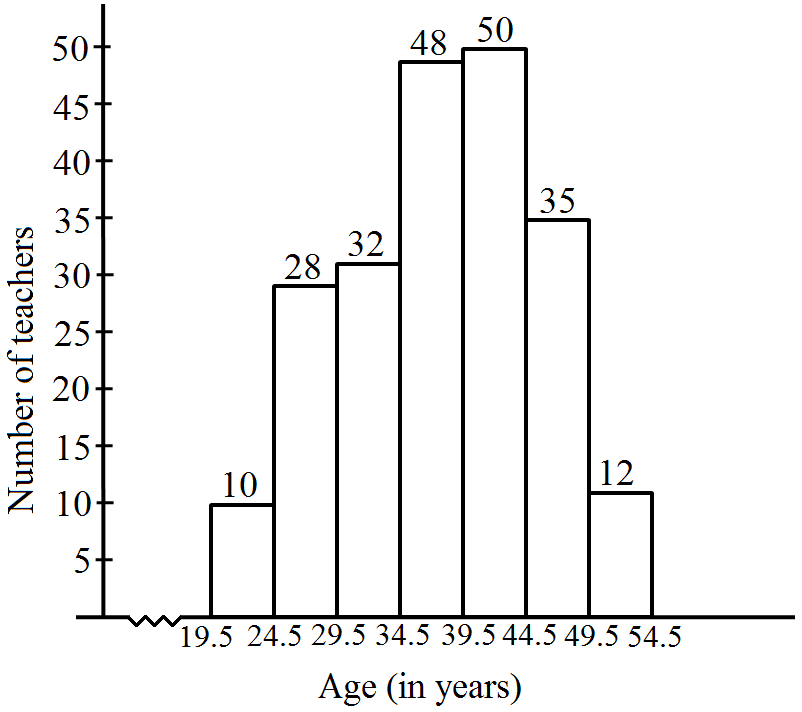
Thus, the given data becomes in exclusive form. Along the horizontal axis, we represent the class intervals of ages on some suitable scale. The corresponding frequencies of number of teachers are represented along the vertical axis on a suitable scale. Since, the given intervals start with $19.5-24.5$. It means that, there is some break (vw) indicated near the origin to signify the graph is drawn with a scale beginning at $19.5$. A histogram of the given distribution is given below:

Need a full question paper?

Generate a complete, print-ready paper with questions like this in minutes — across 16+ boards, with answer keys.

Start Generating Free

Similar questions

If $\text{x}=2+\sqrt3,$ find the value of $\text{x}^3+\frac{1}{\text{x}^3}.$
$O$ is a point in the interior of a square $ABCD$ such that $OAB$ is an equilateral triangle. Show that $ΔOCD$ is an isosceles triangle.
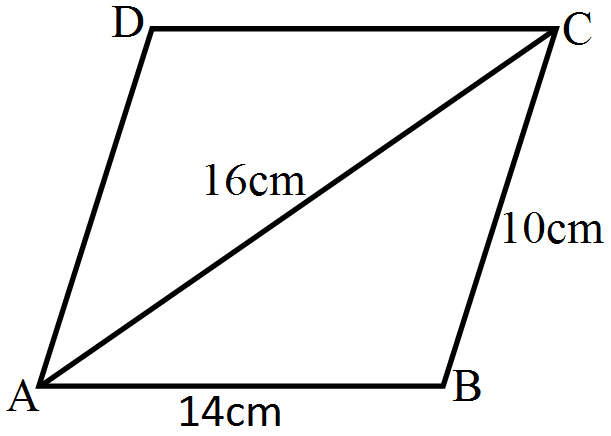
Find the area of a parallelogram $ABCD$ in which $AB = 14\ cm, BC = 10\ cm$ and $AC = 16\ cm$. $\big(\text{Given},\sqrt{3}=1.73\big)$
The daily maximum temperatures (in degree Celsius) recorded in a certain city during the month of November are as follows: $25.8, 24.5, 25.6, 20.7, 21.8, 20.5, 20.6, 20.9, 22.3, 22.7, 23.1, 22.8, 22.9, 21.7, 21.3, 20.5, 20.9, 23.1, 22.4, 21.5, 22.7, 22.8, 22.0, 23.9, 24.7, 22.8, 23.8, 24.6, 23.9, 21.1$. Represent the data in the form of a frequency distribution table with class size $11^\circ\ C$.
Factorise: $a^3(b-c)^3+b^3(c-a)^3+c^3(a-b)^3$
In square $\text{ABCD}$, $P$ and $Q$ are mid-point of $AB$ and $CD$ respectively. If $AB = 8\ cm$ and $PQ$ and $BD$ intersect at $O$, then find area of $(\triangle\text{OPB}).$
Find the values of $n$ and $\overline{\text{X}}$ in the following case:$\sum\limits^\text{n}_{\text{i}=1}(\text{x}_\text{i}-12)=-10$ and $\sum\limits^\text{n}_{\text{i}=1}(\text{x}_\text{i}-3)=62$
If $\text{a}=3-2\sqrt{2},$ find the value of $\text{a}^2-\frac{1}{\text{a}^2}.$
E and F are points on diagonal AC of a parallelogram ABCD such that AE = CF. Show that BFDE is a parallelogram.