Question
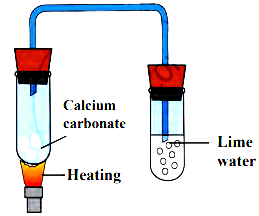
Draw a labelled diagram of the human respiratory system.

Answer

Human Respiratory System:

Need a full question paper?

Generate a complete, print-ready paper with questions like this in minutes — across 16+ boards, with answer keys.

Start Generating Free

Similar questions

A filamentous alga X is found in ponds, lakes and slow-moving streams. The filament of this alga simply breaks into two (or more) pieces on maturing and each piece then grows to become a complete new alga.
  1. Name an alga which X is likely to be.
  2. What is the colour of X?
  3. What is the method of forming new algae by the breaking of parent alga known as?
  4. An Amoeba also breaks up to form two daughter Amoebae. What is the difference in the splitting of Amoeba and splitting of this alga as a method of reproduction?
  5. Name one marine animal which reproduces in the same way as alga X.
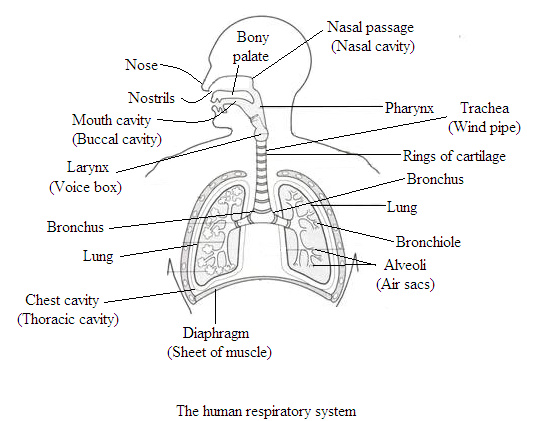
Explain the reaction given in the figure.
 A calorimeter has mass 100 g and specific heat 0.1 kcal/kg ·°C. It contains 250 g of liquid at 30 °C having specific heat of 0.4 kcal/kg·°C. If we drop a piece of ice of mass 10 g at 0 °C into the liquid, what will be the temperature of the mixture?
The image in a plane mirror is virtual and laterally inverted. What does this statement mean?
There are five animals A, B, C, D and E. The animal A uses its modified forelimbs for flying. The animal B uses its forelimbs for running whereas the animal C uses its forelimbs for grasping. The animal D can live on land as well as in water and uses its forelimbs to prop up the front end of its body when at rest. The animal E which respires by using spiracles and tracheae uses wings for flying but its wings are analogous to the modified forelimbs of animal A.
  1. What could the animals A, B, C, D and E be?
  2. Why are the forelimbs of animals A, B, C, D called homologous organs?
  3. What does the existence of homologous organs in animals A, B, C and D tell us about their ancestors?
  4. Why are the modified forelimbs of animal A and the wings of animal E called analogous organs?
  5. State whether animals A and E have a common ancestor or not.
Write one or two words for each of the following statements/ definitions:
  • Each level of food chain where transfer of energy takes place.
  • The physical factors like temperature, rainfall, light, soil, air and water of an ecosystem.
  • Organisms which depend on the producers for food either directly or indirectly.
  • The physical and biological world where we live in.
  • Selfcontained unit of living things and their non-living environment needing only sunlight for its functioning.
Taking into consideration the period of the elements given below, answer the following questions:
ElementAtomic radius (pm)
O66
B88
C77
N74
Be111
Li152
i. Arrange the above elements in a decreasing order of their atomic radii.
ii. State the period to which the above elements belong.
iii. Why this arrangement of elements is similar to the above period of the modern periodic table?
iv. Which of the above elements have the biggest and the smallest atom?
v. What is the periodic trend observed in the variation of atomic radius while going from left to right within a period?
What is meant by ‘rusting of iron’? With the help of labelled diagrams, describe an activity to find out the conditions under which iron rusts.
Write short note: Cybercrimes.
What does a soda-acid type fire extinguisher contain? How does it work?
Explain the working of a soda- acid fire extinguisher with the help of a labelled diagram.