Question
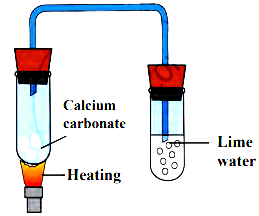
Explain the reaction given in the figure.

Answer

1. Calcium carbonate undergoes a decomposition reaction in the first test tube forming calcium oxide powder and carbon dioxide gas.
2. Carbon dioxide gas formed in the first test tube turns the lime water milky in the second test tube due to the formation of calcium carbonate, which is insoluble in water.
$
\underset{\text { Calcium hydroxide }}{ Ca ( OH )_{2( aq )}}+\underset{\text { Carbon dioxide }}{ CO _{2( g )}} \longrightarrow \underset{\text { Calcium carbonate }}{ CaCO _{3( s )}}+\underset{\text { Water }}{ H _2 O _{( l )}}
$
3. The calcium oxide powder, remains behind in the first test tube.
Activate Win

Need a full question paper?

Generate a complete, print-ready paper with questions like this in minutes — across 16+ boards, with answer keys.
Start Generating Free

Similar questions

Explain the role of district disaster control unit after occurrence of any disaster.
If the distance between two bodies is increased by a factor of $5$, (i) by what factor will the gravitational force change if the masses are kept constant? (ii) by what factor will the mass of one of them have to be altered, keeping the other mass the same, to maintain the same gravitational force between the two bodies?
Name five stimuli which act on plants. Name the type of tropism produced by each one of these stimuli.
There are five animals A, B, C, D and E. The animal A uses its modified forelimbs for flying. The animal B uses its forelimbs for running whereas the animal C uses its forelimbs for grasping. The animal D can live on land as well as in water and uses its forelimbs to prop up the front end of its body when at rest. The animal E which respires by using spiracles and tracheae uses wings for flying but its wings are analogous to the modified forelimbs of animal A.
  1. What could the animals A, B, C, D and E be?
  2. Why are the forelimbs of animals A, B, C, D called homologous organs?
  3. What does the existence of homologous organs in animals A, B, C and D tell us about their ancestors?
  4. Why are the modified forelimbs of animal A and the wings of animal E called analogous organs?
  5. State whether animals A and E have a common ancestor or not.
Complete the following chart with reference to pre-disaster management.
The organs P and Q of two animals have different structures but similar functions. On the other hand, the two organs R and S of two other animals have the same basic structure but different functions.
  1. What are the organs like P and Q known as?
  2. Name the organs like P and Q. Also name the animals which have such organs.
  3. What are the organs like R and S called?
  4. Name the organs like R and S. Also name the animals which have such organs.
What is Biotechnology?
ii. Give one use of Biotechnology.
iii. Give one commercial use of Biotechnology.
iv. Write two bacterial examples of biofertilizer.
v. Write two names of crops genetically developed.
Heat energy is being produced in a resistance in a circuit at the rate of 100 W. The current of 3 A is flowing in the circuit. What must be the value of the resistance?
Write short note: Green revolution.
Answer the following questions based on human male reproductive system:
i. In which organ sperms are formed?
ii. What is the length of a sperm?
iii. What is the work of vas deferens?
iv. By which type of cell division, sperms are formed?
v. Name any two unpaired organs of male reproductive system.